The popular advice says contractor lead generation is a numbers game. Buy more leads, cover more directories, and respond faster than the next company. That approach breaks down when your team spends estimating hours on projects outside its trade, territory, budget, or buying stage. The right lead source saves more than marketing spend because time savings is money savings.
The better workflow prioritizes opportunities by trade, ZIP code, project value, timing, pipeline stage, and reachable decision-makers. This roundup compares seven distinct models, from early project intelligence and commercial bid access to contractor networking and residential marketplaces. Platineer belongs near the top when you want to see projects before they become crowded bid postings, while the other providers solve different parts of the acquisition problem.
Each recommendation evaluates sourcing method, coverage, qualification work, pricing visibility, strengths, weaknesses, and best-fit use cases. Where providers don't publish performance data or pricing, this guide says so instead of inventing claims.
Table of Contents
- 1. Platineer
- 2. Dodge Construction Network
- 3. ConstructConnect
- 4. PlanHub
- 5. The Blue Book Building & Construction Network
- 6. Angi Leads
- 7. Modernize Home Services
- Top 7 Contractor Lead-Gen Companies, Comparison
- Choose the Signal That Matches Your Sales Motion
1. Platineer
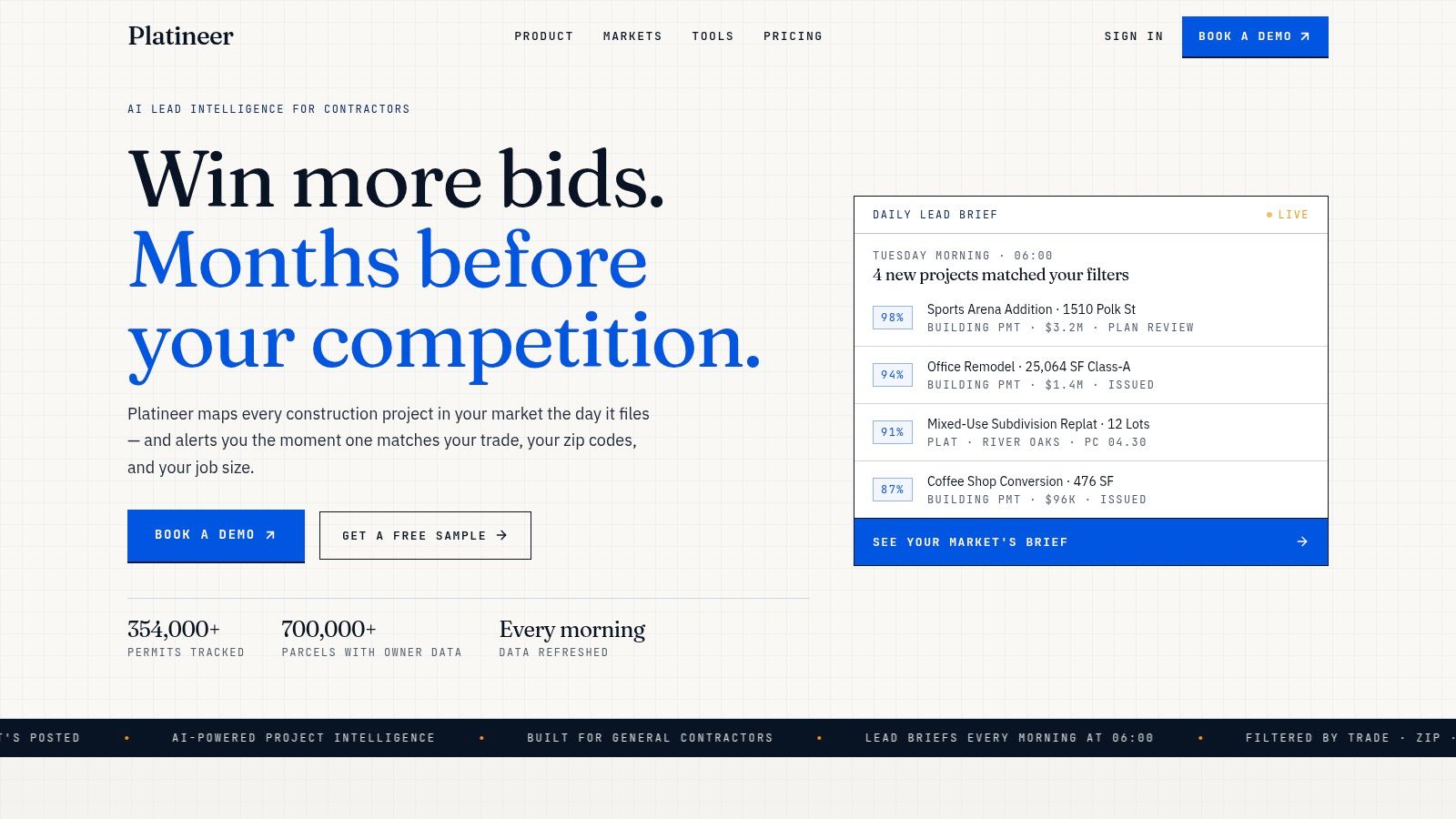
Platineer fits contractors that need project intelligence before the public bid stage. Its AI-powered platform gathers signals from permits, plan reviews, plats, and owner records, then ranks opportunities by trade fit, ZIP code, valuation band, and decision-maker reachability. That makes it an early-warning source, not just another directory of active bids.
Live coverage currently includes Houston, Austin, and Dallas–Fort Worth, with additional U.S. metros onboarding. Platineer pre-indexes market data, so teams avoid starting with an empty database or manually downloading permit records each morning. A prioritized 06:00 daily lead brief, minute-level pipeline updates, and multi-channel alerts surface opportunities that match configured thresholds.
The timing reduces qualification work. A basic permit search may provide only an address, leaving contractors to identify the owner, applicant, project status, and relevant firms themselves. Platineer attaches those contacts and tracks movement from plan review through issuance and ground activity. Signals from plats and planning activity can appear 6–18 months before permit bursts, giving business development teams more time to build relationships before competition increases.
Why Platineer stands out
The platform advertises 354,000+ permits tracked and 700,000+ parcels with owner data on its website. It also shows a sample morning brief with matched projects and confidence scores. These figures describe advertised coverage, not a guaranteed conversion result. Pricing is not listed publicly, so contractors must request access or a demo to receive a quote and detailed walkthrough.
Platineer includes a Render tool for creating a job render in seconds and an Estimate tool for preconstruction work. Those features connect opportunity discovery with the next sales or estimating task. The benefit is greatest for teams that can act quickly on qualified projects. Firms seeking commercial bid access, contractor networking, or residential marketplace leads should compare Platineer with providers built around those models instead.
Practical rule: Judge the platform by the discovery and qualification hours it removes, then compare those savings with its operating cost.
Pros
- Early project visibility: Plats, planning activity, permits, and plan reviews expose opportunities at different stages.
- Automated prioritization: Filters combine trade, geography, valuation, and contactability instead of presenting raw address lists.
- Decision-maker context: Owner, applicant, and firm records support targeted outreach.
- Daily operating rhythm: The morning brief gives estimating and business development teams a shared priority list.
- Pipeline awareness: Near real-time status changes help teams decide when to call, pursue, or stop.
Cons
- Limited current coverage: Live availability is concentrated in Houston, Austin, and DFW while other metros onboard.
- Limited price visibility: Pricing and contract terms require a request-access conversation.
- No displayed certifications: The site does not show public awards or third-party certifications.
Read the Platineer contractor lead generation guide to assess how project intelligence can fit a contractor sales workflow. Visit the Platineer website to request a demo or sample brief.
2. Dodge Construction Network
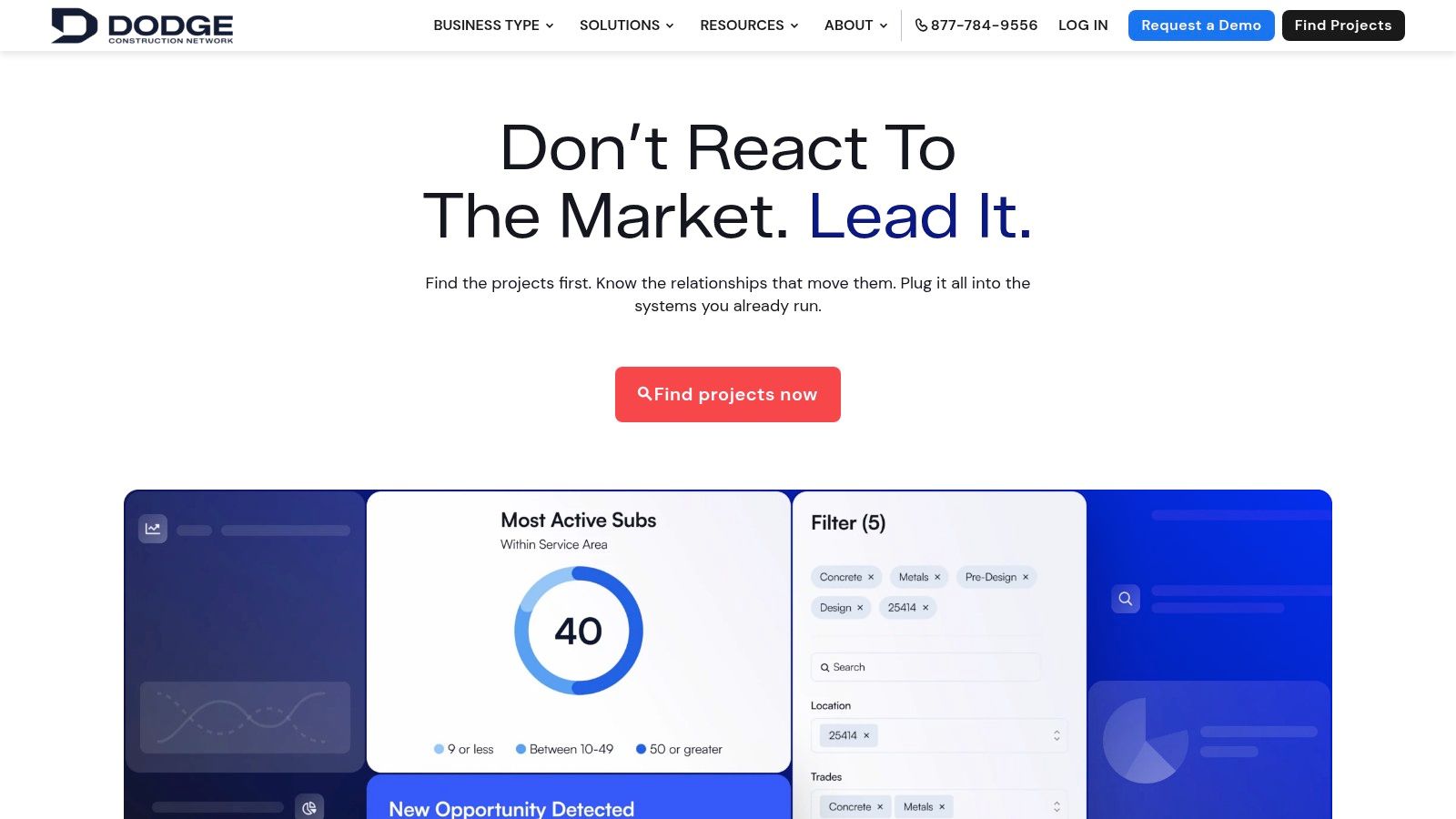
Dodge Construction Network is the best fit for commercial contractors that need broad project intelligence, plan rooms, specifications, contacts, and market context in one commercial-focused environment. Its coverage spans planning, design, and bidding, which lets general contractors and specialty subcontractors act before a formal invitation to bid reaches their inbox.
The platform supports searching and tracking by location, trade, project value, and phase. Daily digests can help teams maintain a regular prospecting routine, while plan and specification access gives estimators more substance than a basic project title or permit record. For firms that compete across commercial markets, that document access can reduce the time spent finding the latest project information.
Best use and main trade-off
Dodge's broader ecosystem includes products such as Dodge One, Blue Book, Sweets, and the Dodge Momentum Index. That combination is useful when business development needs both project opportunities and market indicators. It also gives teams a way to connect project discovery with contact research and pre-bid outreach.
The trade-off is operational. A large commercial database doesn't eliminate qualification work. Your team still needs to confirm trade fit, project timing, bid access, decision-maker relevance, and estimating capacity before investing in a pursuit. Dodge is therefore a strong choice for commercial organizations with people who can actively mine the data, not for a contractor seeking a fully filtered morning queue.
Pricing isn't displayed as a simple public rate card. Access and cost vary by geography and product bundle, so a sales consultation is required.
Choose Dodge if:
- Commercial breadth matters: You need visibility across planning, design, and bidding.
- Documents drive decisions: Plans, specs, and bid information are central to your estimating process.
- Forecasting adds value: Your leadership team wants market indicators alongside project records.
- Your team can qualify thoroughly: You have dedicated preconstruction or business development capacity.
Read this Dodge Construction Network alternative comparison for a different approach based on earlier project signals and automated prioritization.
3. ConstructConnect
ConstructConnect is built for teams that want commercial project leads, bid documents, plan-holder information, and takeoff support in one preconstruction workspace. It suits general contractors, estimators, and specialty subcontractors that already have an established process for reviewing active opportunities and deciding which bids deserve attention.
Saved searches organize projects by trade and location, while daily email digests keep new matches visible without requiring constant manual searching. The platform also provides access to bid documents, addenda, specifications, contact lists, and bidder information. That document-and-contact combination is more useful than a lead record that forces your estimator to search elsewhere for the scope.
A practical commercial workflow
ConstructConnect's clearest advantage is how closely it aligns with estimating work. A team can find a relevant project, inspect available documents, review bidder or plan-holder context, and assess whether the opportunity belongs in the bid pipeline. Takeoff tool trials on real projects can also help teams evaluate whether the additional workflow is useful before adopting it more broadly.
The platform doesn't remove the need to screen opportunities. Commercial teams still need to assess schedule, scope, relationship access, competition, and internal capacity. That qualification work is acceptable when the project documents materially improve bid decisions, but it can become expensive when a team reviews every result without clear pursuit rules.
Coverage is broad across the United States, but pricing isn't fully itemized online. Market selection, feature access, and scope require a sales discussion, so contractors should ask for a quote that separates geography, users, documents, and takeoff functionality.
A commercial lead is only valuable when your estimator can access enough scope information to make a fast go or no-go decision.
Best fit: Commercial subcontractors, general contractors, and estimating teams that want project discovery connected directly to plans, specifications, addenda, and takeoff activity.
Weak fit: Contractors looking mainly for homeowner inquiries, local service calls, or early permit and plat intelligence.
For a broader platform comparison, see this BuildZoom versus Dodge versus ConstructConnect guide for GCs.
4. PlanHub
PlanHub fits contractors that need access to active bid opportunities, not early signals about projects still in planning. Its value is the connection between project posting, subcontractor discovery, document access, quote submission, and bid management. General contractors can post work, invite trades, and compare bids. Subcontractors can search by location and trade, review drawings and other documents, then submit quotes through the same platform.
That timing shapes the qualification workload. PlanHub can put a visible opportunity in front of your team, but estimators still need to check scope, deadlines, document completeness, GC fit, competition, and likely margin. Use it when the project is far enough along to support a real bid decision. It is a weaker choice for teams seeking permit, plat, or preconstruction signals before bid activity becomes visible.
A practical marketplace with clear trade-offs
Free posting features give general contractors a low-cost way to test project participation. Paid subscription tiers include Essentials, Pro, and Premier. PlanHub's subcontractor directory, organized by trade and region, can help GCs build a bidder list, while the quote workflow keeps invitations and responses in one place.
The trade-off is internal workload. Subcontractors may see more nearby commercial opportunities, yet they still compete for attention and must reject weak pursuits quickly. GCs may receive more responses, but bid leveling, follow-up, and bidder quality checks remain their responsibility.
PlanHub does not publish one universal rate for advanced tiers. Coverage radius, geography, and feature access affect the commercial terms, so ask for a market-specific explanation before signing up.
Choose PlanHub if your sales motion depends on responding to live commercial bids and building relationships with regional GCs. Choose another category if your priority is earlier project intelligence, homeowner inquiries, or a fully qualified lead delivered without substantial estimating work.
Pros
- Active bid workflow: Posting, invitations, quote submission, and bid management support live pursuits.
- Regional discovery: Location and trade filters suit subcontractors targeting nearby work.
- Accessible GC entry: Free posting features make initial testing easier.
- Trade directory: GCs can search for subcontractors by specialty and area.
Cons
- Later-stage visibility: It does not primarily surface projects before permits or active bidding.
- Variable advanced pricing: Subscription access and coverage depend on the selected market and tier.
- Qualification remains necessary: Marketplace access does not confirm scope fit or profitability.
Visit PlanHub if active project access, subcontractor outreach, and quote management match your operating model.
5. The Blue Book Building & Construction Network
The Blue Book Building & Construction Network is best for firms that need to be found by commercial GCs and owners. Its core value sits in contractor discovery, directory visibility, project exposure, and industry networking rather than in a continuously scored early-project intelligence feed.
Company profiles and category listings help contractors present their capabilities within the commercial construction ecosystem. Outreach and bid communication tools, including legacy BB-Bid functions, support relationship development and project communication. The Engage app adds a mobile and engagement layer connected to membership.
Visibility is the product
Blue Book makes sense as a complement to project-lead services. A contractor may discover an opportunity through another platform, then use a strong commercial profile to make its trade capabilities, geographic coverage, and past work easier for GCs and owners to evaluate. That profile also gives prospects a destination when a business development representative makes direct contact.
The limitation is important. A directory can improve discoverability, but it doesn't automatically tell you which upcoming project matches your valuation band, when the decision-maker is reachable, or whether a project is still commercially viable. Your team must create the outreach strategy and qualify the opportunity.
Membership and advertising pricing isn't published publicly, so contractors need to contact sales. Ask whether the package emphasizes directory presence, outreach functionality, bid communication, mobile engagement, or a combination of those services.
Choose Blue Book when:
- Commercial credibility matters: You want a recognizable presence in the U.S. commercial construction network.
- Inbound discovery is a priority: GCs and owners need to find your company by category and location.
- Relationship development drives sales: Your team treats profiles and outreach as part of a broader business development motion.
- You already have project sources: You need visibility and networking to complement intelligence or bid platforms.
Don't treat it as a replacement for project intelligence. Its value skews toward being discoverable and connected, while tools such as Platineer focus on finding and prioritizing opportunities earlier in the pipeline.
Explore the Blue Book Building & Construction Network for commercial directory and networking options.
6. Angi Leads
Angi Leads belongs in a different category from commercial project-intelligence platforms. It is a residential marketplace for contractors that want homeowner inquiries and can manage shared, pay-per-lead demand. Coverage spans many home-improvement trades, with category and ZIP targeting, monthly budgets, and lead-flow controls available through the Angi for Pros app.
The opportunity appears late in the buying process. A homeowner submits a request, Angi matches it with professionals, and contractors then confirm the service type, location, urgency, budget, and willingness to speak. That timing can shorten prospecting, but it leaves your team to determine whether the inquiry is reachable, suitable, and worth pursuing.
A marketplace built around response speed
Angi's brand recognition can support residential exposure, but lead pricing varies by task and market and is shown inside the pro account. Shared distribution also means another professional may receive the same inquiry. Your sales process therefore determines whether the platform saves time or adds paid follow-up work.
Fast handling is a direct operating requirement. Contractors that respond slowly risk losing a homeowner after paying for the inquiry. Industry guidance reports that contractors responding within 2 minutes convert 62% of leads, compared with 28% at the 42-minute industry average, according to contractor lead-response research. Use those figures to justify an owned response process, not to forecast Angi performance.
Set ownership before buying. One person should monitor the inbox, call promptly, confirm the job details, and record whether the lead becomes a qualified conversation.
Pros
- Broad homeowner reach: Supports many residential trades and service areas.
- Budget controls: Monthly budgets and service-area settings limit planned exposure.
- Operational dashboard: The Angi for Pros app handles lead-flow and billing management.
Cons
- Shared competition: Multiple professionals may receive one inquiry.
- Variable cost: Pricing changes by task and market.
- Late-stage discovery: You enter after the homeowner submits a request.
- Follow-up workload: Staff must screen and contact inquiries quickly.
Choose Angi Leads if your residential team can answer fast, qualify tightly, and judge spend by qualified conversations rather than raw lead volume. Choose a platform with earlier project intelligence when your sales motion depends on planning before homeowner demand becomes public.
7. Modernize Home Services
Modernize Home Services fits high-ticket residential specialty trades better than broad contractor directories. Its coverage includes roofing, windows, HVAC, solar, and bath or kitchen projects. The platform uses homeowner intent data, screening, SmartMatch, trade-specific reporting, and a dynamic “Right Pricing” approach that connects lead costs with performance signals.
Modernize reveals opportunities after a homeowner has expressed interest in a residential project. That timing gives sales teams a defined inquiry, while leaving them to confirm the trade, property, scope, timeline, financing or budget fit, and decision-maker involvement. Contractors should choose it for structured residential demand, not early project intelligence or commercial bid access.
Trade focus shapes the buying decision. A roofing or HVAC company can assess the program against the economics of higher-value work and assign a more deliberate sales process to qualified opportunities. A general-purpose marketplace may offer broader volume, but Modernize can reduce irrelevant inquiries when the target trade and territory match its coverage.
Pricing is not publicly listed. Per-lead ranges, market availability, and shared or exclusive access vary by trade and territory, so request an account-level comparison before committing. Ask for the distribution model, validation rules, replacement or credit policy, delivery method, reporting detail, and any managed marketing services. Those answers determine whether the potential time savings justify the operating cost.
Pros
- Specialty focus: Programs center on higher-value residential categories.
- Screening support: SmartMatch and intent signals aim to improve fit before delivery.
- Dynamic pricing model: “Right Pricing” adjusts costs using performance signals.
- Managed options: Account support and trade-specific reporting can help teams refine campaigns.
Cons
- No public rate card: Exact pricing requires a sales conversation.
- Variable exclusivity: Shared or exclusive availability changes by market and trade.
- Fast handling required: Residential inquiries lose value when follow-up is slow.
- Limited commercial relevance: The platform does not replace commercial bid documents or preconstruction intelligence.
Response ownership should be part of the purchase decision. Assign a person to receive notifications, contact each inquiry, confirm fit, and record whether it becomes a qualified conversation. Guidance on contractor lead conversion discusses response timing and follow-up practices in construction lead conversion guidance.
Choose Modernize Home Services when your specialty residential team can contact homeowners quickly, screen consistently, and manage marketplace inquiries. Choose an earlier signal source when your sales process depends on finding projects before homeowner demand becomes public.
Top 7 Contractor Lead-Gen Companies, Comparison
| Product | 🔄 Implementation complexity | ⚡ Resource requirements | 📊 Expected outcomes | 💡 Ideal use cases | ⭐ Key advantages |
|---|---|---|---|---|---|
| Platineer | Low–Medium; request-access onboarding and territory setup | Low ongoing effort; subscription + initial config | High early-pipeline visibility and prioritized, call-ready leads | Specialty trades/GCs in covered metros (TX-first) wanting early leads | Pre-indexed permits/plats, owner contacts, daily 06:00 brief |
| Dodge Construction Network | Medium; sales-configured deployment and training | Moderate; subscription + team to mine/qualify data | Broad commercial project coverage months before bids | Commercial-focused GCs and subs targeting large projects | North American scale, plan/spec access, forecasting analytics |
| ConstructConnect | Medium; workspace and saved-search setup | Moderate; used by estimators and takeoff teams | Vetted leads with full docs and bidder/plan-holder info | Estimators, GCs, subs needing integrated docs & takeoffs | Real-time leads + plan/specs + bidder information |
| PlanHub | Low; marketplace-style signup and GC posting workflows | Low–Medium; free GC tier available, paid tiers for advanced | Consistent active-bid pipeline regionally | Regional subs and GCs managing bids and GC–sub workflows | Easy bid posting/invite workflows and large sub directory |
| The Blue Book | Low; profile creation and membership management | Low; membership/advertising spend for visibility | Increased inbound discoverability and networking opportunities | Firms prioritizing marketing and being found by GCs/owners | Established directory brand and local contractor visibility |
| Angi Leads (HomeAdvisor) | Low; account setup and lead-budget configuration | Medium; pay‑per‑lead budgets and lead response operations | High consumer lead volume; conversion varies by speed-to-lead | Remodelers and home‑service contractors handling shared leads | Large homeowner audience, budgeting controls, broad coverage |
| Modernize Home Services | Medium; onboarding with account manager & screening | Medium–High; dynamic pricing, possible managed services | Higher-value residential leads with performance‑aligned cost | Specialty high-ticket residential trades (roofing, solar, HVAC) | Dynamic pricing, intent screening, trade-focused marketplace |
Choose the Signal That Matches Your Sales Motion
The best contractor lead generation companies don't all sell the same kind of opportunity. Choose the provider that reveals the right signal at the right stage for your sales motion.
Start by defining your trade, territory, project value, and market type. A commercial general contractor pursuing large developments needs a different source from a residential roofer seeking homeowner inquiries. A specialty subcontractor may need plans and specifications, while a regional GC may need subcontractor discovery and bid-leveling workflows.
Then identify what each provider uses to create an opportunity:
- Permits, plan reviews, plats, and owner records: These signals support earlier project intelligence and can reveal planning activity before a project becomes a crowded bid.
- Plans, specifications, addenda, and plan-holder records: These support commercial bid qualification and estimating.
- Directories and company profiles: These improve contractor visibility and support networking with GCs and owners.
- Homeowner inquiries: These provide later-stage residential demand, usually with more immediate response expectations.
Ask every provider about lead exclusivity, contact details, update frequency, geographic coverage, onboarding, pricing, contract terms, replacement policies, and workflow integrations. Don't accept “exclusive” without asking whether that means one contractor, one territory, one campaign, or one category. Don't accept “qualified” without asking which questions were answered before delivery.
Your internal calculation should include labor. Construction lead guidance recommends generating, qualifying, and closing in sequence, with phone screening, budget questions, and forms used before a team invests significant time, as explained in this construction leads qualification guide. Count the minutes spent discovering, researching, calling, routing, estimating, and following up for each qualified opportunity. Every avoidable research hour is operating cost.
Test one narrowly defined market before expanding. Track response time, contact rate, qualified conversations, bids submitted, and won work. Don't judge a provider by lead volume alone, because a smaller number of usable opportunities may protect more estimating capacity than a larger stream of poor-fit inquiries.
Platineer is especially relevant when early project visibility, automated qualification, and decision-maker context matter. Dodge Construction Network and ConstructConnect serve commercial teams that need project documents and bid intelligence. PlanHub supports active bid marketplaces, while Blue Book emphasizes directory exposure and contractor networking. Angi Leads and Modernize Home Services serve residential demand, with different approaches to shared leads, screening, and specialty-trade focus.
Platineer surfaces active and upcoming construction projects from permits, plan reviews, plats, and owner records, then prioritizes matches by trade, territory, valuation, and reachability. Visit Platineer to request a demo and see how an early, qualified project pipeline can reduce wasted prospecting and protect your estimating time.


