
Monday morning, a permit list lands in your inbox with hundreds of new records. By Tuesday afternoon, your business development team has spent hours calling owners, leaving voicemails, checking scopes, and cleaning up a CRM that now contains more noise than opportunity. The list looked productive. The work wasn't.
That wasted time is money. Every dead dial takes a rep away from a real project, every unreachable contact delays a first touch, and every stale record makes the pipeline harder to trust. If your team doesn't measure its false positives rate, it can't see the labor line hiding inside its lead-generation process.
A practical starting point is permit tracking software for construction teams, but software alone won't fix a poorly defined qualification standard. Your team needs a metric, a review habit, and filters that reflect how your trade wins work.
Table of Contents
- The Permit List That Ate Your Tuesday
- What False Positives Rate Actually Means
- Why a Small Percentage Becomes a Big Bill
- How Construction Teams Measure and Report the Metric
- Smarter Filters That Catch Bad Leads Before You Do
- The Rescoring Habit That Keeps Your List Clean
- Your Morning Workflow for Low False Positives
The Permit List That Ate Your Tuesday
Jess, a BD manager at a regional contractor, opens her inbox Monday morning to 600 new permit pulls. She has coffee in one hand, a spreadsheet in the other, and the familiar suspicion that most of the list won't survive a basic qualification check.
By Tuesday at 3 p.m., Jess has called 180 numbers, left 110 voicemails, and qualified exactly 6 projects. The rest fail for predictable reasons. Some involve out-of-scope work. Some are homeowner permits instead of commercial opportunities. Some projects have already been awarded. Others sit outside the service radius, point to a fax line, or belong to a general contractor that no longer operates.
The arithmetic is ugly. Jess's team has spent roughly 36 hours calling, 22 hours on voicemail tag, and 4 hours cleaning the CRM before a single estimate goes out. The list didn't merely contain six good leads. It charged the team for sorting through 594 bad ones.
The operational question: How many hours does your lead source consume before a qualified opportunity reaches an estimator?
That is the construction meaning of a false positive. A record signals “pursue this project,” but inspection shows that the signal doesn't represent a workable opportunity. The signal might be accurate as a permit record and still be useless as a sales record.
The silent tax appears everywhere:
- Permit lists include filings with no commercial relevance.
- Scraped bid data includes jobs that have already been awarded.
- AI-scored exports promote records that match one attractive attribute while failing on territory, trade, timing, or contactability.
- CRM imports preserve outdated contacts long after a project or company has changed.
Jess's problem isn't that her team lacks effort. Her team is spending effort on records that never deserved a call. That distinction matters because time savings is money savings. Reclaim the hours spent on false positives, and reps can make more relevant first touches, estimators can review better opportunities, and managers can forecast from a cleaner pipeline.
The first move isn't to demand more calls. It's to calculate how often the list sends your team in the wrong direction.
What False Positives Rate Actually Means
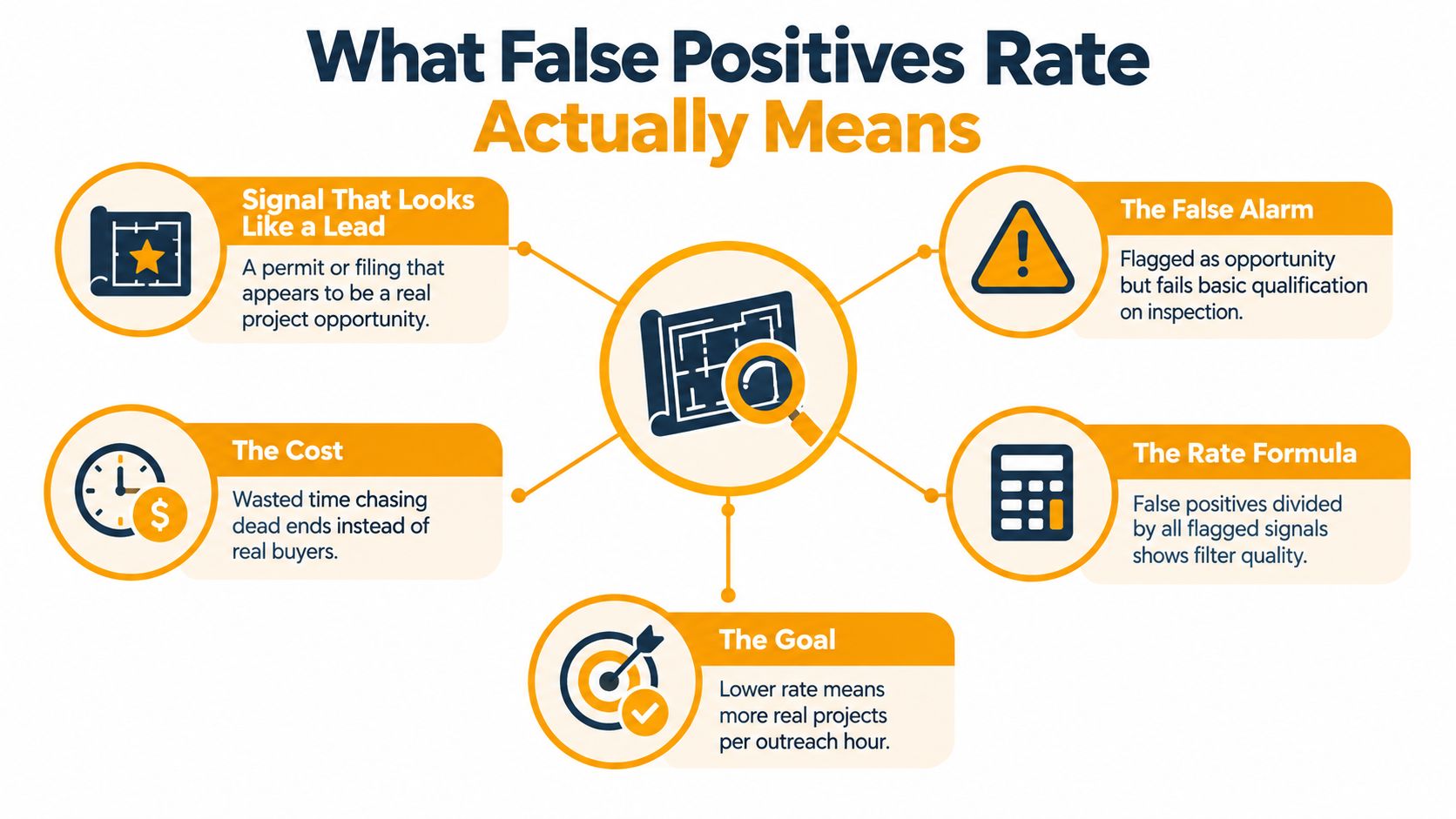
A false positive is a construction lead that looks qualified at first glance but fails a basic inspection. An expired permit, a homeowner pull, an awarded job, a project outside your territory, or a contact number that rings to a fax line can all qualify as false positives.
The false positives rate tells you how much of your flagged opportunity volume falls into that category. Use a plain formula:
False positives rate = false positives ÷ total flagged positives × 100
If your system flags 1,000 permits and only 50 become legitimate opportunities after qualification, 950 records are false positives. The rate is the share of flagged records that fail your agreed qualification test.
Use a job-site analogy
Think of a metal detector at a busy job site. It beeps for a useful tool, but it also beeps for every bottle cap and pull tab. If its false positive rate is 95 percent, the detector may be sensitive, but it slows the crew to a crawl. A lead scraper with the same behavior creates an inbox full of alerts and a sales team that stops trusting the signal.
The metric isn't a judgment on whether the source is "good" or "bad." It measures whether your qualification threshold matches the work your team can pursue. A broad source may be useful for market mapping, while a narrow source may be better for daily outreach. Confusing those jobs is how teams mistake volume for pipeline.
Define the positive before measuring it
You need a written definition of a qualified positive. For one trade, that might require a matching scope, a project in the service territory, a suitable valuation band, an active stage, and a reachable decision-maker. For another, the decisive conditions may be different.
Log the reason each record fails. “Bad lead” isn't enough. Use reason codes such as wrong trade, wrong geography, stale filing, already awarded, no reachable contact, and residential only. Those codes show whether the problem sits in the data, the scoring logic, or the team's threshold.
The next step is simple. Count every flagged record, count every record that fails the qualification test, and calculate the rate by source, market, trade, and rep workflow. A single blended number hides where the hours are disappearing.
Why a Small Percentage Becomes a Big Bill
False positives create four separate costs, and construction teams usually track none of them cleanly.
Wasted calling hours come first. On a list of 500 permits, a 20 percent false positive rate creates 100 dead dials. Those calls still consume research time, dialing time, voicemail time, and follow-up administration.
Misallocated BD effort is more damaging than the call itself. A rep chasing a bad lead isn't reviewing a good one. The opportunity cost doesn't appear as a separate expense, but it shows up when a competitor reaches a qualified project first.
CRM pollution creates a second operational bill. Bad records distort pipeline reviews, inflate apparent coverage, and force managers to debate whether a project is real before discussing how to win it. Reps then add personal notes, duplicate contacts, and conflicting statuses to compensate for weak source data.
Finally, trust erodes. Once a rep sees enough wrong contacts and irrelevant projects, the rep stops working the list. Your organization loses the value of every future signal from that source, even when the source identifies a legitimate opportunity.
Repeated screening changes the workload
The pattern isn't unique to construction. In U.S. breast cancer screening, about 10% of women are recalled for more testing after a screening exam, while only about 0.5% have cancer, leaving roughly 9.5% with a false-positive exam, according to the National Cancer Institute breast screening information. Over 10 years of annual screening, about 50% of women in the United States experience at least one false-positive exam, and roughly 7% to 17% of those false positives lead to biopsies, from the same source.
The lesson for BD is operational, not medical. A modest error rate repeated across many review cycles becomes a queue, and a queue becomes labor. A 2023 analysis estimated the lifetime probability of at least one false-positive screening result at 85.5% for women and 38.9% for men in baseline groups, with variation by demographic group and test type, as reported in this peer-reviewed screening analysis. Repeated testing makes small per-event noise expensive.
Convert improvement into hours
Take the two-person BD team in the working example. If its weekly list produces enough records to create a 35 percent false positives rate and the team spends roughly 30 hours sorting, calling, and cleaning, cutting the rate to 12 percent removes 23 percentage points of bad volume. At the stated workload, that reclaims roughly 23 hours per week for the team.
That is not an accuracy trophy. It's time returned to revenue-producing work. A recovered hour can mean another decision-maker reached, another plan set reviewed, or another estimator handoff completed before the bid window closes.
Healthcare reviews also identify the downstream burden of recalls, follow-up work, anxiety, and implementation costs, reinforcing that false positives should be managed as a workload problem rather than a headline accuracy number. The recent review of false-positive burden supports that broader operational framing.
How Construction Teams Measure and Report the Metric
Start with the same denominator every week: all flagged positives. In construction, that means permits, plan holders, plats, owner records, or project leads that your system or researcher marked for pursuit.
Then classify the outcome. A confirmed-fit lead passes your agreed rules. A false positive fails them. Keep the classification tied to observable reasons, not a rep's general impression.
Build the audit inputs
Your weekly audit should capture:
- Flagged volume: Every record sent to BD during the period.
- Confirmed-fit volume: Records that match the required trade, territory, timing, and contact rules.
- Sample review: A consistent spot-check of 20 records each week.
- Disqualified reason codes: The specific reason a record failed qualification.
- Source and segment: The permit source, market, trade, score band, and assigned rep.
A 20-record audit won't replace full outcome tracking. It gives managers an early warning when a source or scoring rule starts drifting. If the sample contains too many wrong-trade records, adjust project-fit logic. If it contains too many unreachable contacts, tighten contactability filters. If the records are valid but stale, review timing and rescoring.
| Metric Input | Where It Comes From | Refresh Cadence | Trigger Threshold |
|---|---|---|---|
| Flagged volume | Lead platform, permit feed, CRM export | Daily | Review when volume changes sharply without a matching market reason |
| Confirmed-fit volume | Rep qualification and estimator review | Weekly | Investigate when fit falls against the team's established baseline |
| False-positive count | Dispositioned CRM records | Weekly | Rescore when the rate rises for a source, trade, or territory |
| 20-record audit sample | BD manager spot-check | Weekly | Start a scoring review when repeated failures share one reason code |
| Contactability status | Phone, email, and decision-maker records | Daily | Tighten filters when unreachable records dominate the sample |
| Time to first touch | CRM activity timestamps | Monthly dashboard | Review routing when qualified leads wait too long for outreach |
Put the number beside revenue metrics
A monthly BD dashboard should show false positives rate beside conversion rate, time-to-first-touch, qualified lead volume, and source-level pipeline. The metric only becomes useful when managers discuss it in a recurring meeting and assign an owner to each corrective action.
Don't bury it in a spreadsheet. Use it to decide whether a source deserves more budget, whether a threshold needs tuning, and whether a rep's time is being spent on the right work. Teams evaluating automated lead scoring workflows should insist that the system preserves both the score and the eventual disposition, otherwise no one can learn from the misses.
Smarter Filters That Catch Bad Leads Before You Do
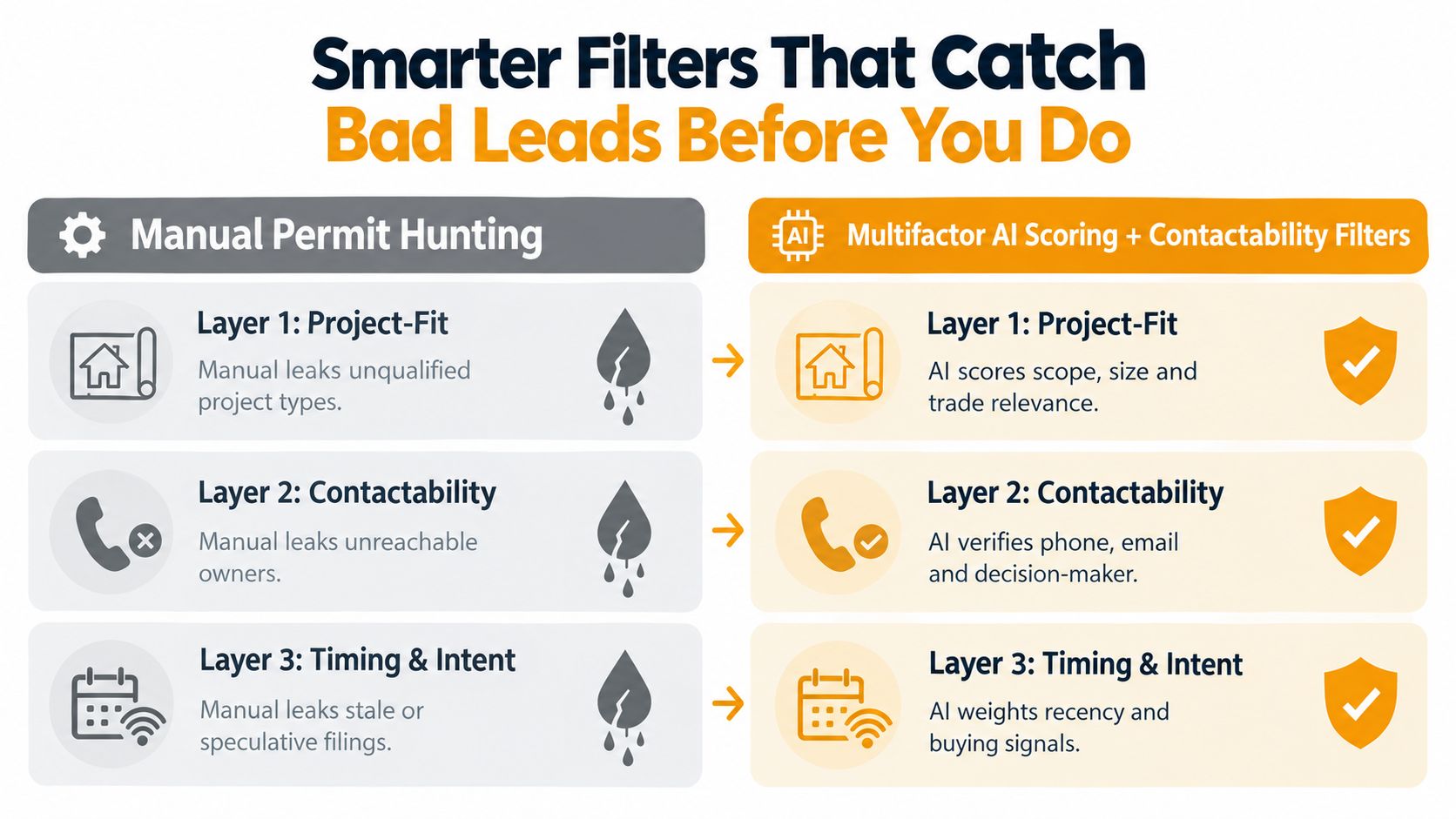
Manual permit hunting usually starts with one strong signal, such as a new filing, then asks a rep to perform every other qualification step by hand. That approach is flexible, but it leaks badly when the list contains mixed project types, stale records, incomplete contacts, and filings that don't indicate active buying intent.
A multifactor approach combines several weaker signals before a record reaches the call queue. The trade-off is straightforward. You may reduce raw lead volume, but you give reps a larger share of records they can pursue.
Layer one project fit
Project-fit signals include sector, valuation band, scope match, territory, and trade relevance.
- Removes: A residential filing sent to a commercial subcontractor, a project outside the service radius, or a job whose scope doesn't match the firm's capabilities.
- Still misses: A project can fit the trade and territory but already be awarded, paused, or controlled by a relationship your team can't access.
- Volume trade-off: Narrower fit rules reduce the list, but they protect estimators from reviewing work the company can't win.
Layer two contactability
Contactability filters ask whether a reachable human sits behind the record. A verified email, direct line, and decision-maker title carry more operational value than a generic office number or an address alone.
- Removes: Fax lines, disconnected numbers, generic inboxes, and records with no identifiable owner, applicant, or builder contact.
- Still misses: A valid contact may have no authority, may not be involved in contractor selection, or may refuse outreach.
- Volume trade-off: Requiring contactability lowers the number of records passed to sales, but it raises the odds that a call can start a real conversation.
Layer three timing and intent
Recent filings, active design stages, plan-review movement, owner occupancy signals, and related project activity help distinguish live work from historical noise.
- Removes: Stale permits, speculative filings, and records that haven't moved through the project cycle.
- Still misses: A fresh filing may reflect an early concept, a private relationship, or a project with no open trade opportunity.
- Volume trade-off: Strong timing rules can delay outreach on early opportunities, so managers should create separate early-stage and ready-to-call queues.
Platineer combines multifactor scoring with contactability filters to weight project fit, territory, valuation, stage, relationships, and reachable decision-makers before records reach BD. Filters won't eliminate every false positive. They shift the error boundary, and the winning combination is the one that lowers noise without starving the pipeline.
The mechanics of scoring also depend on how quickly the system updates. A record that was accurate yesterday can be wrong after a plan change, award decision, or contact update.
The Rescoring Habit That Keeps Your List Clean
A lead score is only as honest as the cutoff your team applies. That cutoff ages as new permits arrive, plans change, project stages advance, and decision-makers move between firms.
Weekly rescoring leaves a large gap between the moment reality changes and the moment your team sees it. A lead that qualified last week may now be stale. Another that looked cold may have entered a more actionable stage overnight.
Operating rule: Treat the threshold as a live control, not a permanent label.
Minute-level rescoring closes that gap. If leads are rescored every 15 minutes instead of weekly, stale projects can be demoted sooner, new decision-makers can surface faster, and records that slipped through yesterday can be reclassified this morning. The value comes from reducing the number of calls made against yesterday's version of the market.
False-positive management connects directly to time-to-first-touch. A clean, current queue lets a rep call the right person while the project context is still useful. It also gives estimators cleaner handoffs, because the opportunity record reflects current stage and contact information rather than an old export.
Make threshold changes visible
Don't let the system change who receives a lead without you knowing. Record the score, the threshold, the signals that moved the record, and the reason for demotion or promotion. Managers can then see whether false positives come from weak source data, an overbroad rule, or a cutoff that is too permissive for a particular trade.
The practical workflow should include automated rescoring triggers and alerts when a previously qualified lead drops below threshold. That turns list hygiene into a routine control instead of a quarterly cleanup project. Construction teams looking to formalize ownership across BD, estimating, and sales can use construction lead management practices to assign those alerts and dispositions.
Rescoring isn't a substitute for human qualification. It is the mechanism that ensures humans spend their time on the freshest, most relevant records first.
Your Morning Workflow for Low False Positives
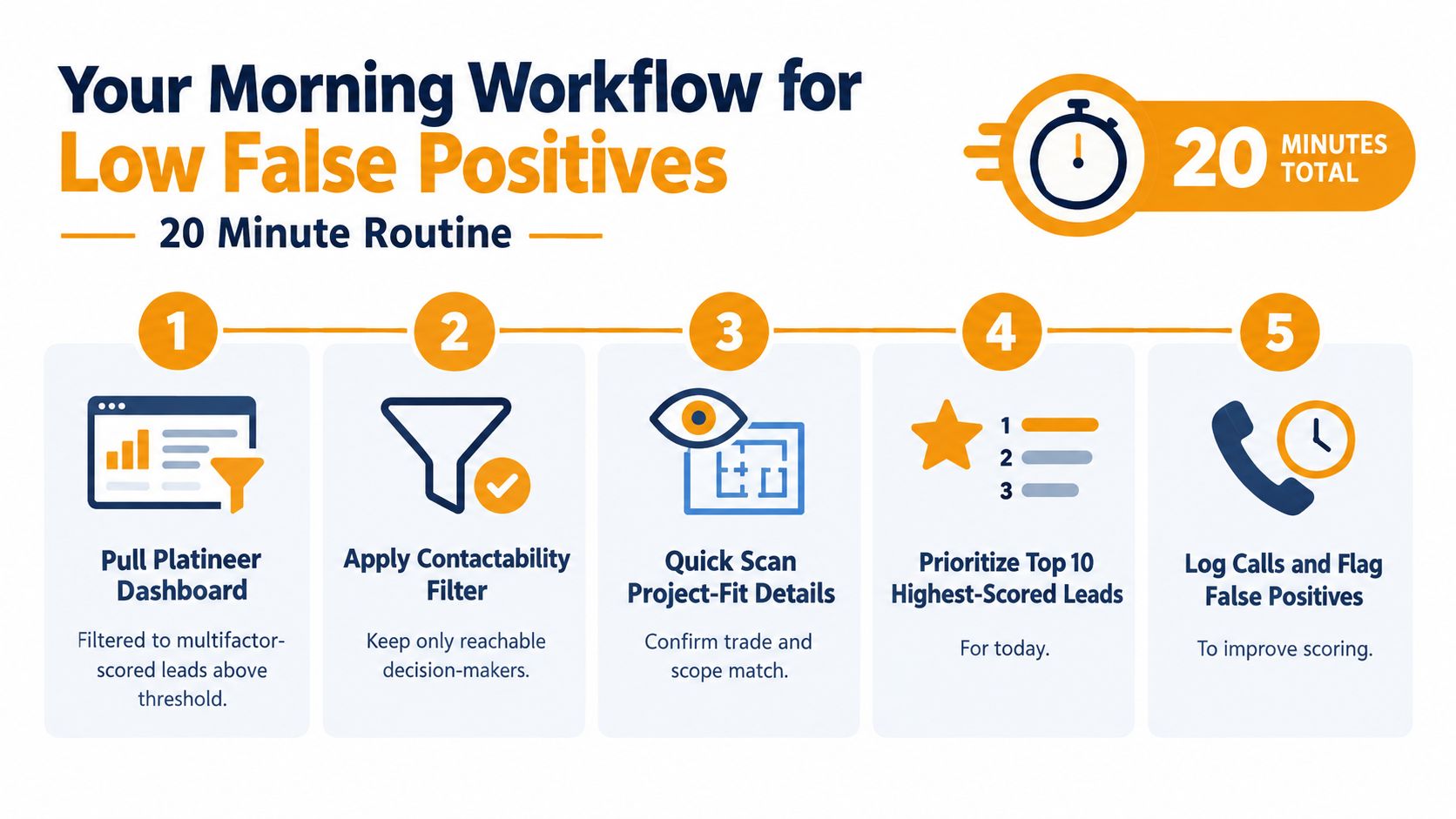
Run a short maintenance routine before the first call block. The objective isn't to stare at a dashboard. It's to make sure today's queue reflects today's opportunity set.
Step one: Pull the Platineer dashboard filtered to multifactor-scored leads above the 70-point threshold, with contactability filters active.
Step two: Review overnight rescoring deltas. Look for projects that moved from cold to warm, dropped below threshold, or gained a new decision-maker contact.
Step three: Triage the top five leads. Confirm permit stage, GC history, scope, territory, valuation fit, and the person your rep should contact.
Step four: Load qualified opportunities into the day's call block. Give reps a concise reason for the score and a clear first-touch objective.
Step five: Log outcomes and flag false positives. A wrong trade, stale project, bad phone number, or awarded job is training data for the next scoring pass.
Treat the false positives rate like a pre-start gauge check. If the number rises, don't tell the team to call harder. Find the failing filter, correct the reason code, and protect the hours that should go toward real buyers.
Platineer gives construction teams project intelligence, multifactor lead scoring, contactability filters, decision-maker details, and minute-level pipeline rescoring in one workflow. Visit Platineer to see the dashboard, configure your thresholds, and watch project changes update the queue so your team can run a cleaner morning call block.


