
A project pipeline is the structured flow of a construction job from early planning signals through permit, start, and completion, with stage visibility that lets contractors act earlier. In practice, that can mean tracking work from a recorded plat through permit issuance, construction, and closeout, while using the time between stages to protect estimating capacity and bid margin.
You may be feeling the cost of a weak pipeline before anyone calls it a pipeline problem. It's Monday morning, an estimator is searching a permit portal, a project manager is forwarding an old site plan, and business development is asking whether the owner has selected a general contractor. The team has work in front of it, but nobody has a reliable view of what's coming next.
That confusion creates unpaid labor. Estimators download the same records, call too late, chase projects that stalled, and rush takeoffs when a bid finally appears. The practical project pipeline meaning for contractors is therefore less about maintaining a task board and more about recovering calendar time before competitors see the same opportunity.
Table of Contents
- What Project Pipeline Means on a Real Job
- The Stages Every Construction Project Flows Through
- Why Early Signals Change Everything for Bids
- Pipeline Metrics Contractors Actually Track
- A Tale of Two Subcontractors on the Same Plat
- Why Permit Pulls Alone Are Not Enough
- From Plat to Permit on One Dashboard
- Building a Daily Pipeline Habit That Pays
What Project Pipeline Means on a Real Job
At a mid-size Houston general contractor, a Monday review can expose the problem quickly. Three estimators may be pursuing the same multifamily job, while two preferred subcontractors have already committed their pricing capacity elsewhere. Someone remembers seeing the site plan recently, but the team can't agree whether it was filed last week or last month.
The missing information isn't a minor administrative gap. If the project is still in planning, the estimator may have time to qualify the owner, identify the likely design team, and understand the scope before drawings become a bidding package. If the project has entered plan review, the opportunity is more mature, but comments and revisions may still change the work. If a permit has already been issued, the contractor may be reacting after critical relationships and pricing conversations have started.
A project pipeline is the structured flow of a construction job from early planning signals through permit, start, and completion, with stage visibility that lets contractors act earlier. This definition aligns with the construction use of pipeline stages such as permit entry, construction start, and completion, while also recognizing that planning and development records can appear before a building permit. The construction project pipeline definition and stage framework explains why the term can describe future work inventory, not only active tasks.
The timing advantage is the working definition
A useful pipeline record tells the estimator more than a project name. It should show the current stage, the last meaningful event, the likely next gate, project priority, trade relevance, and whether the team has enough information to act.
That visibility supports earlier capacity planning. A project-management pipeline works as a portfolio-control layer because it exposes proposed, approved, scheduled, active, and completed work before every commitment is final, helping teams identify resource conflicts and late-stage bottlenecks. Project pipeline management guidance from Lark describes this stage visibility as a way to match demand with available resources earlier.
The Houston Monday scramble isn't a people problem. The estimators may be diligent, and the business-development team may be active. The problem is that each person is working from a different version of the market. Once the pipeline records the same project ID, stage, date, owner information, and scope context in one place, the team can decide whether to pursue, monitor, qualify, or ignore the job.
The Stages Every Construction Project Flows Through
A commercial or multifamily project doesn't jump directly from an idea to a bid invitation. It moves through gates, and each gate produces a different level of confidence. Consider a 240-unit garden-style apartment outside Dallas. The exact duration at each gate will vary by jurisdiction, project complexity, financing, and design readiness, so treat dwell time as a management question rather than a universal schedule.
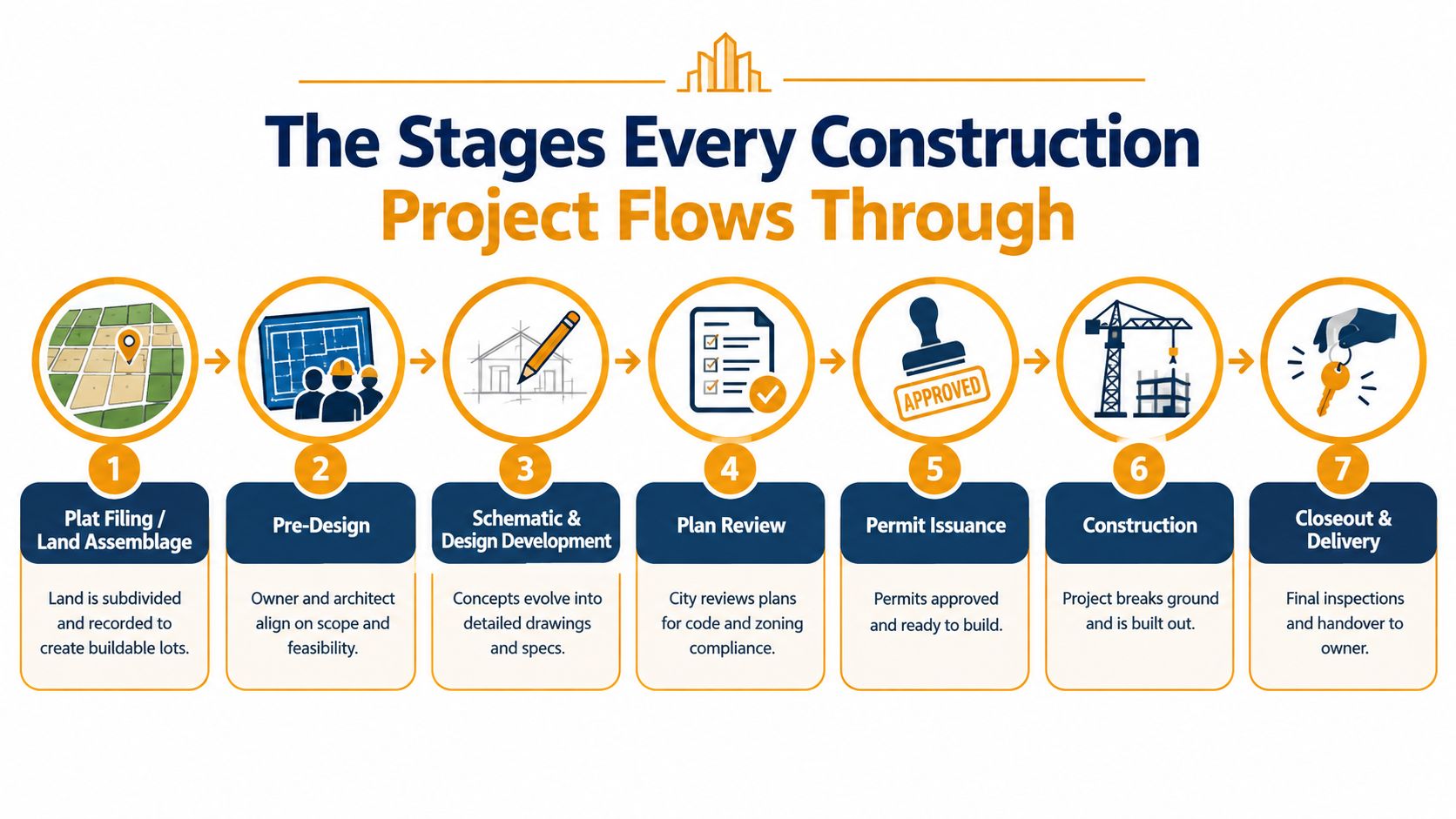
Seven gates from land to closeout
Plat filing or land assemblage. The developer records a subdivision plat or brings parcels together. For the apartment project, this is the first credible indication that land is being organized for development. It's an opportunity signal, not a bid-ready scope.
Pre-design. The owner and architect align on feasibility, intended use, access, density, and broad requirements. At this point, a mechanical or electrical contractor can learn about the project's likely scale, but shouldn't pretend the design is fixed.
Schematic and design development drawings. Concepts become more detailed drawings and specifications. Mechanical rooms, utility assumptions, building systems, and site requirements begin to emerge. Trade-specific review becomes more useful than a generic project name.
Plan review submission. The jurisdiction receives the plans for code, zoning, and technical review. The project has advanced beyond an idea, but it can still change materially through comments and resubmissions.
Permit issuance. The jurisdiction approves the work for construction. This is a stronger readiness signal, but it's also a late point for contractors who want to influence scope or build relationships before bid day.
Ground-breaking and construction. The job starts and moves into execution. The pipeline should retain the project so teams can monitor schedule movement, procurement needs, and future phases.
Certificate of occupancy and closeout. Final inspections, owner handover, documentation, and remaining corrections complete the lifecycle. Closeout data can also improve future qualification and relationship decisions.
Practical rule: Treat every stage as a signal point. A stage change should alter who gets contacted, what gets reviewed, and how much estimating time the opportunity deserves.
Dwell time tells you where to spend attention
The apartment project may move quickly through land organization and early design, then sit during jurisdictional review. That matters because a stalled stage can be more informative than a new record. A project that remains in review without current activity may need monitoring rather than immediate takeoff labor.
Commercial permit timing demonstrates why early visibility matters. An independent 2026 guide estimates that U.S. commercial building permits can take 3 weeks to 18 months, with a typical standard project in an average market taking 12 to 20 weeks from a complete application to issuance. Fast suburban markets in Texas and Florida may take 3 to 8 weeks. The 2026 preconstruction guide to commercial permit timing provides those ranges.
A pipeline doesn't need to predict the exact permit date to be valuable. It needs to distinguish early intent from active construction, show how long a project has occupied its current gate, and help the estimator choose the next useful action.
Why Early Signals Change Everything for Bids
A permit-only contractor waits for public confirmation that a project is ready to build. A contractor with pre-permit visibility can begin qualification while the owner, architect, and jurisdiction are still shaping the job.
The difference is not just more records. It's the number of useful calendar weeks between discovery and bid pressure. Planning and development records can appear months before a building permit, giving firms a forward-looking demand signal rather than a retrospective view of permitted work. Development permit and planning signal guidance explains why those early records can support outreach before competition becomes concentrated.
Two workflows, one opportunity
Permit-first workflow
- Find the issued permit.
- Search for the project team.
- Confirm whether bids are still open.
- Download plans and specifications.
- Rush scope review and subcontractor outreach.
Pre-permit workflow
- Find the plat or development record.
- Identify the owner, applicant, and likely project type.
- Monitor design and plan-review movement.
- Prepare trade questions and relationships.
- Time the takeoff around a credible bid event.
The pre-permit approach can recover meaningful lead time, but contractors shouldn't treat every early record as a guaranteed job. A plat can represent future intent without a finalized design, financing, or construction commitment. The estimator's advantage comes from qualifying early, not from estimating every early signal.
| Pipeline Signal | Weeks Before Permit | Bid Impact |
|---|---|---|
| Plat filing or land assemblage | Qualitative early signal, often months before permit activity | Supports territory planning, owner research, and early relationship work |
| Pre-design and design development | Earlier scope visibility before final plans | Helps identify likely systems, trade fit, and estimating requirements |
| Plan review submission | Shows the project has entered a formal jurisdictional process | Creates a basis for monitoring comments, revisions, and design maturity |
| Permit issuance | Final public readiness signal before construction | Confirms a stronger execution point, but may leave less time for pursuit |
Census construction data measures start timing by the number of months after authorization. Buildings started in the first month after authorization count as 1 month, those started in the second month count as 2 months, and so on. The U.S. Census construction-start timing explanation shows why identifying work near authorization can put a contractor ahead of teams that only monitor later construction activity.
The time recovered becomes money only when the team changes its behavior. Earlier notice can reduce rushed takeoffs, improve subcontractor pricing conversations, and give the estimator enough room to reject poor-fit work. A useful planned construction project workflow should therefore prioritize timing and fit, not just increase the number of leads in the queue.
Pipeline Metrics Contractors Actually Track
A pipeline review should answer practical bid questions quickly. The estimator doesn't need a dashboard full of decorative charts. Five measures usually provide a more useful operating view, although a healthy range depends heavily on project type, trade, geography, and sales cycle.
| Metric | Definition | Commercial Range | Specialty Trade Range |
|---|---|---|---|
| Pipeline value | Total potential contract value across tracked opportunities | Compare by stage and project type, not as one combined total | Separate by trade scope and realistic addressable value |
| Weighted pipeline | Potential value adjusted for confidence at each stage | Use stage confidence consistently across the portfolio | Weight by scope clarity, relationship access, and bid likelihood |
| Stage-to-stage conversion rate | Share of projects moving from one gate to the next | Compare similar building types and jurisdictions | Compare similar scopes, owners, and lead sources |
| Average dwell time per stage | Time projects remain in a pipeline stage | Flag projects that exceed the market's normal review pattern | Track whether scope complexity or owner behavior causes the delay |
| Bid hit rate | Share of submitted bids that become awarded work | Review by client, delivery method, and project category | Review by GC, scope, relationship strength, and price position |
What each number should tell you
Pipeline value answers, “Is enough potential work entering the territory to support the team?” A $12M multifamily pipeline isn't the same signal as a $12M healthcare pipeline. Healthcare projects may spend longer in review because of technical, regulatory, and coordination demands, so raw value can create a false sense of near-term demand.
Weighted pipeline answers, “How much of this apparent opportunity is credible enough to plan around?” Give more weight to projects with identifiable owners, active review, clear scope, and an accessible decision-maker. Don't assign confidence merely because a record has a large valuation.
Stage-to-stage conversion answers, “Where does work stop moving?” A low transition from plan review to permit may indicate jurisdictional friction, design changes, financing problems, or poor data quality. The metric is useful only when stages are defined consistently.
Average dwell time answers, “Which opportunities deserve a status check?” A project lingering in one gate may need a call, a document review, or removal from the active pursuit list.
Bid hit rate answers, “Which pursuits deserve more estimating hours?” Break it down by trade and client. A strong overall hit rate can hide weak performance in one segment, while a modest rate may still be worthwhile if the awarded work carries sound margin.
The ranges should shift by trade. A specialty contractor often needs tighter scope evidence and stronger relationship access before committing takeoff time. A general contractor may tolerate earlier uncertainty because it controls broader pursuit strategy.
A Tale of Two Subcontractors on the Same Plat
A mechanical subcontractor and an electrical subcontractor spot the same 240-unit plat filing in Denton County on the same Tuesday. Both see the same early signal. Their results diverge because they apply different workflows to it.
The mechanical subcontractor files the record under future work and moves on. That choice is understandable. A plat alone doesn't provide enough detail for a responsible mechanical estimate, and the team has current bids to finish.
The electrical subcontractor treats the plat as a qualification trigger. It pulls the utility coordination memo, checks the transformer notes on the recorded plat, identifies the likely service implications, and records the project under the correct territory and multifamily category. It doesn't produce a full estimate immediately. Instead, it prepares a scoped bid position and a short list of questions for the likely project participants.
The same signal can produce different economics
The electrical subcontractor has a scoped bid ready nine weeks before permit pull. That lead time is useful because it creates space for one early conversation, one review of utility assumptions, and one decision about whether the project deserves deeper estimating effort.
The mechanical subcontractor may still encounter the job later, but the work arrives under more pressure. Pricing requests are likely to compete with other urgent pursuits, and the estimator has less opportunity to clarify scope before committing labor.
Earlier discovery only creates value when the team attaches a next action to the record.
In this representative comparison, nine weeks of lead time converts into one fewer rushed takeoff, one more conversation with the GC, and roughly two points of recovered margin on a competitive bid. The figures are part of the defined scenario, not a universal performance promise.
The trade lesson is straightforward. Early signals don't eliminate uncertainty. They give the subcontractor a controlled way to decide when uncertainty is worth investigating. Time savings is money savings when the team uses that time to avoid rework, improve scope confidence, and protect pricing discipline.
Why Permit Pulls Alone Are Not Enough
Watching the permit portal feels objective. The record exists, the address is clear, and the project appears closer to construction. But a permit-only view covers the end of the discovery process, not the full project pipeline.
Three blind spots create three bid problems
No upstream view. Permit searches miss the plat filings, land assemblages, rezonings, and early development records that reveal where projects originate. By the time the permit appears, a contractor may be competing for a job that has already been discussed among owners, architects, and preferred builders.
No plan-review context. A permit number doesn't explain what changed during review. Comments can reveal scope additions, utility issues, code-driven revisions, or design movement before issuance. Without that history, an estimator may price an outdated scope or miss an important trade requirement introduced during revisions.
No post-pull warning. Permit issuance doesn't guarantee an immediate start. Financing, utility coordination, procurement, and owner decisions can still delay construction. A contractor that treats every permit pull as an active bid may waste hours on a project that has stalled.
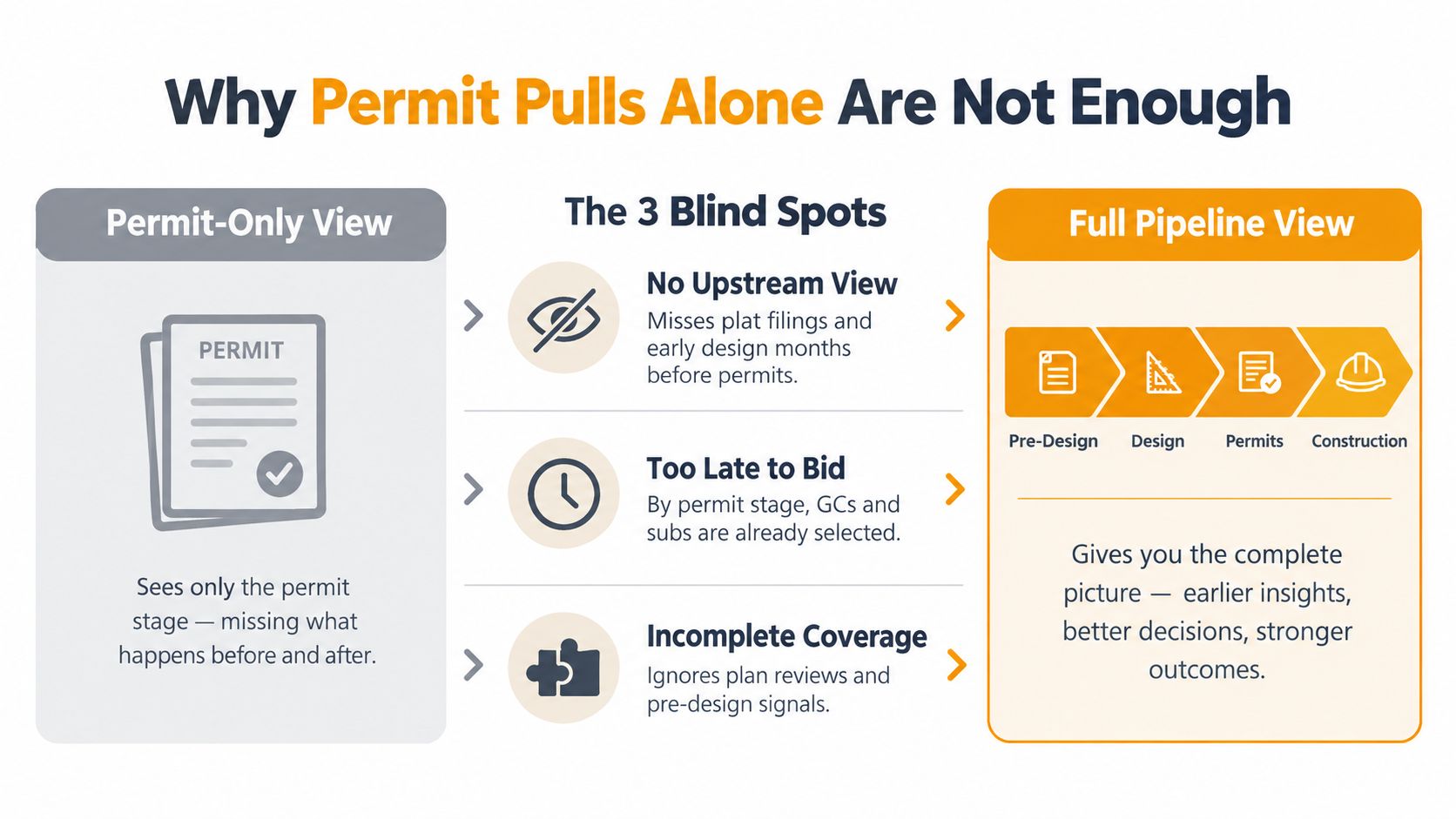
A permit-only strategy also encourages the wrong operating rhythm. The team checks a portal, exports records, cleans addresses, searches for contacts, and repeats the process later. Those clicks consume estimating and business-development capacity without necessarily improving pursuit quality.
Use permit data as a confirmation, not the whole system
Permit information remains valuable. It can confirm project maturity and create a strong trigger for outreach or bid preparation. It just shouldn't be the only layer.
A permit-tracking software workflow is more useful when it connects issuance to earlier planning records and later status changes. The contractor can then distinguish a new opportunity, a design-stage project, an active permit, and a delayed job without treating each record as equally urgent.
The practical test is simple. If your team can't answer what happened before the permit, what changed during review, or whether the project is still moving afterward, permit coverage alone isn't pipeline coverage.
From Plat to Permit on One Dashboard
A usable forecast view connects events that contractors usually inspect in separate places. The plat, plan-review record, permit, owner, applicant, and trade scope should resolve to the same project identity so the estimator can understand movement without rebuilding the file each time.
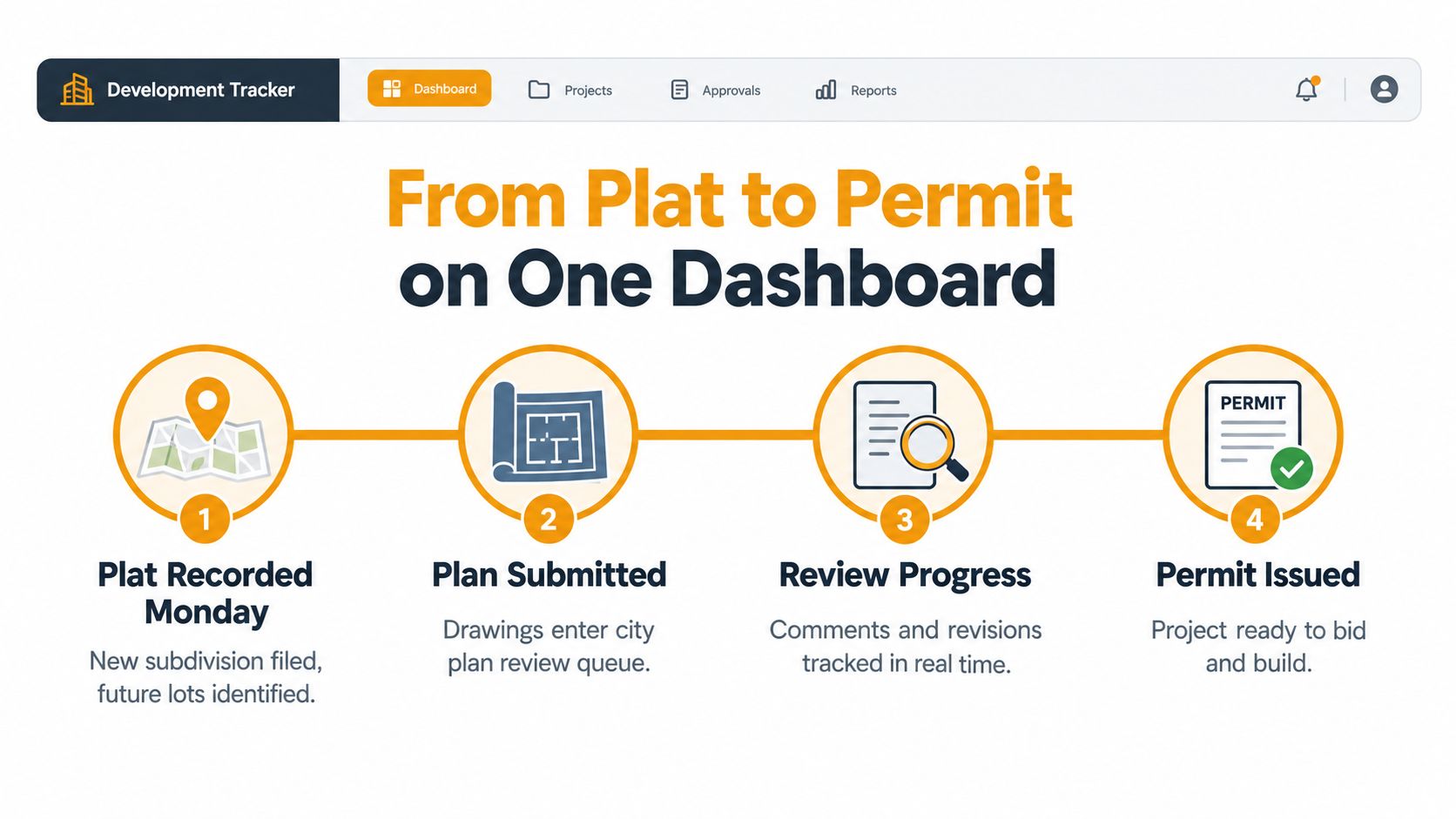
The timeline should preserve the project's identity
Consider the apartment development as a sequence of linked events:
- Plat recorded Monday. The subdivision filing identifies future lots and establishes the initial project record.
- Plan review comment issued Thursday. The jurisdiction's feedback updates the project status and may reveal a scope or coordination issue.
- Building permit pulled three weeks later. The permit confirms a later maturity point and triggers a bid-priority review.
- Trade context remains attached. Owner, GC placeholder, square footage, and likely scope stay connected rather than being re-entered in a new spreadsheet.
That structure matters because a status change without context still forces manual research. The estimator needs to know whether the new event belongs to a relevant project, fits the firm's territory, and warrants immediate action.
Reduce clicks instead of adding another screen
A consolidated view can filter by trade, subdivision, territory, and project stage. An MEP estimator should be able to see mechanical-bearing jobs within the bid radius, while a general contractor may need a broader development map and a view of owner relationships.
The workflow doesn't require a new process for every municipality. Municipal feeds can be normalized into consistent project records, plan-review status can update as it changes, and permit issuance can trigger a priority flag instead of sending the estimator to another tab. The point is to replace repeated searching with a single decision surface.
A construction intelligence platform can support that structure by combining project signals and status context. Platineer is one example of a tool that aggregates permits, plan reviews, plats, and owner records, then presents project intelligence according to trade, territory, and valuation filters. The relevant question isn't whether a dashboard looks polished. It's whether it removes the clicks involved in downloading lists, matching duplicate records, checking multiple portals, and locating decision-makers.
Measure recovered hours honestly
Track the work the dashboard replaces. Count duplicate searches, spreadsheet cleanup, portal checks, contact lookups, and status-review meetings. Then compare the recovered time with the labor required to maintain the system.
Automation isn't automatically efficient if it floods the team with poorly qualified leads. Scoring must filter for fit, scope relevance, location, and reachability. Otherwise, the estimator trades manual searching for manual triage, which isn't a meaningful gain.
Building a Daily Pipeline Habit That Pays
A pipeline only becomes a timing advantage when someone looks at it consistently. A fifteen-minute morning brief is enough to create a disciplined starting point, provided the review ends with decisions rather than passive scrolling.
Run the same short sequence each morning
Open the current dashboard. Start with status changes and new records, not the entire historical inventory.
Scan new plats in the bid radius. Look for subdivisions, larger developments, and project types that match the firm's trade and territory.
Open projects beyond the earliest planning stage. Check whether plans entered review, comments were issued, revisions were submitted, or permits moved forward.
Read for scope clues. Plan-review comments can expose changes that a project title or permit record won't show. Record only the information that changes pursuit priority.
Tag two or three candidates for a next action. That action might be a site walk, an owner lookup, a GC introduction, or a later review date. Don't turn every record into a takeoff.
The habit works because it separates discovery from estimating commitment. Early signals deserve qualification, not automatic production labor. A site visit can be valuable when it answers a question the documents can't, but it shouldn't become a substitute for basic project screening.
Let the habit compound through relationships
In the first week, the review may surface a site visit that catches a grading issue. By the fourth week, the team can have a growing set of conversations with owners and project participants before drawings go out to bid. By the twelfth week, the contractor can review hit rate on awarded work and see whether early contact is producing better opportunities.
Those time markers belong to the operating routine, not a guaranteed outcome. The useful measurement is whether early signals lead to qualified conversations, fewer rushed pursuits, better scope decisions, and awarded work with acceptable margin.
The bid math is simple. A subcontractor who lands three extra jobs a year from earlier-signal contact gains roughly the same margin as raising bid prices on every job, without raising a single number on a single sheet. That comparison captures the central economics of pipeline discipline. The contractor doesn't need to inflate every price to improve the result. It can create more qualified opportunities and use recovered estimating time where it matters.
The pipeline habit pays when it changes which jobs you pursue, when you pursue them, and how much labor you spend before the scope earns it.
Start tomorrow with one territory, one trade filter, and one clear definition of a qualified signal. Keep the review short, record the next action, and remove projects that no longer show movement. Time saved in discovery is money saved in estimating, and money saved in estimating protects the margin you already worked to win.
Platineer aggregates plats, plan reviews, permits, and owner records into a prioritized construction pipeline, helping contractors see relevant projects earlier and monitor status as work moves toward approval. Visit Platineer to explore a workflow that can replace manual portal searches with trade, territory, and project-stage visibility.


