A construction project lead is a verified, data-backed signal of an upcoming building opportunity, such as a permit filing or plat record, that matches a contractor's trade and territory. A hands-on project lead also guides day-to-day execution and owns delivery outcomes, while a project manager usually concentrates more on coordination, administration, and overall control.
You may be looking at the same pipeline right now: bid boards are open, the estimator is waiting for drawings, and business development is calling contacts who may already have awarded the work. Meanwhile, projects are moving through planning, zoning, plat, and permit departments before they ever appear as obvious bid opportunities.
That gap is where construction project leads matter. A lead isn't merely a name in a CRM or a generic sales contact. It's an identifiable project signal with enough verified context to support a sensible next action. Modern construction intelligence platforms can surface permits, plan reviews, plats, and owner records, then match them to a firm's trade, territory, valuation range, and ability to reach the decision-maker. That turns early market activity into a working pipeline instead of a pile of unqualified names.
Table of Contents
- Defining the Construction Project Lead
- Leads Versus Prospects and Bid Opportunities
- The Lifecycle and Stages of Building Leads
- Why Early Pipeline Visibility Matters
- How Firms Qualify and Prioritize Opportunities
- Replacing Manual Permit Hunting with AI Intelligence
- Building a Smarter Preconstruction Workflow
Defining the Construction Project Lead
An estimator hunting for work needs more than another spreadsheet row. A useful project lead answers practical questions: What is being built? Where is it located? What stage is it in? Who is involved? Does it fit our work? If the available information can't support those questions, the opportunity may still be worth watching, but it isn't ready for active pursuit.
In preconstruction and business development, the term project lead describes a verified signal that a specific building opportunity is developing. A new permit filing is one signal. A plan review submission, zoning action, or subdivision plat can be another. Each indicates movement at a physical site, rather than vague interest from a developer or an unconfirmed rumor circulating through the trade.
Construction firms often use the phrase differently from software or office-based teams. A site-based project lead may be the person directing field execution. In that sense, the role resembles the hands-on leadership described by Atlassian's explanation of a project lead, where the lead guides daily work, removes blockers, coordinates stakeholders, and keeps delivery aligned with business goals. In preconstruction, however, the phrase often refers to the opportunity itself, the signal that gives a contractor a chance to engage before procurement is finished.
What makes a lead actionable
A qualified lead should contain enough evidence and context to move someone from research to action.
- A physical project: The signal ties to a site, parcel, address, subdivision, or development record.
- A documented activity: A permit, plan review, plat, zoning filing, or owner record shows that the project has entered a traceable process.
- Trade relevance: The scope appears compatible with the firm's capabilities.
- Territory fit: The location falls within the service area or strategic market.
- A timing clue: The record shows whether the project is early, under review, approved, or already moving toward construction.
- A reachable participant: Owner, applicant, architect, developer, or general contractor information supports targeted outreach.
The distinction matters because manual lead management tends to mix strong signals with stale records and unrelated activity. A practical construction lead management workflow should preserve the project's status, source, contacts, next action, and reason for qualification. Time savings become money savings when estimators stop chasing work that was never a fit and use those hours to build relationships around projects that can be won.
Practical rule: Treat a project lead as evidence of a moving opportunity, not proof that the job is yours to bid.
Leads Versus Prospects and Bid Opportunities
Construction teams lose time when they treat every market contact as the same kind of opportunity. A developer met at an event, a permit filed for a nearby property, and an invitation to price a defined scope all belong in different pipeline stages. Mixing them makes forecasts look fuller than they are and encourages estimators to spend effort without a clear route to award.
The cleanest distinction is based on specificity and timing. A prospect is a person or organization that may buy construction services. A project lead is tied to a particular physical opportunity with documented progress. A bid opportunity is later still, with a defined procurement path and a realistic chance to submit.
Construction Pipeline Terminology
| Pipeline Stage | Definition | Data Signal | Action Required |
|---|---|---|---|
| Prospect | A potential buyer, developer, owner, or partner without a confirmed project fit | Relationship record, referral, meeting, or market contact | Learn the firm's development plans and keep the relationship active |
| Project lead | A specific site or development showing documented movement | Permit filing, plan review, plat record, zoning activity, or owner record | Verify scope, territory, stage, and decision-makers |
| Qualified opportunity | A lead that matches the firm's trade, location, capacity, and timing | Relevant project data plus usable contact and status context | Assign an owner, define outreach, and monitor changes |
| Bid opportunity | A project with a defined request, scope, or invitation to price | RFP, bid package, tender notice, or GC request | Review documents, decide whether to pursue, and prepare the estimate |
| Awarded or locked opportunity | Procurement is advanced or another contractor has been selected | Award notice, contract signal, or confirmed GC selection | Stop spending estimating time unless a legitimate opening remains |
Why the labels protect estimating capacity
A raw prospect may be valuable for future work, but it shouldn't receive the same urgency as a permitted project awaiting trade outreach. Conversely, a published bid may look concrete while already being crowded or effectively committed to a preferred contractor. The label should reflect the evidence, not the optimism of the person entering it.
This also changes how a team forecasts. Prospects support relationship development. Early leads support market mapping and targeted contact. Qualified opportunities deserve a defined pursuit decision. Active bids belong in estimating capacity plans. Awarded work belongs in delivery planning, not in a sales forecast.
A project lead is worth pursuing when the record answers the basic fit questions and reveals a next step. If the only information is a name, a rumor, or an old address, keep it in a low-priority nurture category. Don't let it compete with a documented project that aligns with your trade and territory.
The Lifecycle and Stages of Building Leads
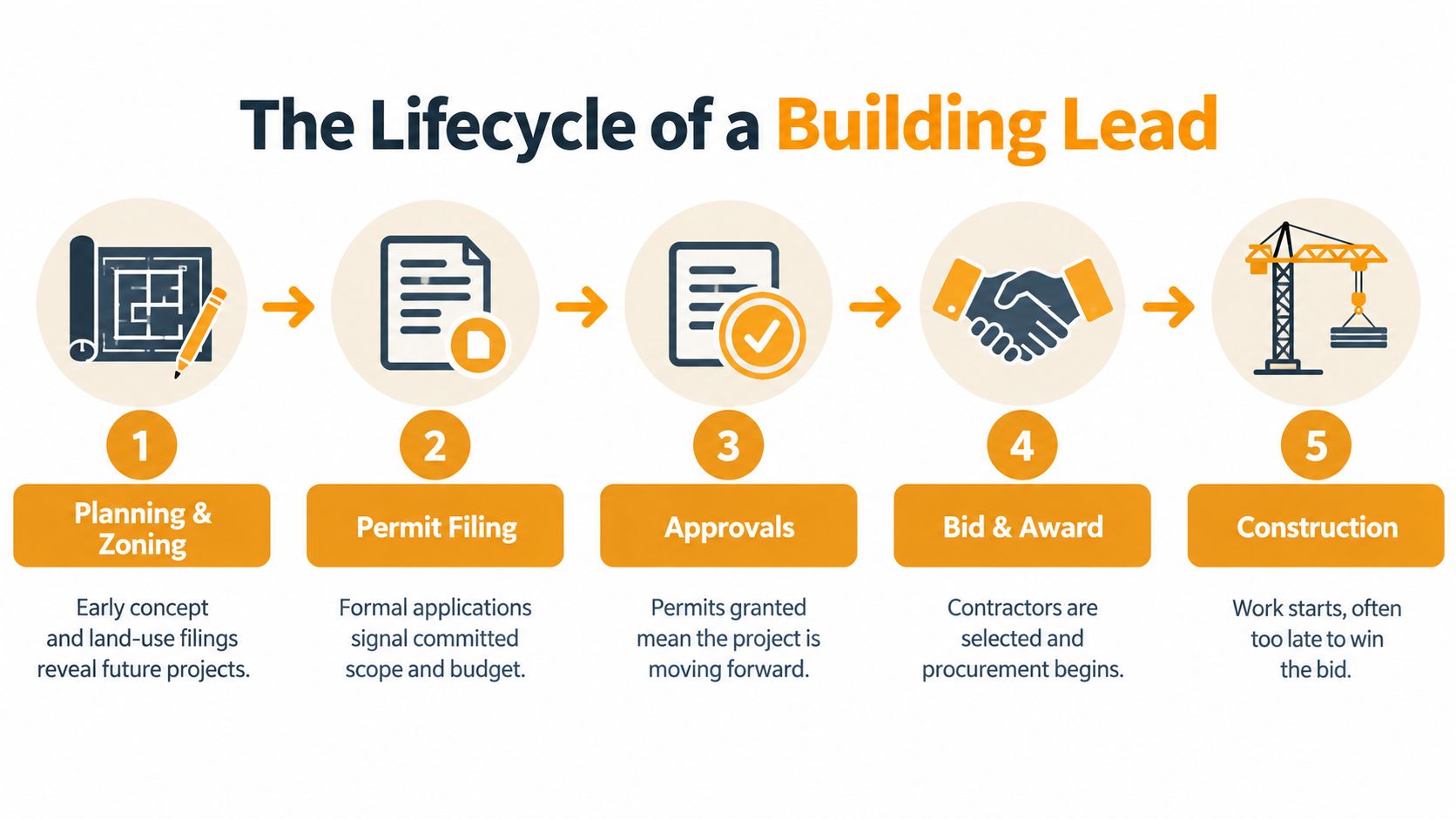
A project rarely appears as a ready-to-bid package. A land-use filing may be the first signal, followed by permit activity, plan review, approval, procurement, and construction. Each stage changes how much confidence a contractor can place in the lead and what action is justified.
Five stages to monitor
- Planning and zoning: Land-use filings, site concepts, acquisitions, and subdivision plat activity can show that a development is forming. These signals support research and relationship mapping, not immediate estimating.
- Permit filing: A formal application usually offers clearer evidence of intended scope, ownership, applicants, and location. It also helps determine whether the work fits the firm's trade and territory.
- Plan review and approvals: Departments may request revisions, pause reviews, or approve the application. Those status changes indicate whether outreach is early, timely, or already late.
- Bid and award: Procurement begins, contractors are shortlisted or selected, and the opportunity becomes visible to more competitors. A firm entering without earlier contact may face a smaller opening and less influence over the work.
- Construction: Field execution takes priority. Lead generation generally has less impact because major buying decisions may already be complete.
Projects do not follow these stages on a fixed schedule. A permit can stall, plan review can change the scope, and an owner can revise the project before award. A static lead list misses those shifts. The team needs current status from the relevant departments, along with a record of each meaningful change.
Reading timing without guessing
The record should determine the next outreach. An early plat may justify mapping the owner, design team, and general contractor, followed by a light introduction. A plan review may support a focused conversation about trade scope. An issued permit may justify direct contact with the applicant, owner, or likely general contractor.
Manual research makes that timing difficult. Departments often use different portals, terminology, and update schedules, so staff can spend hours checking records and reconciling changes. Public permit portals are often the quickest source for current information. Older or undigitized files may require in-person retrieval, adding days to the research cycle, as described in this guide to building permit data.
Each lead should carry a current stage, expected next signal, assigned owner, and review date. That structure turns a project lead into a usable construction signal. The firm can see whether the opportunity is developing, decide when contact makes sense, and protect estimating time from premature or stale pursuits.
Why Early Pipeline Visibility Matters
Reactive bid-chasing starts after much of the relationship-building window has closed. By the time a bid board publishes a package, the owner may know the architect, the developer may have preferred contractors, and the general contractor may already have a short list of trade partners. A late entrant can still win, but the firm is often competing on price and availability with little influence over the scope.
Early visibility changes the type of conversation a contractor can have. When a subdivision, plan review, or development record appears, the team can study the project, identify the owner and other participants, and decide whether a useful introduction is appropriate. The goal isn't to pressure someone into a bid before the project is ready. It's to become known before the procurement process reduces the relationship to a line item.

Early knowledge creates operating room
A specialty subcontractor with early project context can ask better questions. Is the scope aligned with its crews? Does the territory make sense? Is the project type consistent with past work? Does the team have capacity to support the expected schedule? Those questions are difficult to answer when an invitation arrives with limited notice.
The financial logic is straightforward. Every hour spent searching, downloading, cleaning, and checking irrelevant permit records is an hour that can't be spent estimating, contacting decision-makers, or supporting active jobs. If a firm cuts unproductive research, those saved hours become available capacity. In construction, capacity converts into money only when the team redirects it toward qualified opportunities, so process discipline matters as much as data access.
Early pipeline visibility doesn't guarantee an award. It gives the contractor more time to influence fit, scope, trust, and timing before price becomes the dominant comparison.
A proactive workflow also protects margins. The team can decline poor-fit work before it consumes estimating resources, identify projects that deserve deeper review, and avoid treating every public filing as an urgent pursuit. The result is a pipeline based on choices rather than fear of missing out.
The shift is from asking, “What bids are open today?” to asking, “Which projects are developing in our market, and where can we contribute before the bid is defined?” That question supports steadier business development and more deliberate estimating.
How Firms Qualify and Prioritize Opportunities
A permit filing alone doesn't tell you whether the job belongs in your pipeline. Qualification works best when the team applies the same filters every day, records why a lead passed or failed, and reserves human judgment for the opportunities that survive the first screen.
Start with fit, not volume
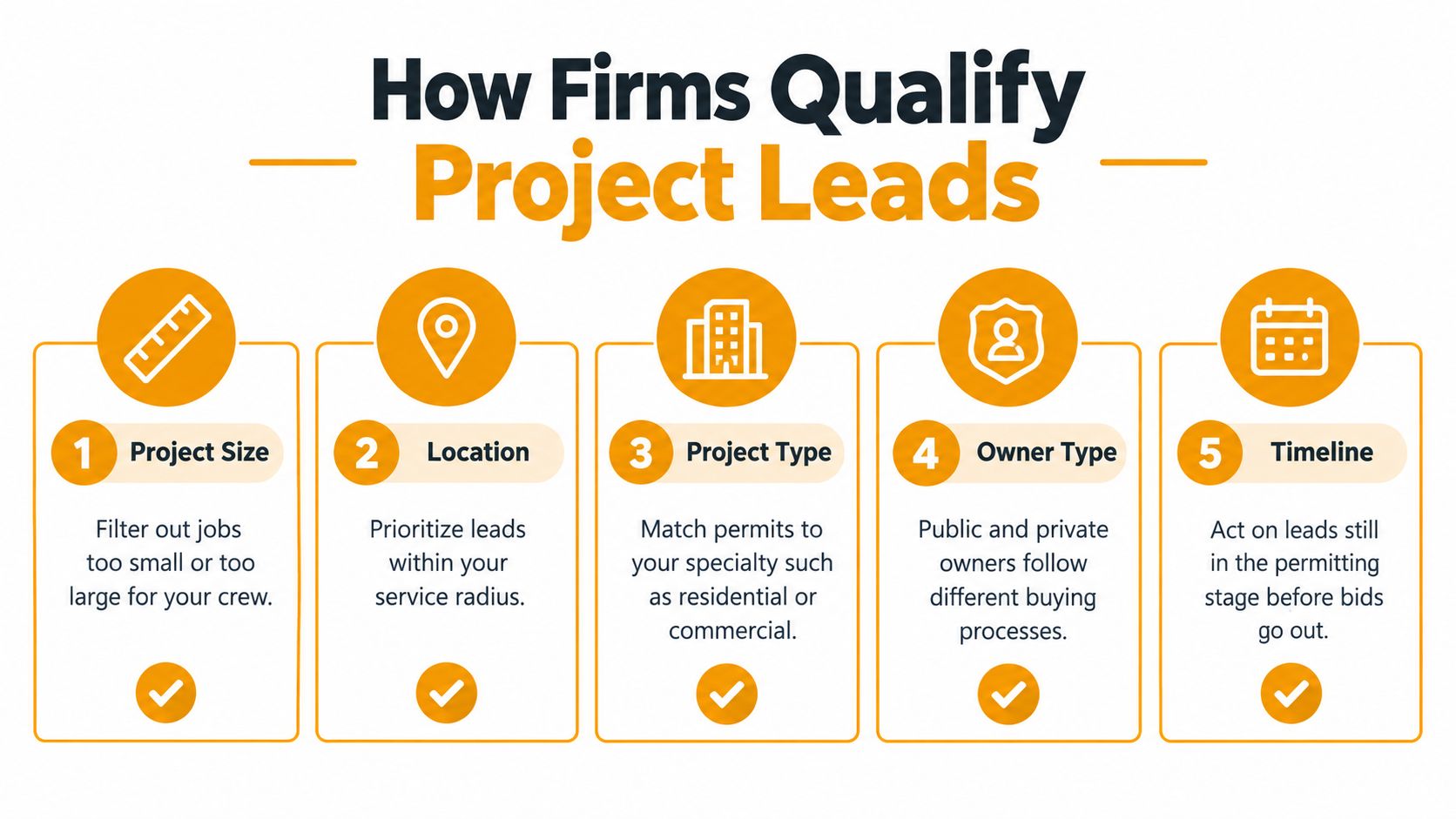
Use five filters to establish a practical score:
- Project size: Remove work that falls below the crew's economics or exceeds its delivery capacity.
- Location: Prioritize serviceable ZIP codes and territories, while accounting for travel, supervision, and local relationships.
- Project type: Match the record to the firm's specialty, whether that means residential, commercial, industrial, civil, or a focused trade.
- Owner type: Public and private owners follow different buying processes, documentation standards, and outreach paths.
- Timeline: Favor projects still moving through planning or permitting when early contact can influence the relationship.
These filters should work together. A large project may be attractive but still fail if it sits outside the service area. A nearby permit may be easy to reach but irrelevant to the firm's trade. A well-matched project may still be a poor pursuit if the application is dormant or the decision-maker can't be identified.
Let automation handle repetitive sorting
AI-driven scoring is useful when it evaluates multiple variables simultaneously instead of sorting one spreadsheet column at a time. A practical system can compare trade fit, ZIP code, valuation band, project stage, and contactability, then route the strongest matches to business development or estimating.
The model shouldn't replace judgment. It should remove repetitive screening so a preconstruction manager can review the evidence, correct bad assumptions, and make a pursuit decision with context. A transparent score is more valuable than an unexplained ranking because the team can see why an opportunity surfaced.
A strong lead qualification checklist should end with a clear disposition: pursue now, monitor, nurture, or reject. That discipline keeps the pipeline honest and prevents the same weak record from returning every time someone refreshes a list.
Replacing Manual Permit Hunting with AI Intelligence
A preconstruction manager can lose a morning checking city and county portals, downloading records, filtering project types, copying addresses into a spreadsheet, and finding ownership details. Repeat that work across jurisdictions, and the team spends valuable hours collecting signals before deciding whether an opportunity fits. Older or undigitized records may require in-person retrieval, adding more delay.
Public portals remain the fastest place to check current records, while older files often require manual retrieval that adds days to the cycle. Fragmented sources create recurring administrative work. A researcher may spend hours locating a record before anyone evaluates its trade fit, territory, stage, or likely value.
What an automated brief changes
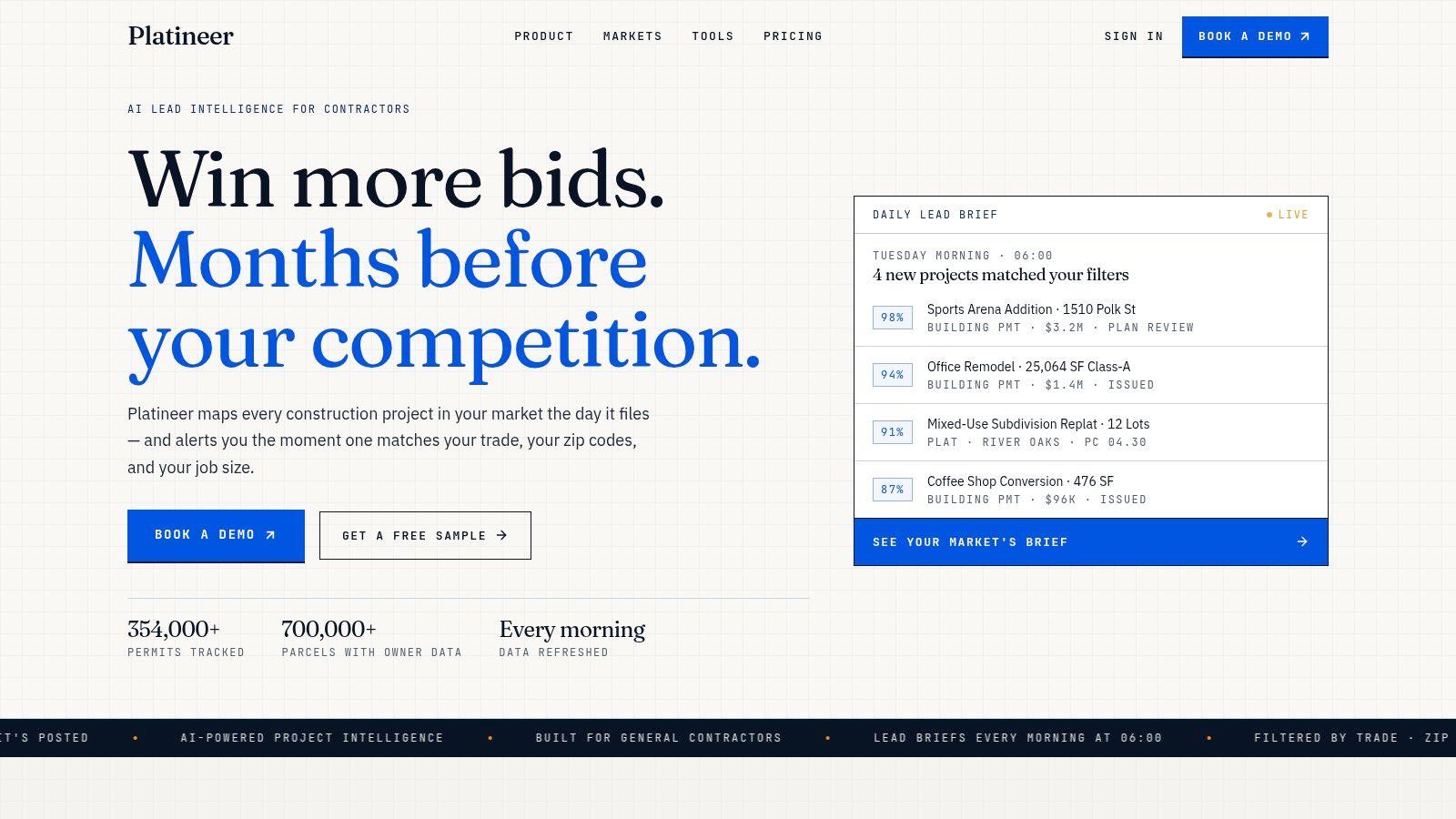
An intelligence workflow can combine permit, plan review, plat, and owner information, then apply the firm's filters before the workday begins. The result is a prioritized brief rather than an unranked export, with the project stage, location, relevant participants, and reason for the match visible in one place.
The team can review fewer, better-matched opportunities, verify the strongest records, assign outreach, and record the next action. Software handles recurring discovery and comparison. People still interpret the evidence, assess scope, build relationships, and decide whether pursuit makes sense.
One vendor workflow reports cutting permit research from 15 days per location to 15 minutes and completing 100 locations in 2 days total, as described in this permit due-diligence report example. Those figures are a vendor-reported example, not an industry benchmark. The practical lesson is narrower and more useful: reducing research time gives the team more capacity to qualify opportunities and act before competitors begin reactive bid-chasing.
A platform such as Platineer can aggregate construction signals, score them against trade and territory criteria, and show project contacts and pipeline status for matched opportunities. Firms still need to validate records and set sensible filters. Automation speeds up the process, including any weak assumptions built into it.
The practical test is direct: can the team identify the source signal, confirm the current stage, reach a relevant participant, and choose the next action without rebuilding the research? If so, permit tracking software has become part of business development, not merely a system for collecting records.
Building a Smarter Preconstruction Workflow
Finding a project lead is only the first handoff. The useful workflow connects discovery to qualification, contact research, outreach, estimating, and follow-up, with ownership clear at every step.
A disciplined process might look like this:
- Map the market: Capture early signals from plats, planning activity, permits, and reviews.
- Score the fit: Apply trade, territory, project-size, owner, and timeline criteria.
- Assign the pursuit: Give each qualified lead a responsible person and a specific next action.
- Track movement: Record status changes so outreach follows the project rather than guesswork.
- Accelerate response: Use tools such as Platineer's Render tool and Estimate tool when a qualified opportunity needs visual or preliminary pricing support.
The strategic shift is clear. Manual searching treats market intelligence as an isolated administrative task. An intelligence-led workflow treats it as the opening stage of preconstruction, where better timing improves decisions and saved research hours become usable selling and estimating capacity.
Start by defining your trade, territory, project-size boundaries, and preferred project stages. Then measure whether the team can act on qualified signals faster than it did with manual portal checks. If the answer is yes, you're no longer just collecting permits. You're building a pipeline around projects before reactive bid-chasing begins.
Platineer provides AI-powered construction project intelligence that aggregates permits, plan reviews, plats, and owner records, then scores opportunities against your trade, territory, and project criteria. Visit Platineer to see how a prioritized project brief, decision-maker context, and connected preconstruction tools can help your team spend less time hunting records and more time pursuing workable opportunities.


