
A construction change order can sit in review for nearly seven weeks, from the moment work is performed to the moment the change is authorized. Fresh contractor research also reports that only 1 in 3 contractors believe their change-order process works, while 96% of trade contractors experience poor or untimely processing and 91% of general contractors sometimes don't pay the full amount because of disputed pricing, incomplete documentation, or scope disagreements. (Business Wire research summary)
That makes a change order more than a form. It's a speed-to-cash problem. The crew has already installed the work, payroll has already run, equipment has already accumulated hours, and the project team is still waiting for someone to agree on scope, price, and time.
The practical objective is simple: identify the change early, build a defensible package, get the right reviewer involved, and carry the approved value into billing without losing fee to delay or negotiation.
Table of Contents
- Why Change Orders Decide Whether a Job Makes Money
- What a Construction Change Order Actually Is
- The Triggers That Drive Most Change Orders
- Pricing Approaches and How to Choose One
- The Approval Workflow From Field Finding to Payment
- Documentation That Holds Up to Audit and Dispute
- Reducing Cycle Time and Protecting Your Fee
- Putting the Process to Work on Your Next Project
Why Change Orders Decide Whether a Job Makes Money
Every general contractor recognizes the sequence. The superintendent flags a buried utility. The owner says, “Just handle it.” The crew keeps moving because stopping would create a larger operational problem, but the written approval doesn't arrive with the instruction. By the time the signed change order clears, the labor has been paid, the subcontractor has submitted its invoice, and the project team has spent weeks carrying a cost that isn't yet billable.
That lag attacks margin in several ways. Extended general conditions, supervision, temporary protection, equipment rental, financing cost, and administrative time continue while the contract value remains unresolved. If the owner negotiates the price after the work is complete, the contractor loses bargaining power and may accept a reduced amount just to close the item.
The scale of the project makes this harder, not easier. Research analyzing 892,457 change orders found that the average number per project rose from 1.7 on the smallest projects to 11.18 on the largest projects, showing how sharply change-order volume scales with project size. The same industry research reports typical cost overruns of 11% to 15% of original contract value and schedule overruns of 10% to 20% of original project duration in large building construction. (AIA Contracts construction change-order research note)
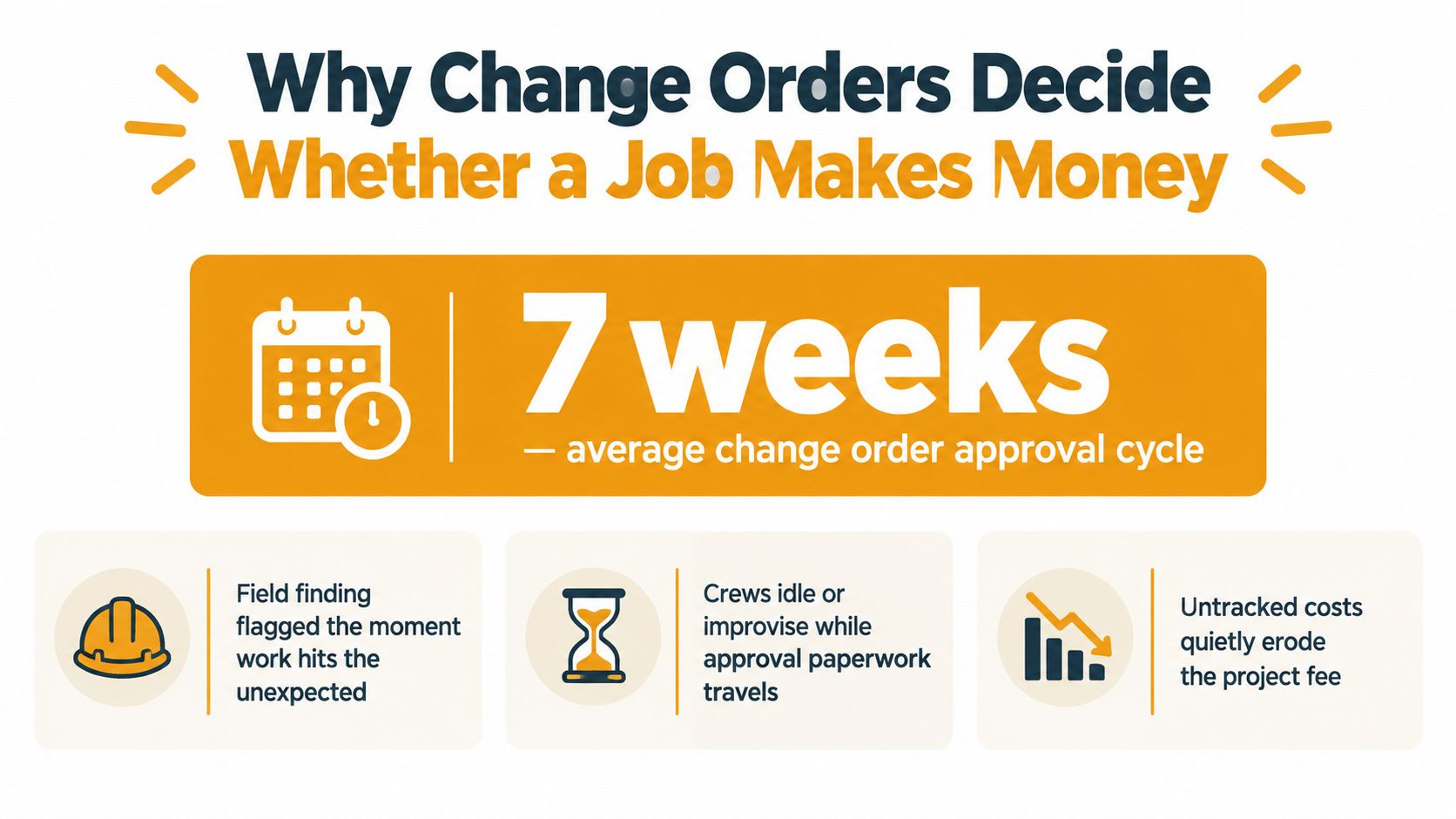
The cost of waiting
A contractor can price a change accurately and still lose money if the process is slow. A pending item often absorbs estimating time, project-management attention, and repeated review meetings before anyone confirms whether the value belongs in the next pay application.
Rework makes the exposure worse. In a study of 98 projects totaling $8.5 billion, average rework cost reached 0.39% of contract value, and the researchers found that rework measurably reduced contractor margin even when the percentage appeared small. Demolition, remobilization, disrupted sequencing, and duplicated supervision turn a modest change into a profitability problem. (Make-or-Break During Production study)
Practical rule: Treat every pending change order as uncollected revenue with a cost attached to the delay.
The rest of the process should be designed around that rule. Templates, signatures, and document control matter, but they only help after someone has captured the field event and moved a complete package to the person who can approve it. The faster that loop closes, the less time the contractor spends financing the job.
What a Construction Change Order Actually Is
Under the AIA A201 General Conditions, a construction change order is a written instrument signed by the owner, contractor, and architect. It states the agreed change in the work, the adjustment to the contract sum, and the adjustment to the contract time. The term appears 23 times in that document. (AIA explanation of change-order fundamentals)
Operationally, that means the document does three jobs:
- It defines what changes, including the affected drawings, specifications, quantities, and installation requirements.
- It defines what the change costs, including additions, credits, allowances, labor, materials, equipment, overhead, and profit as permitted by the contract.
- It defines what happens to time, including milestone effects, sequence changes, and the revised completion position.
The Volpe Center adds an important practical perspective. A change order is a contractual tool for legally modifying scope, schedule, and budget without restarting the bidding process. That makes it a speed mechanism as well as a control document. (Volpe Center report on construction change orders)
Don't confuse the document types
A potential change order or preliminary change notice identifies an issue that may affect the contract. It creates visibility, but it doesn't establish final entitlement or price.
A field order is an instruction used to direct or coordinate work in the field. Depending on the contract, it may authorize limited action, but it doesn't automatically resolve the commercial terms.
A change directive instructs the contractor to proceed when the parties haven't agreed on price or time. It can keep critical work moving, but it leaves the contractor exposed if the records aren't precise and the later negotiation becomes contentious.
A signed change order is the completed agreement. It should replace uncertainty with an authorized scope, price, and schedule adjustment.
| Document Type | Purpose | Pricing Status | Signature Required | Schedule Impact |
|---|---|---|---|---|
| Potential change order | Flag a possible change and start evaluation | Preliminary or undetermined | Usually not final authorization | Identified or estimated |
| Field order | Direct or coordinate field action | May remain open | Depends on contract authority | May be immediate |
| Change directive | Require work before commercial agreement | To be determined or negotiated later | Authorized by designated parties | Often immediate |
| Signed change order | Amend the contract | Agreed or contractually determined | Required from the parties named in the contract | Agreed adjustment |
The classification matters because teams often use a casual field instruction as if it were a signed commercial agreement. That shortcut may keep the crew productive today, but it can create a payment dispute later.
The Triggers That Drive Most Change Orders
Change orders are a speed-to-cash problem before they become a paperwork problem. The trigger determines how quickly the contractor can price the work, defend entitlement, and get paid. A highway-project study found average change-order growth of 7.0% and reported that cost and schedule growth increased significantly once change-order growth exceeded 5%. It also found positive correlations between change-order volume and cost growth, schedule growth, and construction intensity. (ASCE study of highway project change orders)
That matters because an average approval cycle of seven weeks leaves labor, equipment, and supplier commitments funded by the contractor. Disputed pricing extends the delay and can turn an approved scope change into margin erosion. The fastest teams identify the trigger in the field, attach evidence immediately, and use project intelligence to connect the event to scope, cost, and schedule impacts before the request sits in an inbox.
Owner and designer changes
Owner-driven additions are usually visible because someone requests them directly. The commercial risk begins when the request stays in meeting notes or messages instead of becoming a priced change. A revised room layout, upgraded finish, added access-control point, or altered equipment package can affect procurement, coordination, and sequence beyond the visible material difference.
Designer-driven changes include design development, errors, omissions, and coordination corrections. Demolition and rework often cost more than replacement materials because they consume completed work and disrupt the planned sequence. In a school-building renovation study, change orders increased project cost by an average of 3.56% of total contract cost, and about 40% of projects experienced schedule overruns due to change orders. The study also found unforeseen-condition and design-related changes were more costly than owner-initiated changes. (ASCE school renovation studyLA.1943-4170.0000271))
Field conditions
Concealed utilities, unsuitable soil, rock, groundwater, undocumented structural conditions, and restricted access carry substantial uncertainty. Before the condition is covered, the field team should photograph it, mark its location, record affected work, and notify the contract administrator. Those records shorten the entitlement discussion and support a defensible price.
Public-works research found change-order cost ratios typically ranging from 10% to 17% of total project cost. A Tennessee government audit also identified $7.4 million in quantity overruns, representing 94% of the increase in the cost of sampled change-order items. (Public-works change-order research)
Escalation and acceleration
Material escalation, substitutions, restricted availability, and owner-directed acceleration require a clear baseline. Show the original assumption, the event that changed it, the affected purchase or activity, and the mitigation considered. A dated quote, procurement record, delivery notice, and applicable contract clause carry more weight than a general statement that materials increased.
The practical cost ranking is usually more useful than a table of unsupported percentages. On the school renovation sample, unforeseen-condition and design-related changes cost more per event than owner-initiated additions, so those categories deserve the largest contingency and fastest evidence capture. Escalation and acceleration remain event-specific because their cost depends on procurement timing, contract rights, and the required resequencing.
Use the project's own change log to rank frequency, cost, and approval delay. The most common trigger may not be the most expensive, and the largest claim may not be the one that slows payment longest. Teams that classify each event early can route it to the right reviewer, assemble supporting records while facts are fresh, and reduce the time between field discovery and cash collection.
Pricing Approaches and How to Choose One
The pricing method should match how much of the work is known. Contractors get into trouble when they force uncertain work into a fixed price, or use open-ended time and material for a scope the owner expects to be predictable.
A lump sum works when the drawings, quantities, means, and sequence are sufficiently defined. It gives the owner price certainty and gives the contractor a clean billing basis, but the contractor owns the risk of missed scope unless exclusions and assumptions are explicit.
A unit price fits repetitive work where the rate is reliable but the final quantity may move. Trenching, backfill, concrete replacement, and similar work can be measured as installed units. The change order should state how measurement occurs and who verifies it.
Cost-plus is more defensible when the condition cannot be scoped before opening the work. It requires strong cost records and clear rules for allowable expenses, supervision, equipment, and fee.
Time and material is the practical choice for emergency response, investigation, and work that must begin before the full extent is known. The daily log becomes the commercial backbone. Without signed tickets or equivalent confirmation, the contractor may later struggle to prove what was performed.
| Pricing Method | Best Used When | Typical Markup Treatment | Documentation Burden | Dispute Risk |
|---|---|---|---|---|
| Lump sum | Scope and quantities are defined | Contract-specific agreed amount | Takeoff, assumptions, exclusions, and schedule basis | High if scope gaps remain |
| Unit price | Work type is known but quantity can change | Agreed rate per measured unit | Quantity records and verification | Moderate if measurement rules are unclear |
| Cost-plus | Conditions and final scope are uncertain | Contract-defined fee on allowable cost | Detailed cost and backup records | Moderate to high if cost categories are vague |
| Time and material | Immediate or investigative work is required | Agreed labor, equipment, material, and fee rates | Daily tickets, logs, invoices, and approvals | High if tickets aren't signed promptly |
Before pricing, confirm how estimating assumptions become billable cost. A useful primer on the underlying estimating discipline is construction estimating costs, especially for separating direct work from supervision, equipment, and fee.
Don't quote a fixed amount just because the owner wants certainty. If the lump sum is still under negotiation and the work can't wait, issue a written directive or T&M authorization with a daily reporting requirement. That keeps the field moving while preserving a record of actual cost.
The Approval Workflow From Field Finding to Payment
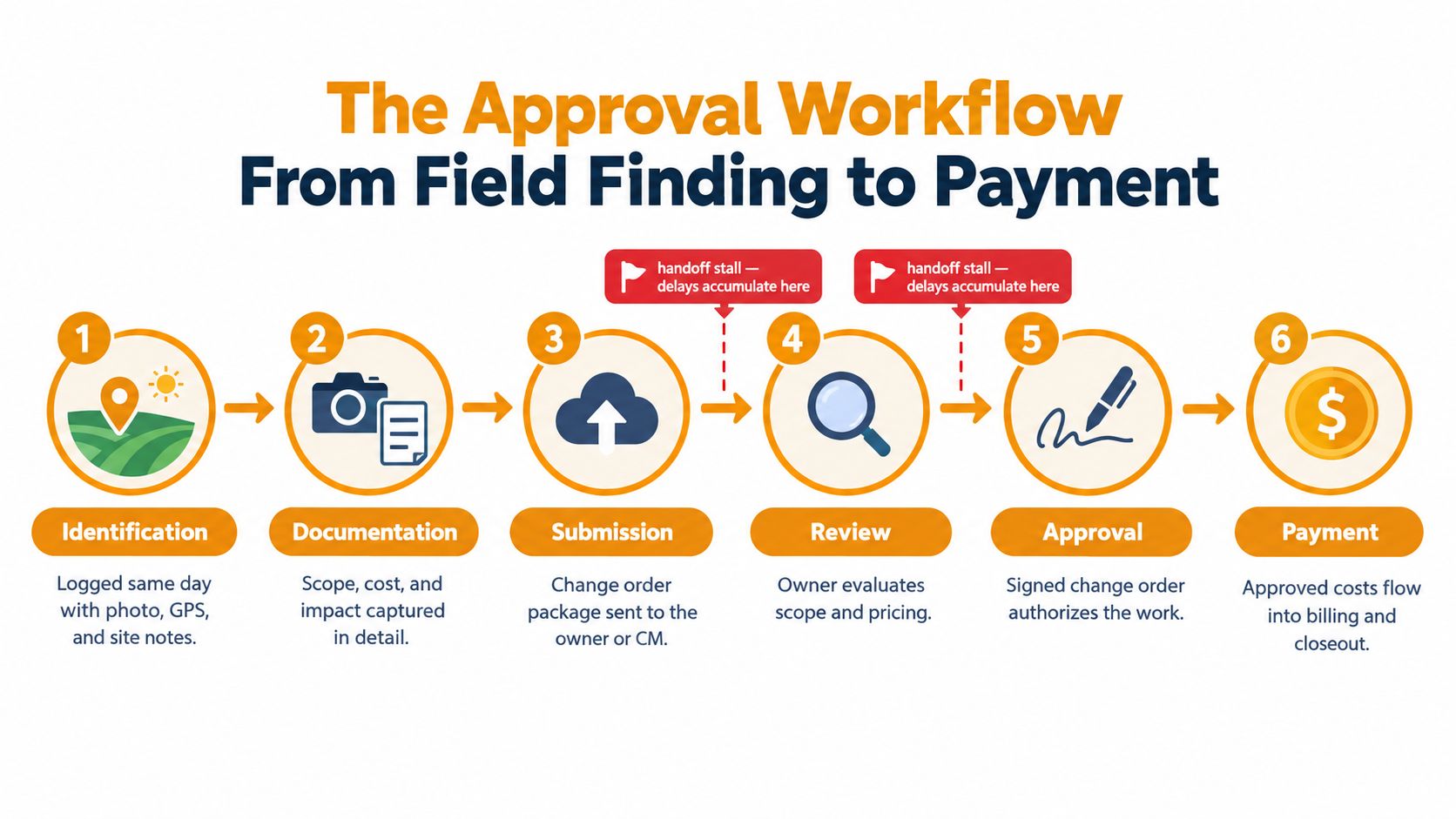
A reliable construction change order workflow has six steps. The delays usually happen at the handoffs, especially when the field record, estimate, and approval request live in separate systems.
Six steps that keep the record intact
1. Identify the condition. Log the issue the same day. Include the location, affected activity, people involved, photographs, and a sketch or other field reference. A Friday email dump is late, incomplete, and difficult for an estimator to price.
2. Build the internal price. The project manager and estimator should connect the field condition to drawings, specifications, labor, material, equipment, subcontractor input, and schedule effect. If a figure is provisional, label the assumption instead of hiding uncertainty inside a lump sum.
3. Submit a complete package. Send a cover sheet that references the original contract documents and identifies the requested decision. Include the scope narrative, cost breakdown, schedule effect, photographs, RFI, quotations, and any proposed credit.
4. Manage review and negotiation. Packages often circulate among the owner, architect, construction manager, legal team, and finance reviewer. A reviewer who can't understand the change without opening multiple folders will return questions, and every question adds elapsed time.
5. Obtain written authorization. The signed change order establishes the agreed commercial position. Contract language commonly requires written authorization before changed work begins, so the team should follow that rule unless an authorized directive provides another route.
6. Carry the value into billing. Update the schedule of values, budget, forecast, and completion date. Then make sure the first progress billing includes the approved value and that the supporting record matches the invoice.
A written field directive can be the practical workaround when waiting for a fully negotiated change order would create safety, access, or schedule risk. It isn't a substitute for closing the commercial loop. The directive should state the work to proceed, the pricing method, the records required, and the person authorized to issue it.
For teams improving visibility across those handoffs, project status tracking provides useful workflow context. The principle is more important than the software: one owner, one status, one next action, and one date for every pending change.
The six-step flow is also available in this short walkthrough:
Documentation That Holds Up to Audit and Dispute
A contractor discovers unforeseen rock while excavating a utility trench. The owner refuses the change for 14 days, arguing that the condition should have been anticipated. The contractor's position is ultimately stronger because the record shows the discovery, the location, the response, the actual resources used, and the written instruction to proceed.
The useful lesson isn't that a good file guarantees payment. It does not. The lesson is that contemporaneous records give the reviewer or arbitrator a sequence they can test, while a reconstructed summary asks them to trust a conclusion formed later.
The six records that matter
- Daily field log: Record the date, time, location, activity, crew, equipment, conditions, instructions, and any effect on planned work. Weather conditions matter when they affect access, production, or site conditions.
- Photograph set: Take images with a measurement reference, identifiable location, and enough surrounding context to establish what was exposed and when.
- RFI and design response: Link the RFI that raised the issue to the designer's clarification, revised detail, or instruction. Don't file the response separately from the potential change.
- Cost breakdown: Separate labor hours, equipment hours, material invoices, subcontractor quotations, and applicable fee. A single unexplained total gives the reviewer little to validate.
- Written field directive: If work begins before final pricing, preserve the directive that authorized the action and identifies the required reporting method.
- Signed change order: Close the loop with the executed document, revised scope, contract sum, contract time, and billing treatment.
A photograph proves a condition. A photograph tied to a dated log, RFI, instruction, and cost code proves the chain of events.
Keep records for at least the applicable statute-of-limitations period, plus the project warranty window and any longer period required by the contract, funding source, or law. The exact retention period depends on the jurisdiction and agreement, so the project team should confirm it during contract review rather than choose a universal number.
A project-intelligence workflow helps when it attaches photos, RFIs, drawing revisions, correspondence, and cost codes to the same change record. That doesn't replace judgment. It removes the document hunt that causes reviewers to miss the connection between the field event and the amount requested.
Reducing Cycle Time and Protecting Your Fee
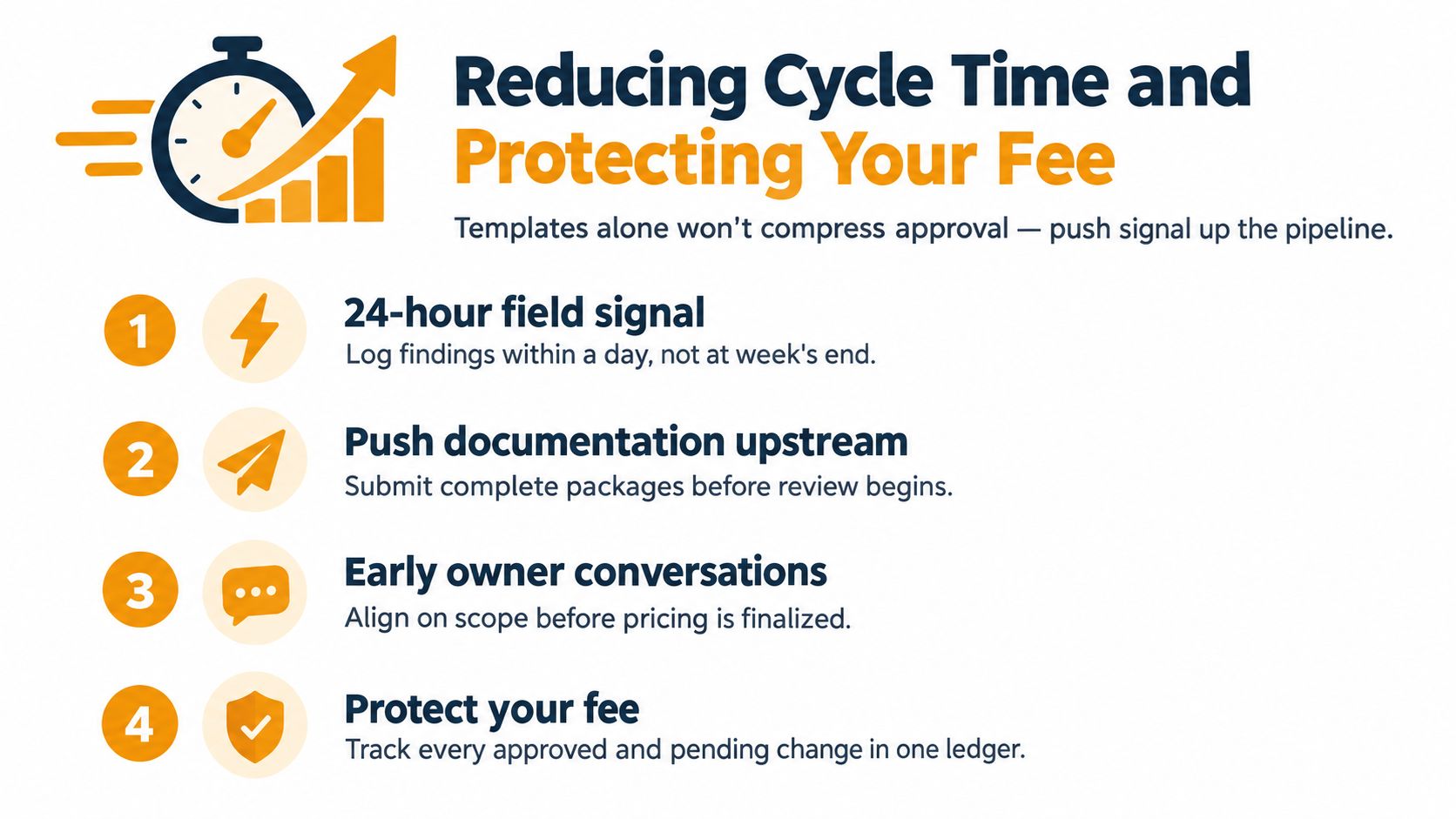
Better templates won't solve a late signal. A polished change-order form still arrives too late if the superintendent waits until the weekly meeting, the estimator prices from memory, or the reviewer receives a cost number without the underlying field evidence.
Start at the front of the pipeline. Require field findings to reach the project manager and estimator within a defined daily window. Use contract language that identifies escalation triggers, notice requirements, supporting records, and the reviewer responsible for resolving a pricing question. When the clause and routing path are clear, the team spends less time debating where the issue belongs.
Replace the month-end change log with an aging tracker that shows:
- Age: How long the item has been open and when the next response is due.
- Value: What was submitted, what has been quoted, what has been approved, and what remains disputed.
- Evidence: Whether the item has its photographs, RFI, drawings, tickets, and cost codes.
- Exposure: Whether work is proceeding under a signed change order, field directive, or unresolved instruction.
AI-assisted project intelligence can compare submitted and quoted values, flag aging items, identify related RFIs and drawing revisions, and surface scope creep before it reaches the pay application. The value isn't a generic promise of automation. It's giving the reviewer one view of the story instead of asking that person to reconcile email, field software, spreadsheets, and PDF folders.
A highway study found cost and schedule growth increased significantly after change-order growth passed 5%, while large-building research reports schedule overruns of 10% to 20% of original project duration. (AIA industry research on change-order effects) Those figures explain why cycle time deserves management attention, but a contractor shouldn't claim a specific savings amount without measuring its own carrying cost and fee recovery.
Construction workflow automation can support this operating model, but culture still decides whether it works. Teams that discuss pending changes every day, assign the next action, and connect approval to billing protect the fee more reliably than teams that stack PDFs for month-end review.
Putting the Process to Work on Your Next Project
The next Monday-morning action isn't to create another template. It's to make the existing contract, field record, pricing file, and billing process agree with one another.
Start with the contract
Before mobilization, confirm the definition of a change, notice requirements, approval authority, pricing methods, escalation provisions, markup limits, and schedule-impact procedure. Make sure the superintendent, project manager, estimator, and subcontractors know which instructions require written authorization.
A clear clause won't eliminate changes, but it can prevent an argument about whether the contractor gave notice or used the permitted pricing method. It also gives the team a route for urgent work when a full agreement can't be prepared immediately.
Make the field record same-day work
Give the superintendent a short capture routine:
- Record the condition, location, activity, and instruction.
- Take photographs with a measurement reference.
- Identify the affected drawing, specification, RFI, or permit.
- Note whether the crew stopped, resequenced, or continued under direction.
- Send the record to the project manager and estimator before the next production cycle.
The point is not administrative perfection. It is preserving facts while people, equipment, and conditions are still visible.
Submit one decision-ready package
The reviewer should be able to answer four questions without searching:
- What changed?
- Why did it change?
- What does it cost, and how was that amount calculated?
- What happens to the schedule if the owner approves or rejects it?
Bundle the backup behind a concise request. Separate known costs from allowances and assumptions. State credits as clearly as additions. If the work is already proceeding under a directive, identify the authorization and the reporting basis.
Track approval through payment
Assign one owner to each pending item. Review aging changes in the weekly owner meeting, record the next response date, and escalate stalled handoffs before the item reaches the pay-application deadline. Once signed, update the schedule of values, forecast, schedule, and billing file immediately.
The financial test is straightforward. Every day between field performance and authorization creates exposure. Every approved change that misses the next billing cycle delays recovery. The process earns its keep when it turns field evidence into an approved contract value without allowing the fee to disappear during review.
A connected project-intelligence system can place change orders, RFIs, submittals, drawing revisions, and schedule float on one timeline. That gives the contractor a practical way to see not only what is pending, but also which unresolved decision is threatening production or cash.
Platineer gives construction teams AI-powered project intelligence for finding and prioritizing relevant opportunities, while its workflow tools help organize the project signals that support faster decisions. Visit Platineer to see how a connected workflow can help your team keep change orders, documentation, and commercial follow-through moving.