The best construction lead may appear before a bid ever exists. Permits, plan reviews, plats, developer records, public solicitations, bid networks, and homeowner inquiries describe different moments in a project's buying cycle. A permit can signal active work. A plan review can indicate that approvals are moving. A plat may reveal a subdivision or larger development long before contractors see a bid invitation.
That timing matters because lead generation has a labor cost. Someone has to download records, remove duplicates, identify the trade fit, find the decision-maker, check the project stage, and decide whether the opportunity deserves a call. Estimator and business-development hours spent sorting weak records are hours unavailable for pricing, outreach, and winning work. Digital takeoff research illustrates the same principle, with a typical project taking about 25 hours to measure manually compared with about 8 hours digitally, according to The Contractor Matrix. Time savings is money savings when freed capacity creates room for more bids and faster follow-up.
Platineer addresses that gap by turning supported permits, plan reviews, plats, and owner records into a prioritized morning brief. The list below ranks construction lead sources by when they reveal opportunity, manual effort, decision-maker access, geography, project value, cost, and follow-up work. It separates early project intelligence from bid-stage networks and consumer demand, so you can choose a source that matches your actual sales cycle.
Table of Contents
- 1. Platineer
- 2. Dodge Construction Network
- 3. ConstructConnect
- 4. Autodesk BuildingConnected
- 5. PlanHub
- 6. The Blue Book Network
- 7. Deltek GovWin IQ
- 8. SAM.gov
- 9. Angi Leads
- 10. Houzz Pro
- Top 10 Construction Lead Sources Comparison
- Build a Lead Mix That Matches Your Sales Cycle
1. Platineer
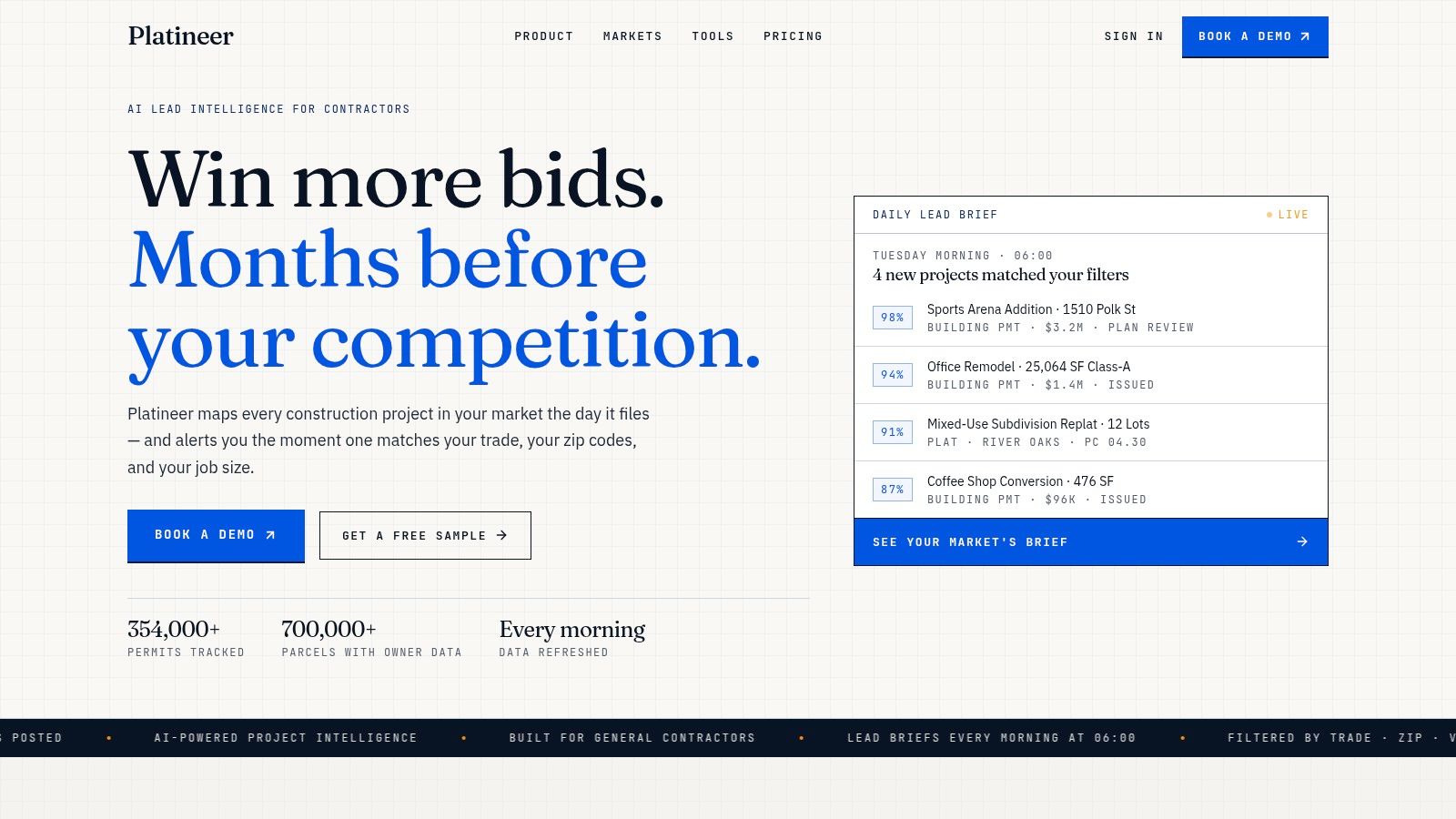
Platineer is the strongest choice for contractors who want to find projects before the opportunity becomes a crowded bid posting. The AI-driven platform maps permits, plan reviews, plats, and owner records, then scores opportunities by trade fit, ZIP code, valuation, and decision-maker reachability. It's built for general contractors, specialty subcontractors, estimators, and business-development teams that need a repeatable pipeline rather than another database to search.
The practical difference is timing. Platineer can surface early-pipeline activity from plats and planning moves months, often 6 to 18 months, before permit bursts. That gives a trade contractor time to identify the owner, applicant, associated firms, developer, engineer, or likely GC, then build a relationship before the bid-stage rush. Its pipeline view follows project status across plan review, issuance, and other points, helping teams decide whether to introduce themselves now, monitor the job, or prepare for a later bid.
Why it reduces lead research
The platform pre-indexes supported markets on day one, continuously rescans them, and delivers a concise 06:00 AI-scored morning brief. Matching isn't limited to a permit type. Platineer evaluates multiple factors, including:
- Trade fit: Route opportunities to the scopes your company performs.
- Geography: Focus outreach on selected ZIP codes and service territories.
- Valuation: Remove projects outside your preferred job-size bands.
- Contactability: Prioritize records with useful owner, applicant, or firm information.
- Project status: Align outreach with planning, review, issuance, and bid timing.
The system advertises 354,000+ permits tracked and 700,000+ parcels with owner data on its website, while sample briefs display confidence scores such as 94%, 91%, and 87% alongside associated valuations. These figures are product-facing claims, so confirm current coverage and fit during onboarding. Platineer is live in Houston, Austin, and Dallas–Fort Worth, with additional metros being onboarded. Pricing isn't publicly listed, and access requires a demo or request.
Practical rule: A raw address is not a lead until you know the project stage, relevant trade, and person worth contacting.
Platineer's add-on Render tool helps trades visualize a job quickly, and its Estimate tool supports faster pricing workflows. The main limitation is coverage. Firms outside the current and onboarding metros should confirm availability before changing their process.
2. Dodge Construction Network
Dodge Construction Network is a strong commercial source when your team needs visibility from early planning through bidding and construction start. It offers more than a plan room. The platform combines project tracking, alerts, dashboards, mobile access, and subcontractor-facing tools that help firms get noticed by GCs and appear on bidders lists earlier in the process.
Its value depends on how much pre-bid work your team can perform. A subcontractor that waits for a formal invitation will use only part of the platform's advantage. The better workflow is to monitor planning-stage projects, confirm scope and location, identify the likely GC or owner, and send a qualifications-focused introduction before bid documents dominate the conversation.
For commercial trades, that earlier contact can matter more than raw project volume. Dodge's coverage is designed around project intelligence, so it can support territory planning and account targeting as well as immediate pursuit. The Blue Book and Sweets relationships within the broader ecosystem can also help teams move from project discovery toward company and product research.
Where Dodge earns its place
- Early visibility: Useful before a project reaches a conventional plan-room cycle.
- Commercial depth: Better suited to institutional, commercial, and larger private work than homeowner inquiries.
- Subcontractor discovery: Helps subs present qualifications and connect with active GCs.
- Workflow monitoring: Alerts and dashboards reduce the need to check every project manually.
The trade-off is cost and complexity. Pricing is quote-based and isn't publicly listed. Value can vary by trade and geography, so a firm should test whether the local project flow justifies the subscription and whether its team will act on early signals.
For a narrower comparison of workflow, coverage, and positioning, see this Dodge Construction Network alternative for contractors. Dodge is powerful when a company has dedicated business development and estimating capacity. It's less attractive when nobody owns qualification and follow-up.
3. ConstructConnect
ConstructConnect fits contractors that want project research, bid coordination, and estimating tools connected in one vendor ecosystem. Its intelligence products provide planning-phase visibility, while iSqFt supports invitations to bid and communication with subcontractors and suppliers. PlanSwift, On-Screen Takeoff, Quick Bid, and Auto Takeoff extend the workflow into quantity takeoff and pricing.
That breadth reduces re-entry between opportunity research and estimating. It does not remove the qualification work. Teams still need to decide whether a project matches their trade, territory, building type, schedule, and likely buyer before an estimator spends time on documents.
A useful workflow starts with saved searches organized around those filters and the project stage. A business development manager or estimator can reject poor-fit records early, assign viable opportunities, review available plans, and move qualified work into takeoff. The payoff depends on preserving the chain from lead to scope to estimate, with clear ownership at each handoff.
ConstructConnect is strongest for commercial general contractors, specialty contractors, and suppliers pursuing structured preconstruction work. Its established iSqFt network can help firms already receiving or sending bid invitations, while the estimating products may reduce the need to move files between separate systems.
The trade-offs are practical:
- Coverage versus focus: A broad commercial database can surface useful projects, but weak filters create noise.
- Workflow versus cost: Core intelligence pricing is quote-based and not publicly listed, so the subscription needs to earn its place through active use.
- Discovery versus decision-maker access: It can identify projects and bid activity, yet early owner records, plats, and plan reviews may reveal opportunity before a conventional bid process begins.
- Integration versus simplicity: The connected product set helps larger estimating operations, while a small firm seeking local intelligence and direct owner contacts may find it more than it needs.
ConstructConnect therefore ranks well for bid-stage coordination and production workflow, but less strongly for the earliest possible signal. Platineer can complement that process by consolidating and prioritizing earlier public-record and planning indicators before teams commit research and estimating time. For a focused comparison of commercial intelligence tools, see BuildZoom versus Dodge versus ConstructConnect for GCs.
4. Autodesk BuildingConnected
Autodesk BuildingConnected is primarily a bid-management and subcontractor-qualification platform, not a public database of every early construction opportunity. Its strength begins when a GC is distributing invitations or a subcontractor is receiving ITBs and needs one place to organize deadlines, documents, and responses.
Subcontractors use Bid Board Pro to centralize invitations and prioritize active bids. GCs use BuildingConnected Pro to send organized invitations, compare responses, and manage the bidding process. TradeTapp adds qualification and risk assessment, which makes the system particularly relevant to GCs that need to evaluate subcontractor capacity, experience, and risk before award.
The network effect is the main reason firms adopt it. Mid-to-large GCs commonly use the platform, so a subcontractor with a complete profile and credible qualifications may become easier to find when bid invitations are assembled. Autodesk's wider preconstruction ecosystem and AI features can support firms already invested in Autodesk products.
Bid management helps you respond to known opportunities. It doesn't replace the work of finding projects before the invitation list is set.
That distinction determines where BuildingConnected ranks. It's excellent for document exchange, invite organization, bid comparison, and GC-to-sub workflows. It's weaker as a standalone early-warning system for plats, owner records, or planning activity. Pricing is quote-based and not publicly listed, and bundles may exceed what a smaller contractor needs.
Use it when your company already receives meaningful ITB volume or wants to become easier for established GCs to qualify and invite. Pair it with an earlier intelligence source if your sales strategy depends on influencing the project before bid distribution.
5. PlanHub
PlanHub belongs in the bid-stage portion of a contractor's lead mix. It functions as a cloud planroom and collaboration network where GCs post projects and subcontractors search commercial opportunities through Project Finder, Bid Board, and Job Board.
For a GC expanding distribution, the low entry barrier can speed up outreach beyond an established contact list. Free GC tools include unlimited project posting and basic bid leveling. Paid options add analytics, private planrooms, and broader lead discovery. Ongoing communication between GCs and subcontractors can also support relationship building, although the platform does not replace direct follow-up.
A practical PlanHub workflow is short and deliberate. Set trade and geographic filters, review plans as soon as an alert arrives, eliminate scopes outside your capacity, then send a concise qualification package. The opportunity is already visible, so the work shifts from finding early project signals to deciding whether the bid deserves estimating time.
- GCs: Post quickly, reach more subcontractors, and coordinate bids.
- Subcontractors: Keep project discovery and bid tracking in one queue.
- Growing networks: Find firms outside existing contacts.
- Disciplined teams: Reduce noise by filtering alerts aggressively.
PlanHub does not provide the same early intelligence as plats, plan reviews, or owner records, where a contractor may identify a project before plans circulate widely. It also does not independently confirm that every notification is worth pursuing. Check the project stage, scope, location, and decision-maker before assigning estimating or sales resources.
Sub pricing details are not fully public, and results vary by market. Email volume can become a problem when GCs use the platform mainly for broad distribution. Treat each alert as an unqualified lead until someone verifies its fit and timing.
PlanHub is a reasonable bid-stage layer, particularly for teams that need organized access to active commercial opportunities. Pair it with an earlier project-intelligence source, or with a system such as Platineer that consolidates and prioritizes pre-bid signals, when reaching owners or developers before invitation lists are set is part of the sales plan.
6. The Blue Book Network
The Blue Book Network combines a commercial construction directory with BB-Bid, a project-communication system used by owners and GCs to distribute ITBs and documents. Its directory structure is the differentiator. Contractors can search by trade and company type, while GCs can build targeted distribution lists instead of relying entirely on an existing contact book.
BB-Bid's core project messaging and ITB distribution are available to GCs and owners without the same barrier as a fully paid intelligence platform. BB-Gateway adds integrated messaging and outreach reporting, which helps teams see whether their distribution process is reaching the intended subcontractor audience.
For a specialty contractor, the platform's value depends on profile quality and market density. A complete listing with service categories, territory, qualifications, and project experience gives GCs a better reason to include the company. A thin profile turns the directory into a passive listing that may never influence an invitation.
Best use by role
- GCs and owners: Build and manage bid distribution lists, then send documents through a familiar network.
- Subcontractors: Maintain an accurate company presence and monitor relevant bid communications.
- Business development teams: Use categorized company records to identify potential partners and accounts.
- Vendors: Locate trade-specific firms and support relationships around active projects.
The core messaging option broadens reach quickly, but paid exposure and marketing tiers are not publicly priced. Anecdotal feedback on paid-tier return is mixed by market, so don't buy visibility without tracking conversations, invitations, and awarded work back to the source.
The Blue Book is strongest for commercial relationship development and bid distribution. It offers less help with the earliest planning signals than a platform built around plats, plan reviews, and owner records. Use it to improve contact coverage and document exchange, not as a substitute for project-stage intelligence.
7. Deltek GovWin IQ
Deltek GovWin IQ fits contractors that need project intelligence before a public solicitation appears. It covers federal, state, local, and education opportunities, with analyst-sourced information on agency plans, budgets, pre-RFP activity, contract history, competitors, and likely procurement conditions.
That timing separates GovWin IQ from live-bid portals. A public-sector contractor can identify an agency preparing work, assess the likely procurement path, see potential competitors, and decide when to begin teaming or capture planning. The trade-off is effort. Early information only creates value after someone verifies it and turns it into outreach, account planning, and qualification work.
Where the platform earns its cost
Assign an owner to each target agency or program. That person needs to confirm the signal, identify decision-makers and partners, check contract vehicles, monitor timeline changes, and prepare the firm's qualifications. Without that workflow, the subscription produces research rather than opportunities.
- Best fit: Federal and SLED construction firms with a dedicated capture process.
- Primary advantage: Pre-RFP visibility supported by analyst research.
- Useful context: Agency plans, budgets, pricing, competition, and contract history.
- Main constraint: Quote-based pricing can be substantial depending on seats and modules.
GovWin IQ includes AI-assisted tracking and integrations across Deltek's ecosystem. Those features can reduce monitoring time, but they do not replace judgment or coordination. Government pursuits still require eligibility checks, registration, teaming decisions, compliance review, and proposal preparation.
Use GovWin IQ when the goal is to influence or prepare for work before bid-stage activity becomes public. It ranks high for timing and context, but lower for simplicity and direct consumer demand. Contractors seeking occasional open solicitations may get a clearer starting point from SAM.gov. Contractors pursuing government work consistently can justify GovWin IQ when the team has the capacity to act on its signals.
8. SAM.gov
SAM.gov Contract Opportunities is the official federal portal for live contracting opportunities, including construction opportunities identified under NAICS 23. It's free to search and remains the authoritative source for federal solicitations and related prime and subcontracting discovery.
The portal gives contractors direct access to federal listings, agency filters, NAICS filters, solicitation documents, amendments, and deadlines. It doesn't add much interpretation. The contractor must read the notice, understand the requirement, confirm eligibility, identify the right contacts, monitor updates, and complete the necessary entity registration before submitting a bid.
Why free doesn't mean low effort
SAM.gov removes subscription cost, but it transfers research and capture work to your team. Search terms can miss relevant work, broad searches create noise, and an overlooked amendment can affect the entire pursuit. A disciplined public-sector workflow should include saved searches, a named reviewer, document storage, deadline controls, and a clear go or no-go decision.
Use the official record for verification. Use a capture process for interpretation.
SAM.gov is strongest when your target is a live federal opportunity and your firm already understands federal procurement. It's weaker as an early market-intelligence source because it generally becomes useful once an agency has published an opportunity or notice. GovWin IQ can provide earlier analyst context, while SAM.gov is the authoritative place to verify the actual solicitation.
The learning curve can challenge newcomers, but DoD guides and training materials support navigation. Contractors should treat this source as essential for federal bidding, not as a complete business-development system. Free access saves subscription money. It doesn't save the hours required to qualify and pursue the work.
9. Angi Leads
Angi Leads addresses a different demand pattern from Dodge, GovWin IQ, or SAM.gov. It connects residential service providers with homeowner inquiries by trade and territory, making it relevant to remodelers, repair contractors, and service trades that need immediate consumer demand rather than a project pipeline developing months ahead.
The platform delivers leads through a pro portal or app and may charge when a homeowner expresses interest. Budget controls can throttle lead volume and spending, while programs may use per-lead or per-appointment models. Those controls help a contractor avoid accepting more inquiries than the office or sales team can answer.
The trade-off is lead exclusivity and qualification. Shared-lead models can put several contractors in front of the same homeowner, and quality varies by trade and market. A contractor needs a fast response process, a clear service area, call tracking, and a way to record whether the inquiry became a site visit, estimate, or signed job.
When Angi fits
- Residential service work: Good for demand that starts with a homeowner rather than an owner, developer, or GC.
- Schedule filling: Useful when crews need nearer-term work.
- Budget-controlled acquisition: Helpful when the firm wants to limit lead flow.
- Sales-process testing: Appropriate for teams that can measure response and close outcomes.
Premium fees and special terms may apply to certain lead types, so review the terms before committing spend. Angi isn't designed to reveal a subdivision during planning or identify a commercial project before a permit. It's a consumer-demand channel, and its success depends on speed, reviews, call handling, and careful source-level ROI tracking.
For a broader discussion of residential and commercial acquisition paths, see how to get leads for construction.
10. Houzz Pro
Houzz Pro combines homeowner lead generation with CRM, proposals, scheduling, client communication, and takeoff support. It suits design-build firms, remodelers, custom builders, and other residential contractors whose portfolio influences the buying decision.
Houzz gives the contractor a chance to establish credibility before the first call. Project photos, service descriptions, before-and-after examples, and organized profile information help homeowners judge fit. That advantage requires ongoing work. A thin portfolio or unclear service area leaves the platform competing mainly on inquiry response and price.
The platform is most useful after consumer demand has surfaced. A homeowner is already searching, comparing firms, and looking for confidence that the contractor can deliver the intended result. Strong visuals can support that decision, especially for renovation and design-led work.
Houzz Pro also puts several follow-up tasks into one workflow:
- Lead handling: Capture and manage homeowner inquiries.
- Client communication: Keep conversations and project details organized.
- Proposals and scheduling: Move qualified prospects toward a defined next step.
- Takeoff support: Connect scope discussions with estimate preparation.
- Visual selling: Present completed work during the sales process.
The trade-off is timing and audience. Houzz Pro does not primarily identify a subdivision during planning, an owner before plan review, or a commercial project before bidding. It is not a substitute for public records, plan-review research, plats, or bid networks when the goal is early project intelligence or commercial ITBs.
Pricing is quote-based by region and trade and must be requested. Contractors should judge the platform by more than inquiry volume. Track response time, consultation bookings, estimates, and signed residential work, then compare that outcome with the time required to maintain the profile and portfolio.
Houzz Pro earns its place when homeowners make the decision and presentation affects conversion. Platineer and other early-signal sources serve a different point in the sales cycle, helping contractors find forming opportunities before consumer demand reaches a marketplace.
Top 10 Construction Lead Sources Comparison
| Product | Core features & timing | Quality (★) | Price/Value (💰) | Audience (👥) | Differentiator (✨) |
|---|---|---|---|---|---|
| Platineer 🏆 | AI-scored leads from permits/plan reviews/plats; morning 06:00 brief; minute-level rescoring; early-pipeline 6–18mo | ★★★★★ | 💰 Quote/demo, high relevance per lead | 👥 GCs & specialty trades (TX-first; expanding metros) | ✨ Pre-indexed market day‑one; decision‑maker contacts; Render & Estimate tools |
| Dodge Construction Network (DCN) | Extensive commercial project DB; tracking pre‑planning → start; alerts & directories | ★★★★ | 💰 Quote | 👥 GCs & subs nationwide | ✨ Large dataset + directory ecosystem (Blue Book/Sweets) |
| ConstructConnect (iSqFt + Takeoff) | Project intelligence + iSqFt invites; native takeoff/estimating links; auto‑takeoff | ★★★★ | 💰 Quote | 👥 GCs, subs, estimators | ✨ End‑to‑end lead → estimate workflow |
| Autodesk BuildingConnected | Bid Board Pro, BC Pro, TradeTapp; GC↔sub bid management & qualification | ★★★★ | 💰 Quote / bundles | 👥 Mid–large GCs & subcontractors | ✨ Network effect with GCs; tight bid/qualification flows |
| PlanHub | Cloud planroom + free GC posting; bid board & project finder; paid analytics tiers | ★★★ | 💰 Low / paid tiers | 👥 GCs & subs (national) | ✨ Free GC tier; persistent GC↔sub communication |
| The Blue Book Network (BB‑Bid) | Large categorized directory; free BB‑Bid messaging & ITB distribution | ★★★ | 💰 Free core / paid exposure | 👥 GCs, owners, subs | ✨ Deep national directory; zero‑cost ITB messaging |
| Deltek GovWin IQ | Analyst-augmented pre‑RFP intelligence for federal & SLED; capture tools | ★★★★ | 💰 Quote, often premium | 👥 Firms pursuing public‑sector work | ✨ Analyst coverage & capture planning |
| SAM.gov (Contract Opportunities) | Official federal contract listings; searchable by NAICS/agency | ★★ | 💰 Free | 👥 Federal contractors & subs | ✨ Authoritative, required source for federal bids |
| Angi Leads (HomeAdvisor/Angi) | Consumer lead marketplace; per‑lead delivery; budget controls | ★★★ | 💰 Per‑lead pricing | 👥 Residential remodelers & service trades | ✨ Fast homeowner demand; spend throttling |
| Houzz Pro | Lead gen via Houzz traffic + CRM, proposals, scheduling, takeoff tools | ★★★ | 💰 Quote / region‑based | 👥 Remodelers, designers, builders | ✨ Visual portfolio + integrated business tools |
Build a Lead Mix That Matches Your Sales Cycle
No single construction lead source covers every buying signal. A commercial electrical contractor pursuing large developments needs earlier visibility and relationship time. A subcontractor responding to active GC invitations needs planrooms, bid boards, and document exchange. A federal builder needs official solicitations and capture intelligence. A remodeler may need immediate homeowner inquiries plus a portfolio that helps convert them.
Build the mix around timing first. Early intelligence from plats, plan reviews, permits, and owner records helps identify projects before bids are widely distributed. Permit data is especially useful because the U.S. Census Bureau's Building Permits Survey publishes monthly information at the national, regional, state, and CBSA metro levels, with residential permit records from about 21,000 issuing jurisdictions. The HUD SOCDS permits database notes monthly data back to January 1997 for roughly 9,000 monthly-reporting jurisdictions, while annual data extend back to 1980. The Census Bureau's Building Permits Survey is therefore a durable public signal, but raw records still require cleaning, qualification, and outreach work.
Construction activity can also cluster heavily by market. In 2025, Texas led the United States with 140,002 building permits, despite an 11.7% decline from 2024, and the ten states with the most multifamily permits accounted for 60.5% of multifamily permits nationwide, according to NAHB's building-permits data. That concentration supports a focused territory strategy. It also shows why a contractor shouldn't treat every geography equally.
A workable operating sequence
- Define the target: Set your trade, territory, ZIP codes, preferred project types, valuation bands, and desired lead timing.
- Choose a primary source: Use Platineer or another intelligence platform for early opportunities, a commercial network for bid-stage work, SAM.gov for federal solicitations, or Angi Leads and Houzz Pro for homeowner demand.
- Add one validation source: Confirm project stage, documents, ownership, solicitation details, or GC involvement before assigning estimating time.
- Assign daily ownership: One person should qualify new records, identify the next contact, and set a follow-up date.
- Track the source: Record where each opportunity originated, the first response, decision-maker conversation, estimate activity, and outcome.
- Measure labor as well as revenue: Track time spent searching, cleaning, calling, estimating, and following up. A source that looks cheap can become expensive when your team spends hours filtering weak opportunities.
The right source produces more than names. It produces a qualified conversation with someone who can influence scope, procurement, or the contractor list. That's why early project intelligence and contactability deserve more weight than raw lead volume.
Automation can improve the economics after discovery as well. One construction automation guide reports that estimating automation can reduce bid-preparation time by 35% to 50% and improve estimate accuracy by 12% to 18%, based on USTech Automation's construction automation guide. Another guide describes manual mid-size bid estimating as commonly taking 8 to 15 hours, versus 3 to 6 hours with automation, with proposal automation saving 2 to 4 hours per bid, according to USTech Automation's estimating checklist. The lesson is straightforward. Discovery, qualification, takeoff, and proposal work all consume capacity, so the best lead system is the one that reduces avoidable labor across the chain.
Construction AI adoption remains early enough that firms can still gain an operational edge by connecting intelligence to daily routines. A global RICS survey of more than 2,200 construction professionals found that 45% reported no AI implementation, 34% were in early pilot phases, just under 12% used AI regularly in specific processes, 1.5% used it across multiple processes, and fewer than 1% had organization-wide deployment, as reported in the RICS artificial intelligence in construction report. The opportunity isn't to replace estimating judgment. It's to stop skilled people from spending their mornings hunting, downloading, and sorting records that software can prioritize.
Platineer maps permits, plan reviews, plats, and owner records, then delivers AI-scored opportunities with project status and decision-maker contacts matched to your trade, territory, and valuation bands. Visit Platineer to request a configured demo and see how an automated morning brief can reduce lead hunting and improve the timing of your outreach.


