Across 741 U.S. cities, the average initial building permit review time was 22.9 days and the median was 14 days. For contractors, that means every week lost inside plan review is a week of bid readiness, crew planning, and revenue timing that doesn't come back.
Most owners and architects look at the plan review process as a compliance checkpoint. Contractors can't afford to. We have to read it as a live signal of when a project is becoming real enough to chase, price, staff, and eventually build.
That's why earlier visibility matters more than is commonly admitted. If you can see projects while they're still moving through review, instead of waiting for a permit issue date to hit a public feed, you can start outreach while scope is still fluid and bidder lists are still forming. That's the practical value of project-intelligence platforms that surface review-stage signals months ahead of permit bursts.
Table of Contents
- What the Plan Review Process Actually Means for Contractors
- The Four Stages Every Plan Review Follows
- How State-Level Timelines Standardize Plan Review
- Why Correction Cycles Drive the Real Schedule
- What Fast Versus Slow Plan Review Looks Like in Practice
- Turning Plan Review Signals Into Earlier Contractor Outreach
- A Contractor's Monitoring and Engagement Playbook
What the Plan Review Process Actually Means for Contractors
The plan review process is the municipal gauntlet a drawing set runs between submission and permit issuance. Jurisdictions use it to check code compliance. Contractors should read it through a different lens. It's the period when opportunity is either getting closer to bid-ready or drifting into delay.
Across 741 U.S. cities analyzed in 2026, the national average initial building permit review time was 22.9 days, the median was 14 days, 51% of cities completed first plan review in 14 business days or less, and 11% took longer than 30 days, according to Permit Place's 2026 building permit benchmark. That spread matters because preconstruction isn't scheduled off a national average. It's scheduled off the local desk your project lands on.
Plan review versus plan check
In practice, people mix up plan review and plan check. They usually mean the same general activity, but contractors should separate the workflow into two viewpoints:
- Jurisdiction viewpoint: reviewers check submitted drawings against code, zoning, and submission requirements.
- Contractor viewpoint: the same workflow tells you whether a job is nearing pricing, drifting into redesign, or stuck in administrative traffic.
Owners, architects, and permit staff all touch the same file, but they experience the timeline differently. Staff see code compliance. Owners see a pre-start delay. Contractors see backlog risk, estimating drag, and pipeline dollars sitting idle.
A useful way to think about it is this: your project pipeline doesn't begin when the permit is issued. It begins when a project first starts showing enough review motion to justify pursuit.
Practical rule: If your team waits for permit issuance to start paying attention, you're already late to the relationship side of the job.
What contractors actually control
Contractors don't control reviewer staffing, municipal backlog, or local policy. We do control where we spend estimating hours, when we call an architect, how early we line up subs, and which jobs get active pursuit.
That's why the plan review process isn't just an administrative topic. It's a revenue clock. If the review drags, mobilization slides. If correction rounds stack up, bid timing shifts. If the package clears comments cleanly, outreach should accelerate before every competitor sees the same green light.
The Four Stages Every Plan Review Follows
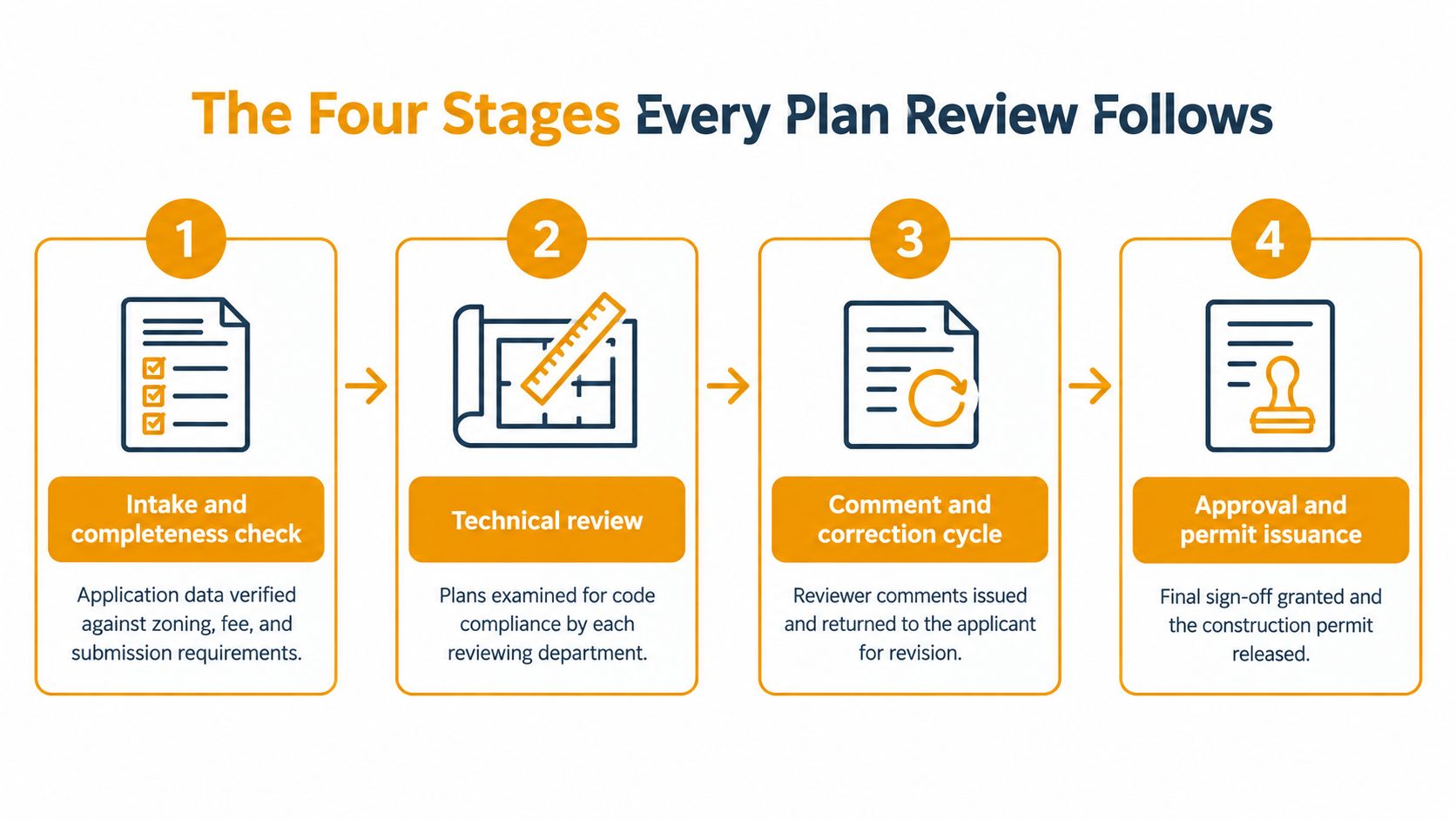
Every jurisdiction dresses it up differently, but the workflow is usually the same. A project enters intake, moves through technical review, cycles through comments and corrections, and then reaches approval and permit issuance.
Stage 1 intake and completeness check
Clerks or intake staff verify that the application is complete enough to move forward. They check forms, fees, required sheets, basic zoning items, and submission requirements. A project can stall here before any reviewer opens a drawing.
In some jurisdictions, the completeness step has its own legal deadline. Washington requires a completeness determination within 28 calendar days after a permit application is received, then a second completeness response within 14 days after additional information is submitted, as outlined by MRSC's summary of Washington permit review timelines.
Stage 2 discipline review
Once intake clears, the package gets routed to discipline reviewers. The standard mix usually includes structural, fire and life safety, mechanical, plumbing, electrical, energy, accessibility, and zoning.
The key operational fact is that plan review is usually discipline-based and iterative, not one clean approval event. WABO's guidance describes how local jurisdictions route drawings across reviewers, and each reviewer issues correction notices citing the deficient element, the code section, and the required remedy through repeated rounds until comments are resolved or appealed, as explained in the WABO discussion of plan review workflow.
Stage 3 comment and correction cycles
Schedules start slipping. Reviewers issue comments. The design team revises. The package goes back in. Then another round starts if anything remains unresolved.
Most permit schedules don't break on the first review. They break when the second and third rounds arrive slower than the field team expected.
Stage 4 approval and permit issuance
Once all required reviews clear, the jurisdiction issues final approval and releases the permit. For contractors, this is the handoff point from opportunity tracking into active mobilization, final pricing, subcontract commitment, procurement planning, and startup scheduling.
The mistake many teams make is treating this fourth stage as the first useful signal. By then, the best-positioned bidders have often already built contact, clarified scope, and aligned internal capacity.
How State-Level Timelines Standardize Plan Review
Some states put a formal clock on review. That helps, but it doesn't remove delay. It only makes the delay easier to model.
Indiana is a good example because the state publishes a structured review sequence. The process starts an automatic 10-business-day clock when an application is submitted and requires an initial response within those 10 business days. If the project is selected for review, the state sets a 20-business-day window for a release or correction request, followed by 10-business-day cycles for each corrected resubmission until design release is issued, according to Indiana's building plan review process.
What the clock really means
For contractors, the value isn't the statute itself. The value is predictability. You can build a more realistic pursuit timeline when you know resubmittals trigger another defined review cycle.
A commercial package that goes through multiple correction rounds can burn a long stretch of tracked review time even when everyone is moving inside the published process. The permit isn't late in a legal sense. It's late in a contractor cash-flow sense.
| Indiana Statutory Plan Review Clocks | Residential (business days) | Commercial (business days) |
|---|---|---|
| Initial response after submission | 10 | 10 |
| Release or correction request if selected for review | Not separately stated in the same way as commercial in the source process summary | 20 |
| Each corrected resubmission cycle | 10 | 10 |
Where standardized clocks still fall short
A statutory clock doesn't tell you whether the comments will be minor or design-changing. It doesn't tell you whether the architect will turn revisions in quickly. It doesn't tell you whether related reviews outside the main building review will drag.
Jurisdictions without a formal clock can be harder to read because staffing, intake quality, and local volume drive the pace. Jurisdictions with a formal clock are easier to forecast, but contractors still need to track actual elapsed time instead of assuming every file moves exactly on schedule.
Why Correction Cycles Drive the Real Schedule
Every correction round keeps the revenue clock running. Contractors do not get paid for a permit sitting in review, and the first submission date tells only a small part of that story.
The schedule usually turns on how many times the plans come back marked up, how big those comments are, and how fast the design team can answer them. On a straightforward tenant improvement, one correction cycle may be manageable. On a ground-up commercial job with code, fire, structural, and MEP conflicts stacked together, each resubmittal can move procurement, staffing, and start dates far enough to affect backlog and cash flow.
What first-cycle comments usually signal
Comment letters are one of the best early reads on whether a file is close or still immature. They show whether the next pass is likely to clear with minor edits or go back through another full round because the issues cut into the design itself.
| Typical First-Cycle Review Comments by Discipline | Common First-Cycle Comments | What It Usually Means for Schedule |
|---|---|---|
| Structural | Load path questions, foundation calculations, detail coordination gaps | Engineer revisions often trigger drawing updates in other sheets |
| Fire and life safety | Sprinkler calculation issues, egress width questions, occupancy and separation clarifications | Code interpretation can pull in architect, fire protection, and owner decisions |
| Mechanical | Ventilation rates, equipment schedules, outside air calculations, duct routing conflicts | Equipment selections and ceiling coordination often need another pass |
| Electrical | Single-line diagram deficiencies, panel schedule issues, load calculations, circuit identification gaps | Late electrical fixes can affect service sizing and related disciplines |
| Energy | Missing compliance documentation, inconsistent envelope data, incomplete forms | Sometimes administrative, sometimes tied to broader envelope revisions |
| Accessibility | Ramp slope issues, fixture counts, turning clearances, door maneuvering concerns | Layout changes can ripple across architectural sheets |
| Zoning | Setback conflicts, use inconsistencies, parking or site-plan mismatches | These comments can force site or program changes, not just redlines |
A correction notice that stays administrative is frustrating but survivable. A correction notice that exposes design coordination gaps is expensive.
Why rounds matter more than intake
Published review clocks often make the process look cleaner than it feels in the field. Indiana's state plan review process, for example, gives commercial submissions an initial response timeline and then starts a new business-day clock for corrected resubmittals, as outlined by the Indiana Department of Homeland Security plan review process summary. That structure matters because every return adds another formal review period even when the jurisdiction is operating exactly as designed.
From a contractor's seat, that is the difference between a permit that is "on process" and a permit that is still slipping the job. If the architect takes a week to turn comments, then the agency gets another review window, then one discipline kicks out a second set of corrections, the calendar loss is real whether anyone missed their statutory target or not.
I have seen teams focus on the intake date because it feels concrete. The better predictor is the quality of the first comment set and the speed of the first resubmittal.
What contractors can control
Contractors cannot control reviewer staffing or queue volume. They can control how early they read risk and how hard they push coordination before the permit set goes in.
That usually means:
- reviewing first-cycle comments discipline by discipline instead of treating the letter as one lump sum of "permit comments"
- separating drafting cleanups from design changes, because those carry very different schedule risk
- pressing the design team for a real resubmittal date, not a vague promise to "address comments"
- updating procurement and subcontractor outreach based on correction severity, not the owner's original milestone sheet
This is also where earlier review-stage visibility pays off. Platforms like Platineer help contractors spot projects while they are still moving through entitlement, design, and municipal review signals, often months before permits break loose. That does not shorten a jurisdiction's correction cycle by itself. It does give teams more time to build relationships, qualify opportunities, and time their outreach before the job hits the noisy post-permit rush.
The practical takeaway is simple. Count correction rounds, read the comments for severity, and tie every week of review churn back to labor loading, bid timing, and revenue timing. That is the schedule that matters.
What Fast Versus Slow Plan Review Looks Like in Practice
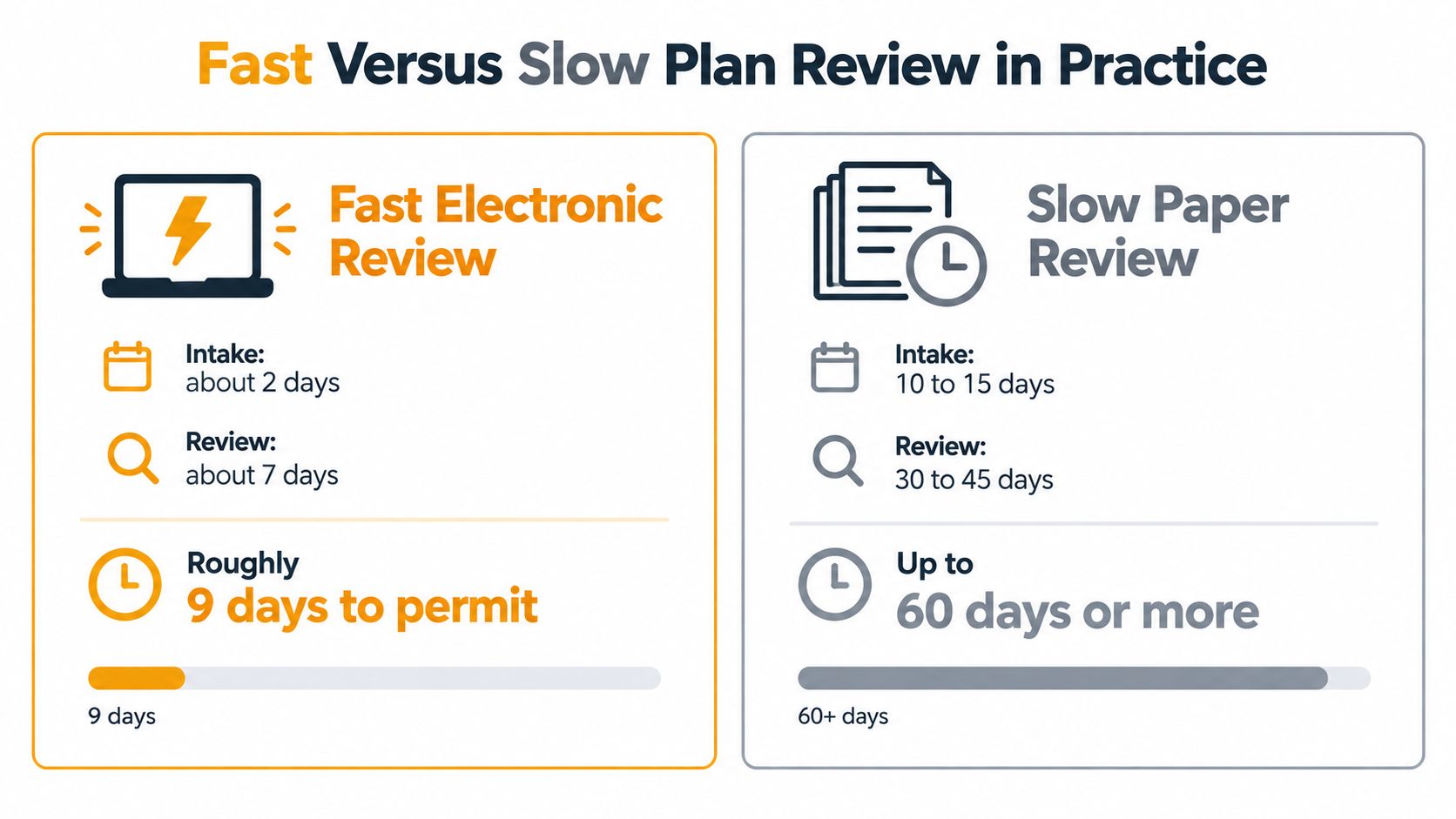
A two-week difference in review speed can easily turn into a 30 to 60 day shift in when a contractor can bid with confidence, release buyout, or start loading labor. That is not an admin problem. It is a revenue-timing problem.
What fast looks like
Fast review does not mean lenient review. It means the jurisdiction moves the file cleanly, routes it quickly, and returns comments in a format the design team can act on without losing a week to confusion.
Contractors usually see a few common traits in those markets. Intake standards are clear. Digital submissions are accepted and routed without manual handoffs. Reviewers are staffed well enough that one vacation or sick day does not stall the entire package. Comments also tend to come back in a predictable sequence, which matters because preconstruction teams can line up outreach, pricing refreshes, and bid effort around a review pattern they trust.
That kind of speed changes pursuit strategy. If a city consistently pushes plans through a clean first cycle, a contractor can stay closer to the job with estimating hours, supplier check-ins, and subcontractor budgeting because the permit path is behaving like a live near-term opportunity.
What slow looks like
Slow review has a different feel, and experienced teams spot it early.
Common warning signs include:
- manual intake steps that create avoidable holds
- split reviews across departments that do not clear comments on the same cadence
- limited reviewer availability in one key discipline
- outside-agency or specialty sign-offs that stack instead of running in parallel
- comment formats that are vague enough to trigger another round of interpretation before redesign even starts
In those markets, the permit file may look active while the contractor's revenue clock barely moves. The owner still expects progress. Estimating time still gets spent. Budget numbers still age. Supplier quotes still expire.
The financial effect shows up fast. A job that looked like a Q2 pursuit starts consuming Q3 attention. Internal handoffs stretch. Trade partners stop holding coverage. If crews were tentatively lined up, operations has to refill that future slot with something else or carry the gap.
Why the distinction matters
Fast versus slow review changes more than a permit date on a milestone sheet. It changes how aggressively to pursue, how long to keep a budget current, and how much confidence to place in an owner's target start.
On a fast review track, it can make sense to commit more preconstruction effort earlier because the path to bid and permit is short enough to support that spend. On a slow track, discipline matters more. Keep the relationship warm, but be selective about where estimating hours go and when to refresh pricing.
This is also where early review-stage visibility has real value for contractors. Platforms like Platineer help teams spot projects while they are still moving through design and municipal review, often 6 to 18 months before permits hit the broader market. That does not speed up the jurisdiction. It does let contractors align outreach with momentum, reserve effort for jobs that are advancing, and protect margin by seeing schedule drag before it shows up as a missed revenue month.
Turning Plan Review Signals Into Earlier Contractor Outreach
A permit date is a lagging indicator. Contractors who wait for it are working from the back of the timeline.
The better signal is review movement. Intake acceptance means the job is alive. First-cycle comments tell you where the package is weak. Resubmittal shows the team is still pushing. Fire clearance and zoning sign-off tell you major friction is dropping out. Final approval confirms the handoff to active execution.
That sequence matters because review-stage activity often appears well before permits issue. In practical terms, it gives preconstruction teams a window to call the architect, identify the owner's rep, qualify whether the job fits their trade and geography, and decide if estimating hours should be reserved.
Earlier signals change the outreach math
When teams can see project movement 6–18 months before permit bursts, they can prioritize the jobs that are advancing instead of chasing every name on a permit list. That's the difference between broad prospecting and targeted pursuit.
Project-intelligence systems can help. Platineer tracks signals such as intake acceptance, comment issuance, resubmittal, and final approval, then organizes that activity into views that help preconstruction teams see where momentum is real. Its approach is closest to what good real-time pipeline monitoring should do for contractors: move attention toward projects that are progressing, not just projects that exist.

What changes inside the contractor's workflow
The biggest operational shift is simple. The team stops organizing pursuit solely by permit issue date and starts organizing it by review momentum.
That improves several decisions:
- Estimating allocation: hours go to jobs with visible movement, not stale listings
- Business development timing: outreach happens while bidder lists are still open
- Subcontractor coordination: trade partners hear about likely work earlier
- Internal forecasting: leaders can separate active near-term work from design-stage noise
If a project has entered review, received comments, and come back with a resubmittal, it deserves more attention than a permit record with no movement behind it.
The revenue consequence is straightforward. Earlier, better-timed outreach reduces wasted pursuit on dead files and increases the odds that your team is in the conversation before pricing gets crowded.
A Contractor's Monitoring and Engagement Playbook
Most permit chasing fails because the team treats review status as a one-time lookup. It isn't. It's a monitoring job. The firms that stay ahead usually run a simple cadence and repeat it every week.
The weekly operating cadence
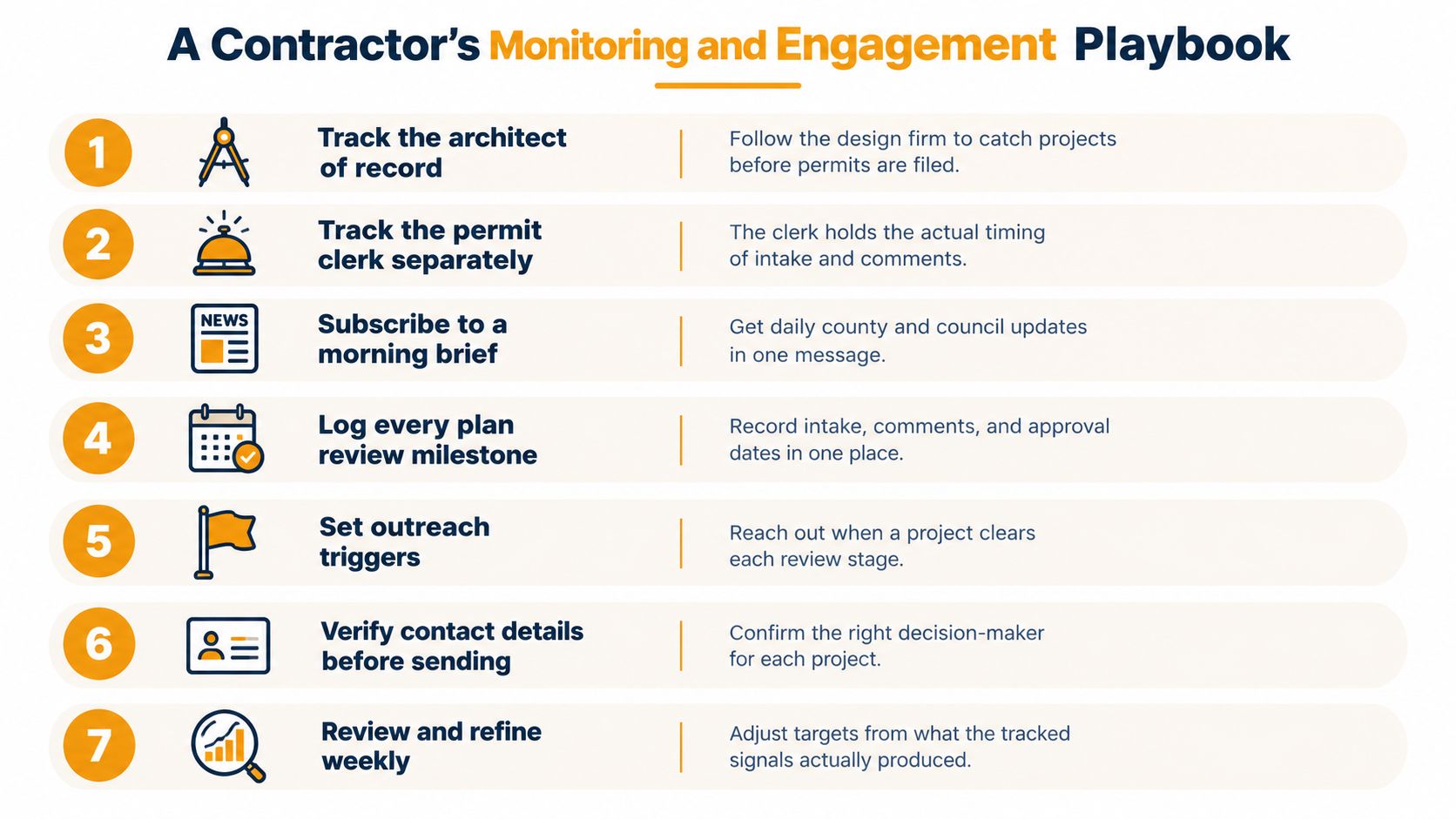
Use a repeatable checklist:
- Track the architect of record: the design team often signals pursuit timing before the permit goes live.
- Track the permit clerk separately: intake and status handling often sit with different people than design coordination.
- Subscribe to a daily signal feed: a focused brief beats random searching. A good example of the category is permit tracking software that organizes updates into something estimators can act on.
- Log every milestone: intake accepted, reviewer assigned, comments sent, resubmittal received, approval issued.
- Set outreach triggers: the first comment letter is usually a better outreach point than the third.
- Match estimating capacity to probable approval timing: don't overload the team on jobs with weak review motion.
- Reconcile permit records back to pipeline tracking: closed jobs should improve how you read the next wave.
What works and what doesn't
What works is early, light-touch engagement tied to real signals. A first comment cycle tells you the project is moving, and it gives you a reason to ask informed questions. That's far better than a generic “checking in on the project” email sent after permit issuance.
What doesn't work is spraying outreach at every new filing or waiting so long that the owner already has a short list. The sweet spot is when the project has enough motion to be real but still enough uncertainty that relationships and responsiveness matter.
Oregon's residential framework shows how some jurisdictions also impose distinct timing rules upstream and downstream. Jurisdictions must complete a completeness review within 30 days, issue a final land use decision within 120 days after an application is deemed complete for residential projects inside an urban growth boundary, and cities must approve or disapprove simple low-rise residential dwellings within 10 business days in cities under 300,000 population or 15 business days in larger cities, according to the Oregon residential development process report.
That kind of structure won't make every job predictable, but it does give contractors a framework for when to watch harder and when to engage faster.
Review status is only useful if someone on your team turns it into a call, a qualification decision, or a staffing move.
Platineer gives contractors a way to see projects while they're still moving through plan review, plats, and permits instead of waiting for the market to get obvious. If your team wants earlier visibility into which jobs are gaining momentum and who to contact before bid windows crowd up, visit Platineer.