Most advice on how to bid jobs on construction starts too late. It starts with takeoff speed, markup, and proposal formatting, as if the only problem is getting a number out the door. That's backwards.
The first mistake usually happens before anyone opens the plans. Contractors lose money because they bid work that never fit their crew, their geography, their cash flow, or their customer list. A full bid board can hide a weak pipeline. Busy estimators don't always mean profitable work is coming.
Time savings is money savings in preconstruction. Manual estimating on complex commercial bids is often described as taking 20 to 40 hours per bid according to this estimating software ROI breakdown. Even more typical commercial bid workflows still consume 8 to 24 hours, with 4 to 12 hours tied up in takeoff alone according to this bid workflow breakdown. If you're spending that time on bad-fit jobs, you're not just losing bids. You're paying to lose them.
That's why I'd rather have a short list of real opportunities than a bloated invite log. Tools that help qualify, estimate, and route work faster matter because they give those hours back. If you want one place to start, Platineer's Estimate tool demo is relevant here because it's built to turn plans or site inputs into structured estimate outputs faster, which helps when the goal is protecting estimator capacity for jobs worth chasing.
Table of Contents
- Why Most Contractors Lose Money Bidding the Wrong Work
- Running a Bid or No-Bid Filter Before You Touch a Takeoff
- Reading the Scope So You Don't Buy the Design Mistakes
- Estimating and Takeoff Without Burning Your Week
- Pricing the Job So Margin Actually Survives Award
- Assembling a Bid Package That Wins Reviews
- Submitting the Bid and Running Follow Up That Books Work
Why Most Contractors Lose Money Bidding the Wrong Work
The old advice says bid more work and the wins will come. That sounds logical until you track what those bids cost.
In construction bidding, the bid-hit ratio is the core metric for measuring how often a contractor wins the jobs it bids, and industry guidance recommends tracking it by count, by dollar value, by customer, and by job type, not as one blended number across everything on the board. A commonly cited benchmark is a 5:1 bid-hit ratio, which means five bids submitted for every one award, or a 20% win rate, according to For Construction Pros on bid-hit ratio. That matters because it turns bidding into a business system instead of a guessing exercise.
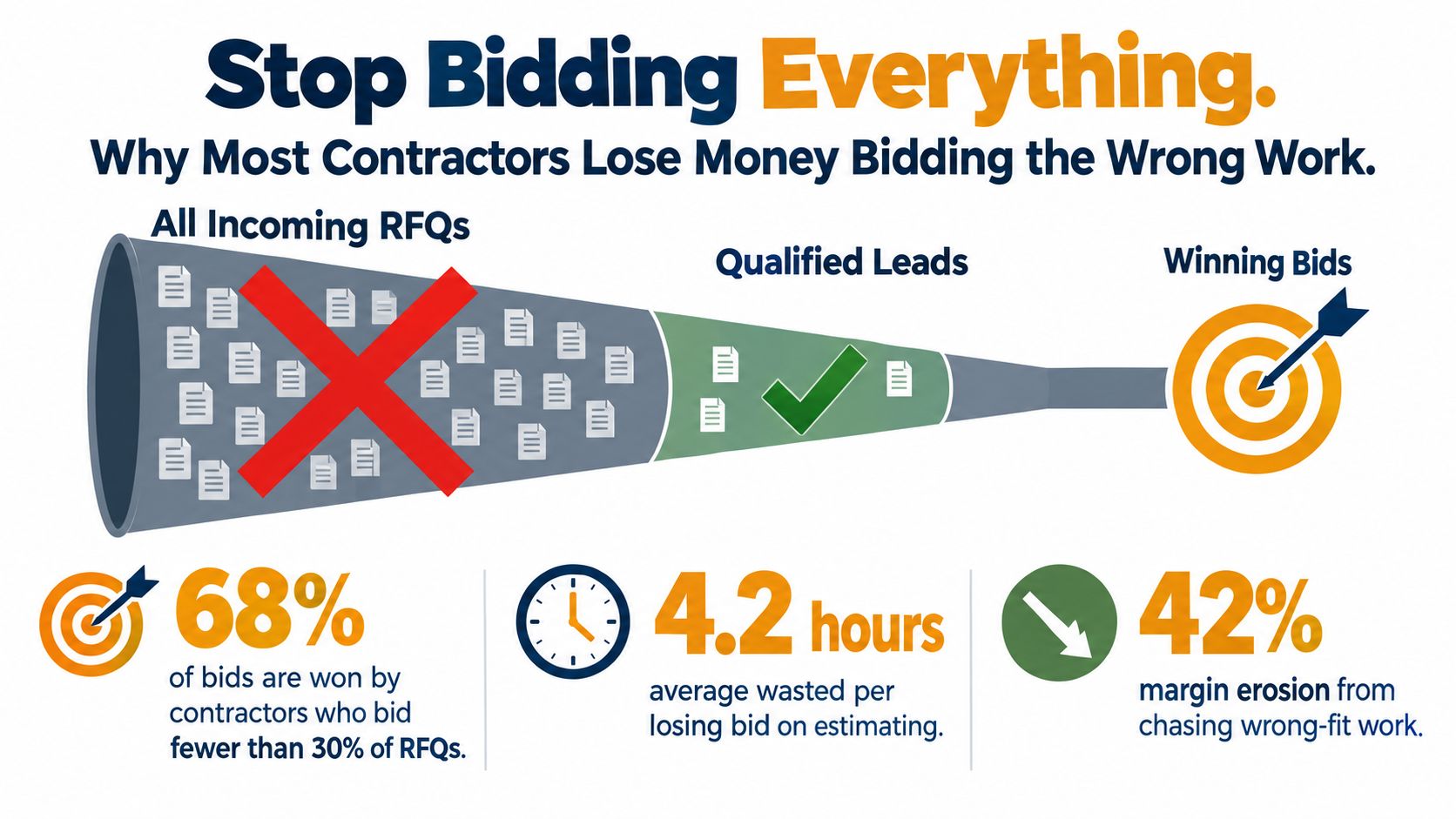
Activity is not the same as selectivity
A contractor can look busy and still be bleeding margin. One expert bid/no-bid model says firms should rank opportunities by bid-hit ratio and expected gross profit per won job, because a pile of low-margin pursuits inflates estimating overhead without improving profit. That same model says specialty subcontractors tend to do best around a 20 to 30% hit rate, while hard-bid public general contractors often cluster around 10 to 15% on profitable work, as explained in this bid/no-bid scoring model.
That lines up with what happens in the field. The wrong jobs cost you twice. First in estimating hours. Then again after award, when the project turns into a fight over scope, schedule, travel time, or buyout pressure.
Practical rule: If a job only makes sense when everything goes perfectly, it was underqualified before it was underpriced.
Where bad-fit work hurts
The bad-fit signals are usually obvious once you stop ignoring them:
- Unfamiliar scope: Your crew can install it, but they haven't self-performed enough of it to price the production risk cleanly.
- Weak customer fit: Some generals grind subs after award, strip scope in buyout, or hold everyone hostage over closeout paper.
- Distance creep: The number looked fine in the office. The travel, staging, and supervision burden shows up later.
- Schedule fantasy: Fast-track jobs often force overtime and stacked trades before anyone has room to work.
The fix isn't heroic estimating. It's discipline. Track wins by job type, customer, and project class. Then aim estimating hours at the work your team can build well and bill well.
Running a Bid or No-Bid Filter Before You Touch a Takeoff
Some bids should die in the first fifteen minutes. Not after half a day of takeoff. Not after you've chased supplier numbers. Immediately.
A practical bid/no-bid system starts with project fit, risk, and expected return. Industry guidance on contract risk says contractors should evaluate the owner and project fundamentals first, then frame risk as accept, clarify, negotiate, or decline. Academic work on bid/no-bid decisions points to recurring criteria such as contractual arrangements, scope of work, financial considerations, client relationships, and location/resources, which is why lowest-price thinking misses the decision, as discussed in ConsensusDocs on contract risk screening.
Fast disqualifiers worth writing down
Put these next to the monitor so nobody relitigates them every afternoon.
- Outside your self-perform strength: If the core scope isn't work your field team regularly executes, pass.
- Bad documents: Incomplete drawings, missing addenda, or messy version control usually mean you'll be buying someone else's confusion.
- Schedule that doesn't match production reality: If the timeline only works on paper, the bid should probably stay on paper.
- Payment terms that strain working capital: Slow pay, aggressive retainage, and long approval chains can erase a decent margin.
- Known post-award games: If a GC has a history of scope stripping or leveling subs against incomplete apples-to-apples comparisons, treat that as a pricing risk, not a relationship.
Bid no-bid scoring sheet
Use a simple weighted sheet. It doesn't need to be elegant. It needs to be fast and repeatable.
| Criterion | Weight | Score (1-5) | Weighted Score |
|---|---|---|---|
| Trade fit | |||
| Project size fit | |||
| Geographic fit | |||
| GC or owner relationship | |||
| Document quality | |||
| Timeline realism | |||
| Payment risk | |||
| Margin potential |
If your team doesn't already have a qualification process, this lead qualification checklist is a useful starting point for building one around fit instead of impulse.
Most bid mistakes don't start in the spreadsheet. They start when someone says, “We're slow, so let's price it anyway.”
Set a cutoff score. Below that line, decline or ask clarifying questions before any estimator burns time on it. Above that line, assign a time budget and move.
Reading the Scope So You Don't Buy the Design Mistakes
A sloppy scope review is the cheapest mistake to make on bid day and the most expensive one to carry into the job.
Construction bids are only as reliable as the scope and change-order control behind them. Research summarized in an academic paper found that design changes account for 56.5% of cost overruns and 40% of project delays, while planning errors account for 34.5% of cost overruns and 23.1% of delays. Other published studies and industry summaries in that same review report that change orders commonly add about 10% to 15% of original contract value on large building projects, with schedule overruns often running 10% to 20% of planned duration. The same paper also cites an INDOT analysis where changed conditions produced $266 million in cost overrun, equal to 42% of total change-order magnitude in that dataset, according to the ETASR paper on change-order impacts.
Scope review that catches what drawings hide
The trap is simple. One sheet says one thing. Another says something else. The spec points a third direction. If you don't reconcile that before bid, the argument after award starts with your number.
A disciplined scope walk is slower at the front and cheaper at the back. The sequence that works is plain:
- Read the cover sheet first. Check sheet index, issue date, and addenda list.
- Mark every revision cloud and triangle. Don't assume someone else already folded it into the package.
- Cross-check specs against drawings. Section numbers, rated assemblies, finishes, and delegated design notes are where quiet misses live.
- Write assumptions directly into the estimate. If the drawings are unclear, the takeoff needs a note, not a memory.
- Build exclusions before you build confidence. If it isn't in your number, say it in writing.
Don't count on change orders to save a weak read
General contractors and owners don't pay for assumptions they think were inferable. Architects don't always issue the neat revision trail estimators wish they would. Field crews end up absorbing the gap.
If the scope is muddy at bid time, clarify it or price the risk. Don't leave it floating.
That habit is cheap insurance. It's also one of the few parts of bidding you fully control.
Estimating and Takeoff Without Burning Your Week
Estimating needs a time budget. Without one, the bid expands to fill the whole week.
Typical commercial bid workflows consume 8 to 24 hours of estimator time, including 1 to 2 hours reading plans and specs, 4 to 12 hours on takeoff, 2 to 4 hours getting material and subcontractor quotes, and another 1 to 2 hours each for estimate assembly and bid-package prep, according to Easy Takeoffs on bid workflow timing. On more complex commercial projects, manual estimating is often described as taking 20 to 40 hours per bid, while AI-powered estimating can cut takeoff time by 60 to 80%, turning a 30-hour manual workflow into roughly 6 to 10 hours, as outlined in Hub Service's construction estimating ROI guide.
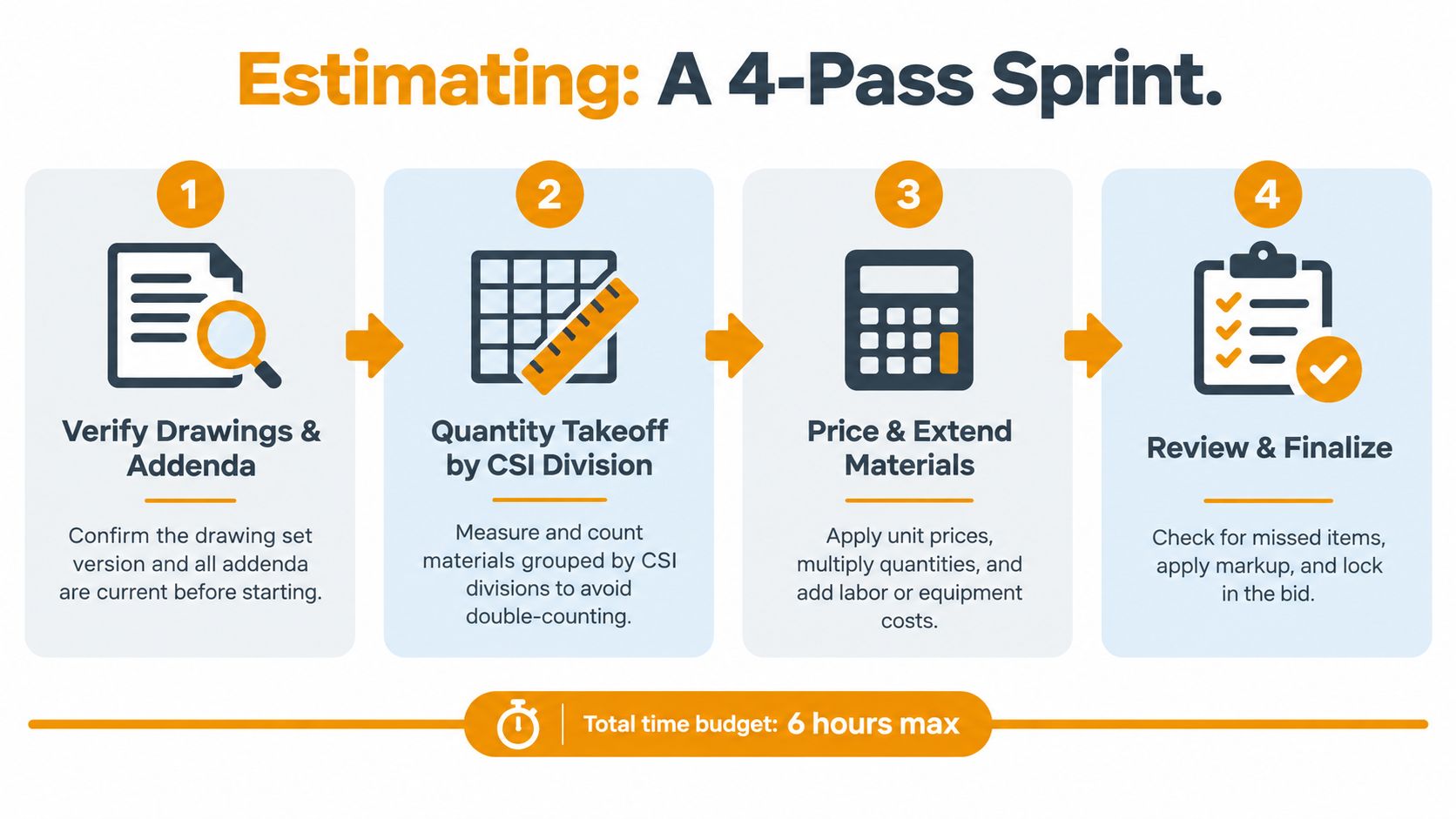
Use a four-pass sprint
The cleanest estimating workflow isn't one giant session. It's four shorter passes with a stop/go decision after each.
Verify drawings and addenda
Confirm the current set, issuance, and all addenda before measuring anything.Run quantity takeoff by CSI division
Group the work logically so you don't double-count or lose scattered items in a mixed scope package.Load labor, equipment, and quotes
Actual field knowledge matters. Anyone can count. Not everyone can price installation risk.Sanity-check against known history
Compare unit costs, crew loading, and oddball conditions to similar completed work.
If your team wants a tighter process for the measurement side, this guide to material takeoff is useful for standardizing how quantities get captured before they hit the pricing sheet.
Where software earns its keep
Not every bid tool saves time in the same place. Gains usually come from repetitive counts, not judgment.
Good takeoff software helps when you're counting fixtures, devices, conduit runs, studs, doors, or sheets across repeated plan areas. PDF-based takeoff software can reduce the takeoff portion by 30 to 60% according to the same Easy Takeoffs workflow article, which is meaningful because those are hours you can shift into scope review, quote leveling, or a better bid/no-bid call.
Platineer is one option when you want faster preconstruction triage because it combines project intelligence with estimating support. It's built to surface jobs by trade, territory, and valuation fit, and it also offers estimate tooling that helps structure scope and early pricing from plans or site inputs.
Kill bids that overrun the budgeted effort
An estimate that keeps spilling into nights and weekends usually tells you one of three things. The documents are weak. The scope is wrong for your shop. Or the team never set a cap on effort.
Treat estimating like production. If the bid blows through the allotted hours, either escalate it because it's strategic or kill it because it isn't. Don't let mediocre opportunities eat the same time your best-fit jobs need.
Pricing the Job So Margin Actually Survives Award
A lot of bids look fine at submission and weak at buyout. That's usually a pricing structure problem, not just a markup problem.
Start with the cost stack from the bottom up. Labor at burdened rates. Current material quotes, not old memory. Equipment. Subcontracted scopes. Permits. Small tools. Freight. Supervision if the job needs dedicated oversight. Then allocate overhead in a way that reflects how your company operates.
Build the number in layers
The part many teams skip is separating what the job costs from what the job risks.
Use three distinct top-side checks before finalizing:
- Contingency for scope risk: Cleaner documents justify less. Design-assist, phased, or revision-heavy jobs justify more.
- Financing cost: This one gets missed all the time. Billd's 2025 National Subcontractor Market Report says only 53% of subcontractors include the cost of financing in their bids, which implies nearly half are absorbing a hidden cost, according to Billd's market report summary.
- Margin floor: If the final number drops below the minimum your company requires, the right move may be to pass.
Bid pricing format by project type
How you present the number matters almost as much as how you build it.
| Project Type | Pricing Format | Margin Protection | Risk to Watch |
|---|---|---|---|
| Hard-bid public work | Lump sum with tightly defined inclusions and required forms | Better when the scope is standardized and submission rules are rigid | Scope gaps hidden behind the lowest number |
| Private negotiated work | Itemized breakdown with alternates and clarifications | Better because the owner or GC can see where money is going | Buyout pressure on visible line items |
| Design-assist or evolving scope | Line-item pricing plus assumptions, allowances, and contingency language | Stronger because it shows what is firm and what is not | Assumptions getting treated as fixed scope later |
| Repeat customer work | Hybrid format based on customer preference | Better if you know how they level proposals | Informal changes that never make it back into the contract |
Don't confuse a low number with a competitive one
Industry guidance repeatedly flags avoidable failures like inaccurate cost estimation, misread scope and site conditions, incomplete bids, rushed submissions, and poor coordination. It also notes that competitive public work often yields only 10 to 20% win rates, while negotiated or selective work can rise to 30 to 50%, according to Estimate Hawk on bidding mistakes. That's why selective pricing beats desperate pricing.
Cheap work can keep the field busy and still leave the company weaker.
On private work, itemized pricing often wins reviews because it gives the customer a usable buying document. On hard-bid public work, lump sum is often fine because the procurement format drives the comparison. Either way, the math has to survive first payment, not just bid day.
Assembling a Bid Package That Wins Reviews
A clean bid package is a sales document wearing work boots. Reviewers notice when it's organized, easy to level, and easy to trust.
Too many contractors treat submission as a document dump. That's how numbers get detached from scope, exclusions disappear into email threads, and someone submits the wrong file version five minutes before deadline.
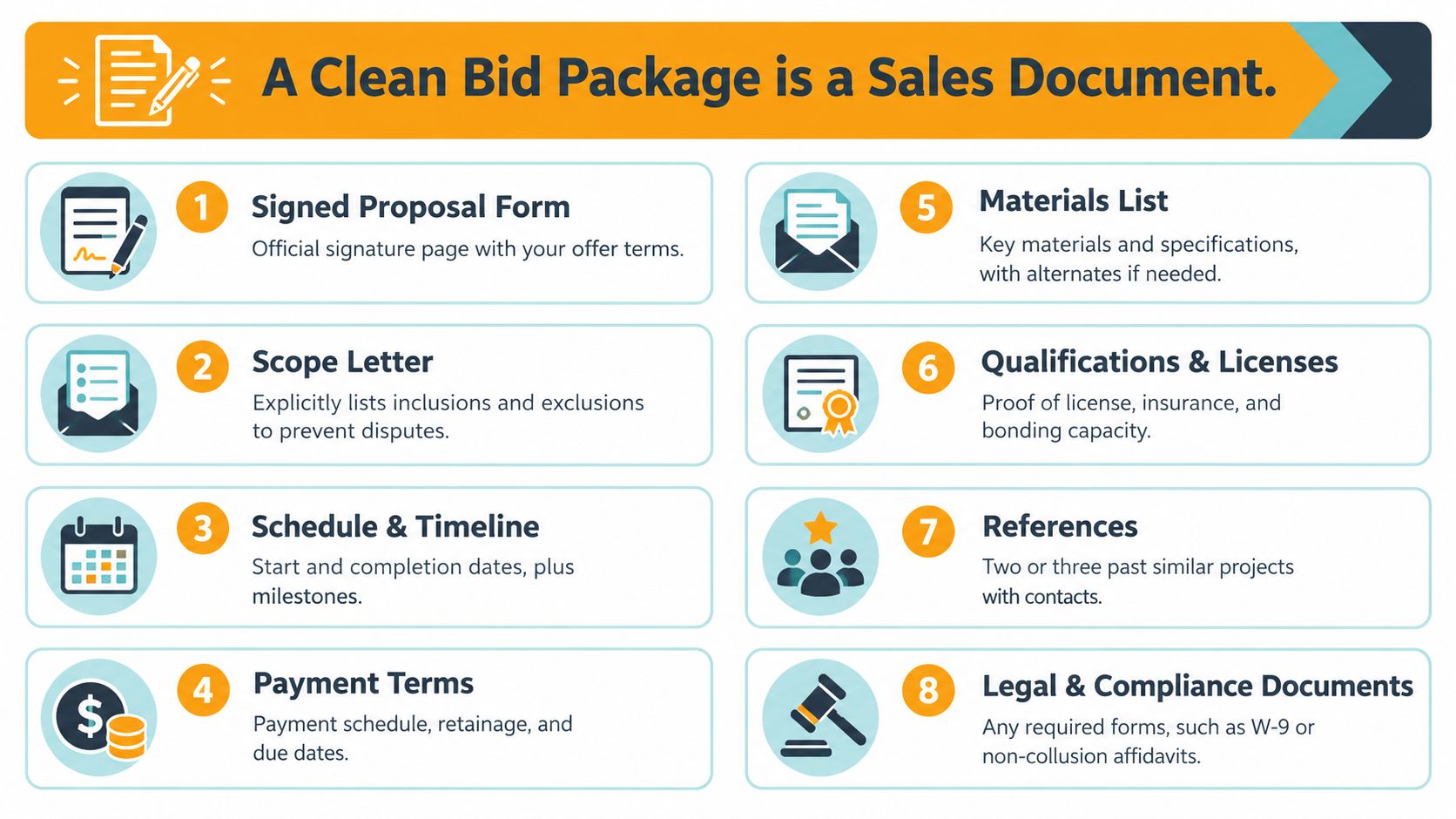
What the package needs
A strong submission usually includes these pieces:
- Signed proposal form or bid form page
- Scope letter with plain inclusions and exclusions
- Alternates priced separately
- Unit prices where required
- Schedule with major milestones
- Qualifications and clarifications
- Bonding and insurance documents if required
- One-page cover letter with the estimator's name and a real phone number
If you need a structure to model from, this construction proposal example is a practical reference for how to organize the scope and commercial terms.
Version control saves embarrassment
Keep one master filename. Add a revision log on the cover page. Generate the final PDF from the locked source file, not from an attachment chain with three people making edits in parallel.
Then do one last submission review:
- Check addenda acknowledgment
- Confirm every number ties to the summary
- Read exclusions against the schedule
- Verify required forms are signed
- Open the final PDF and scan every page
A clean package doesn't win every job. It does keep you from losing one for a preventable paperwork mistake.
Submitting the Bid and Running Follow Up That Books Work
Bid submission isn't the end of the process. It's the handoff into follow-up.
Construction bid solicitation isn't a high-response channel. Subcontractor bid invitations typically receive only 30 to 50% response rates, and another benchmark says construction RFQ response rates commonly sit around 30 to 40% with 10 to 14 day cycles, according to Struvia on subcontractor bid solicitation. That alone should change how you think about outreach. A lot of invites never turn into useful bid activity, which is why timing, qualification, and follow-up matter so much.
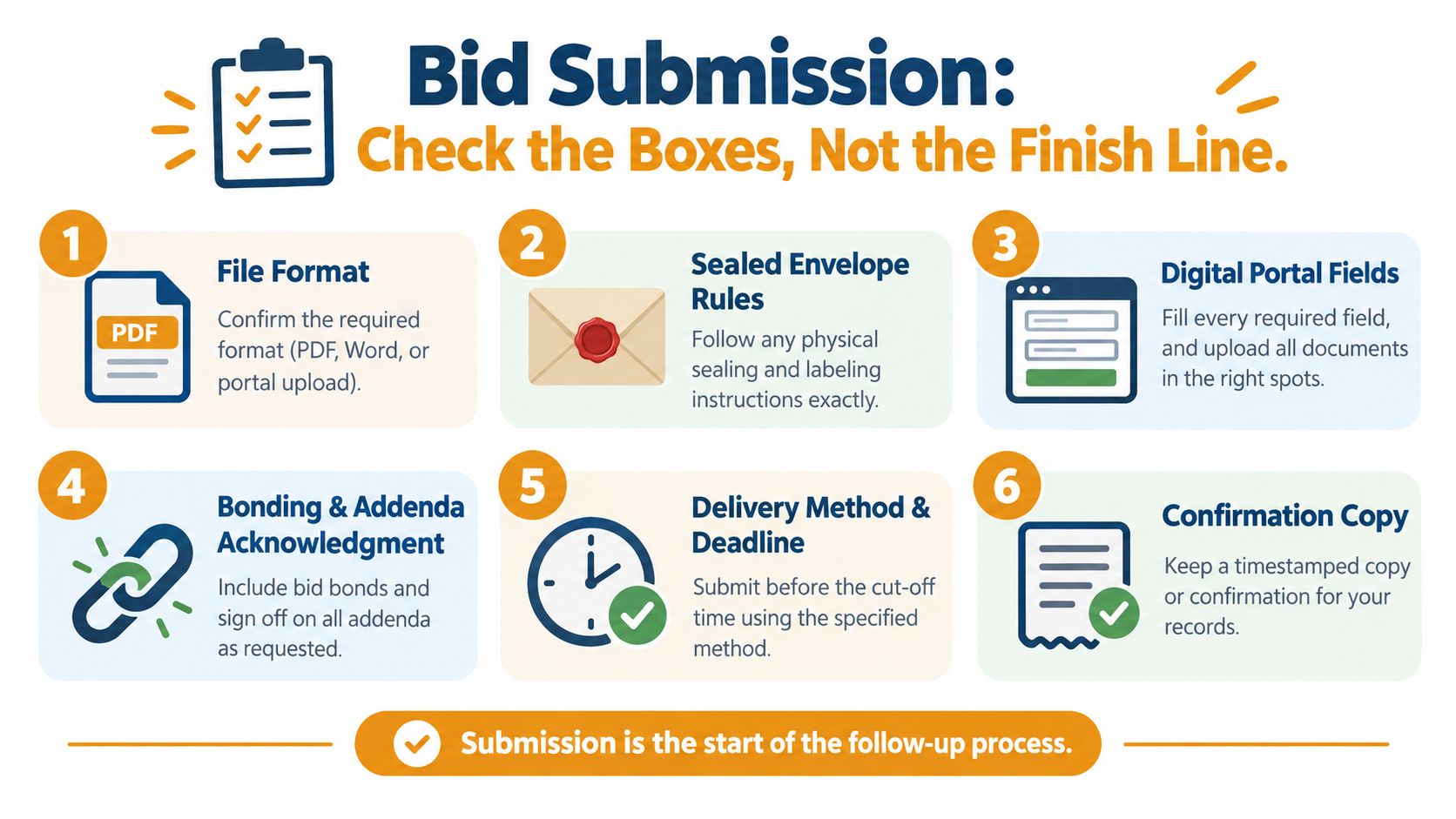
Submission is a checklist beat
Before the file leaves your hands, confirm the mechanics:
- Correct format: PDF, portal upload, sealed envelope, or whatever the instructions require
- All required fields completed: Especially in digital procurement portals
- Bonding and addenda included: A good number can still get tossed for missing paperwork
- Timestamp and confirmation saved: Keep proof of what was sent and when
After that, log what you learned. Who sounded serious. Where the GC said the budget was tight. Which alternates drew interest. Whether your exclusions raised questions.
The morning brief habit
The best follow-up system I've seen is short and boring. That's why it works.
Run a daily stand-up. Fifteen minutes. Review incoming invitations, yesterday's submissions, outstanding clarifications, and the two or three jobs that deserve estimating time next. That keeps the queue from turning into a graveyard of old RFQs.
Timing matters here. Some projects show planning activity 6 to 18 months ahead of permit bursts, and another benchmark says AI-assisted estimating can compress bid turnaround from 3 weeks to 72 hours, according to Mirage Metrics on AI construction estimating. Earlier visibility plus faster turnaround changes who gets the first call in and who gets left reacting late.
The firms that book better work usually aren't bidding more. They're seeing it earlier, qualifying it faster, and following up while everyone else is still sorting downloads.
That's the rhythm worth building. Not endless bidding. Consistent selection, clean estimating, and disciplined follow-up.
Platineer helps contractors do exactly that. It gives you project intelligence, daily matched lead briefs, and estimating tools that support faster qualification and preconstruction work, so your team spends more time on bids that fit and less time chasing noise. If that's the bottleneck in your shop, visit Platineer.