
Texas led the country in 2025 with 140,002 single-family permits, even after an 11.7% decline from 2024, and the ten highest-permit states still accounted for 61.8% of all U.S. single-family permits (U.S. Census Bureau Building Permits Survey). That tells you everything you need to know about construction project leads, the work is concentrated, fast-moving, and useless if you treat it like a raw address dump instead of a ranked signal stream. If you're still crawling county portals every Monday, you're already late.
The right way to work this business is simple. More leads don't equal more revenue, better leads do. That means stage, trade fit, territory, valuation, and reachability matter more than volume, and the best teams use tools that compress discovery into a morning brief instead of turning preconstruction into a scavenger hunt.
Table of Contents
- What Construction Project Leads Actually Are
- Where Construction Project Leads Come From
- Qualifying Leads by Trade, Territory, Value, and Contact
- Manual Search Versus AI-Assisted Lead Intelligence
- A Repeatable Workflow From Signal to Bid
- Connecting Qualification to a Daily Operating Rhythm
- Putting It All Together and Trying the Workflow
What Construction Project Leads Actually Are
A permit record can point to work, but it does not prove that work is worth pursuing. A construction project lead becomes useful only after the record connects to a live project, a relevant trade, a workable territory, and a reachable contact.
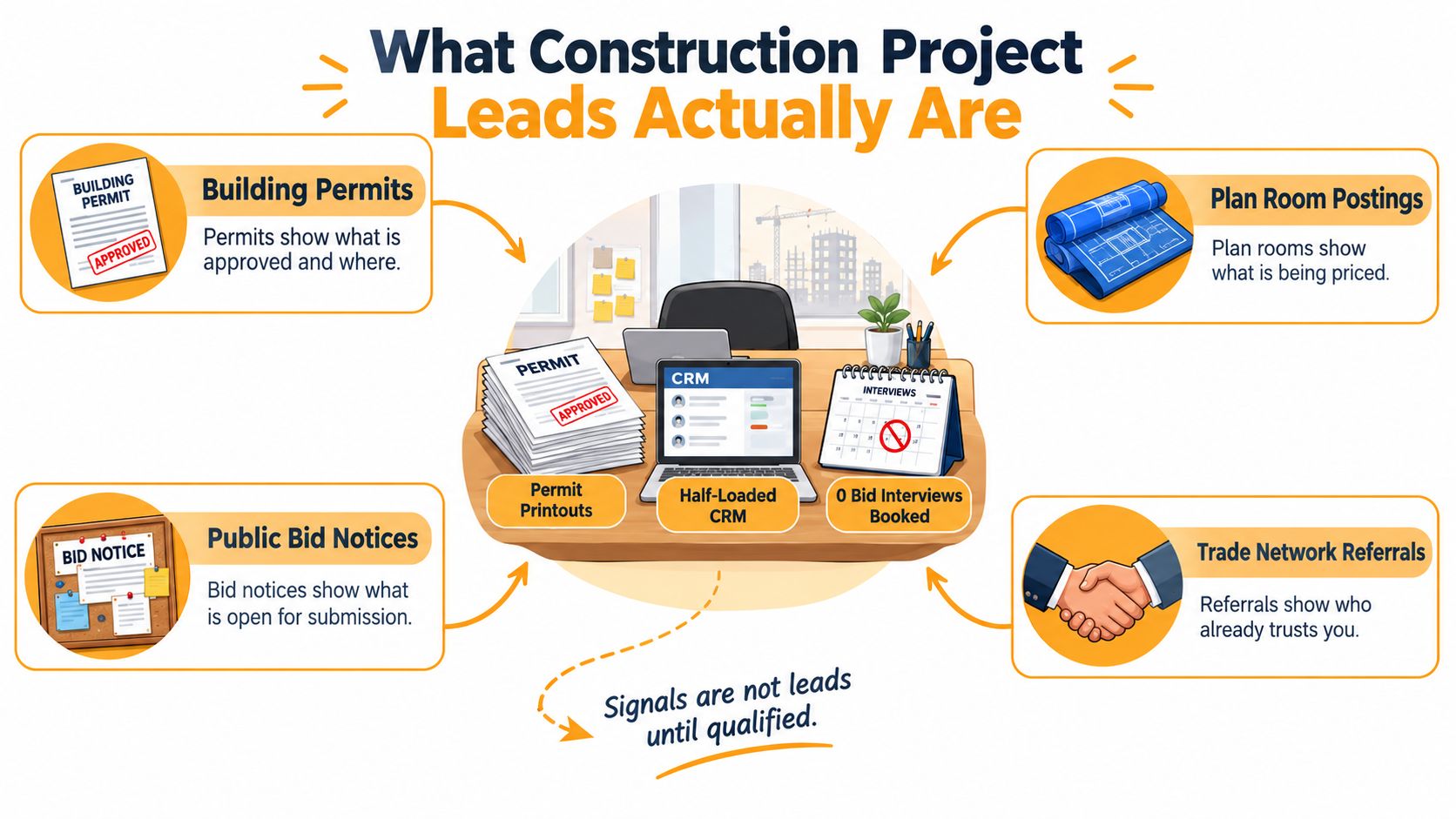
A qualified signal has enough evidence to support a next action. Check the project address, filing or review date, current stage, project type, estimated value band, and assigned parties. Then confirm that your trade fits the scope and that someone connected to the work can be reached. A permit filed last Thursday for a tenant improvement may deserve immediate review. An address scraped three months ago may have stalled, changed hands, or already passed your bid window.
The record also needs a freshness check. A recent update, revised plan, inspection activity, or newly listed contact can change its priority. Old records should not sit beside fresh opportunities in one undifferentiated queue. Rank them by how recently the project changed and how directly your team can reach the people involved.
Signals change by stage
The project stage remains a qualification field, not a reason to treat every record alike. Planning, pre-construction, bidding, and awarded describe different levels of certainty and different next actions. Capture the stage, source, last activity, trade fit, territory, and contact path in the record so the team knows what deserves attention first.
A permit is evidence, not a complete lead. A raw address becomes actionable only when the record supports a clear owner, developer, general contractor, architect, or other decision-maker to contact.
Practical rule: if you cannot name the trade, site, current stage, and contact path, you have a clue, not a lead.
The Census Bureau's Building Permits Survey publishes permit data across national, state, county, place, and metro levels, with monthly, year-to-date, and annual views. Its coverage reaches back to 1959 or 1960 depending on the series, and more than 99% of privately owned residential buildings are built in permit-issuing places (Census Building Permits Survey). That makes permit data a strong discovery input, provided qualification turns records into reachable opportunities.
Where Construction Project Leads Come From
The source matters as much as the lead itself. Some channels are early but messy, some are late but precise, and some tell you who controls the work before a permit ever shows up.
| Lead Source | Typical Lead Time | Data Depth | Best For |
|---|---|---|---|
| Building permits | Short to medium | Strong on location, weaker on decision-maker detail | GCs, subs watching approved work |
| Plan reviews | Short | Better scope clarity, tighter timing | Estimators who need to move fast |
| Plats and land use | Long | Strong early-pipeline visibility | Site work, concrete, utilities |
| Owner and developer records | Variable | Best for repeat-client and relationship mapping | Business development and account targeting |
Permits are the obvious place to start because they're public and standardized. But they're often too late for the best outreach window, especially when the project has already moved through planning and review. If you only look at issued permits, you're usually watching the loudest part of the process, not the earliest.
Plan review tells a different story. Drawings are in, scope is clearer, and you can often infer trade packages before the permit is issued. The problem is timing, because the window can be short and the team watching it needs to move immediately.
Plats and land-use cases are where good preconstruction people win. They show ground-up development well before vertical work starts, which is why they're so useful for site, civil, concrete, and utility trades. Owner records add another layer, because they help you see who has bought, developed, or repeated work in a market before.
Source speed versus source reach
Permit data gives you reach. Plan review gives you clarity. Plats give you lead time. Owner records give you relationship context. The wrong mistake is chasing all four the same way.
A contractor who serves a tight geographic area should care more about recency and reachability than about raw count. A contractor who does repeat developer work should care more about ownership patterns and historical project behavior. If your trade can't act on early signals, you're not being selective, you're just being slow.
Direct takeaway: a good source is the one that gets you a reachable name early enough to matter.
Qualifying Leads by Trade, Territory, Value, and Contact
A lead only matters if it survives the screen. I use four filters, and I don't apologize for cutting aggressively, because chasing junk burns estimating hours you don't get back.
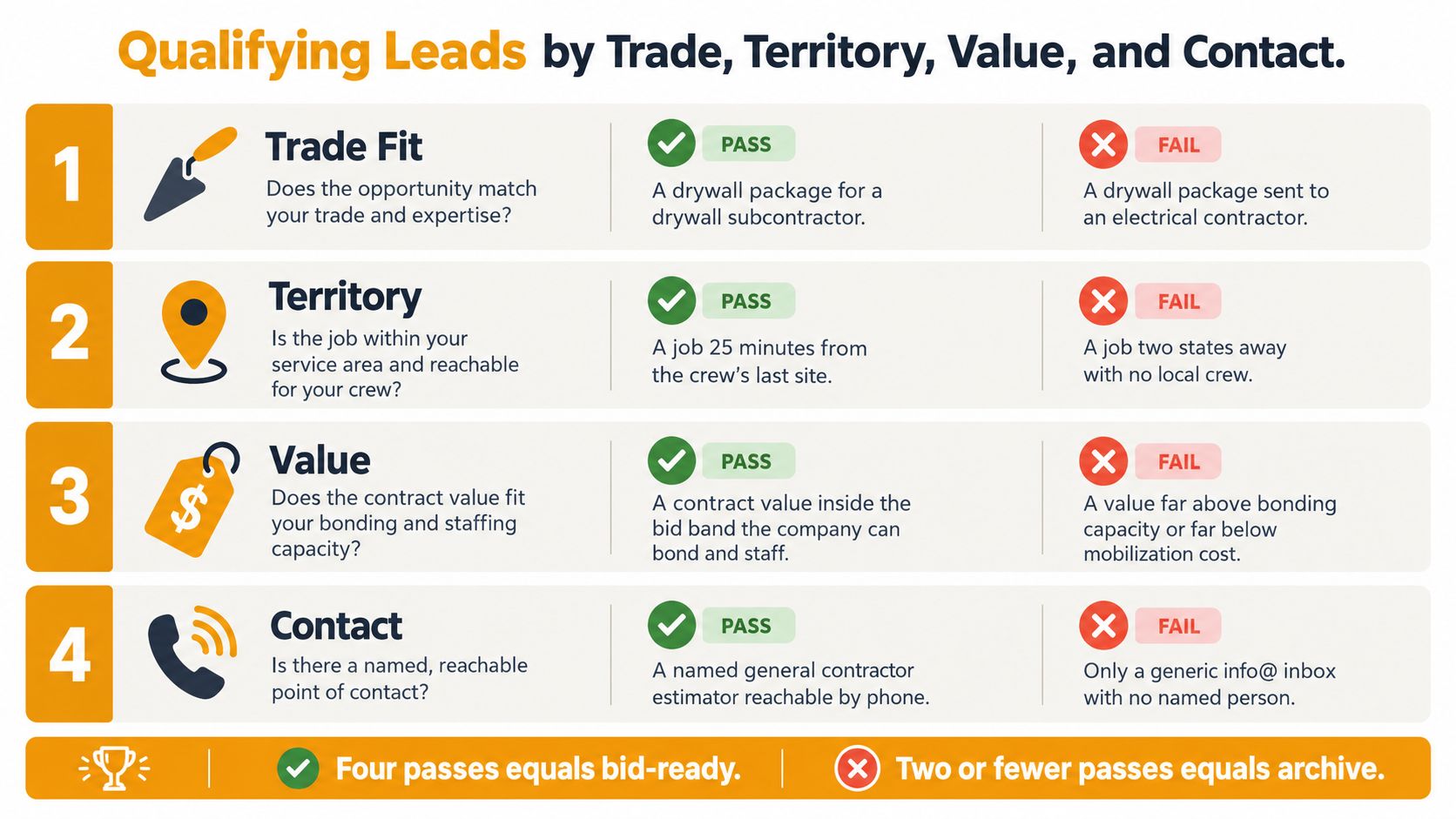
1. Trade fit
If you're a drywall subcontractor, a $3M structural steel package is a hard no. If you're a mechanical contractor, a hospital HVAC retrofit is the right kind of opportunity. Trade fit should fail fast, because a mismatched package wastes more time than a bad referral ever will.
2. Territory
I care about drive time, labor access, and licensing radius before I care about the project name. If your crew can't get there without wrecking productivity, the lead doesn't belong in the active pile. Territory also includes practical jurisdiction issues, because some work is only worth chasing inside the areas you already know how to staff.
3. Value
A job can be real and still not be worth estimating. If the scope is too small, you'll spend too much time mobilizing and too little time making margin. If it's too large, the package can exceed your bond, your staffing, or your appetite for risk.
4. Contactability
This is the one that usually decides it. A named project manager, GC estimator, or property owner email beats a generic inbox every time. If the only contact is a permits@ address that never replies, don't fool yourself into thinking it's actionable.
The order of disqualification is simple. Trade fit is first, because if you can't do the work, nothing else matters. Contactability is second, because if you can't reach anyone, you can't influence the bid. Territory and value come next, because those are economics, and bad economics still kill good-looking opportunities.
Use this lead qualification checklist as your working filter. Score each item before it hits the CRM, not after you've wasted a morning on it.
Four passes equals bid-ready. Two or fewer passes, archive it.
Manual Search Versus AI-Assisted Lead Intelligence
Manual permit work still has one advantage. It costs nothing but your time. That sounds smart until you add up the time, the missed contacts, and the projects that age out before anyone on your team calls.
| Criterion | Manual Permit Search | AI-Assisted Intelligence |
|---|---|---|
| Time to first contact | Slow, depends on who has time to pull lists | Fast, because the brief arrives ready to use |
| Ownership and decision-maker reach | Often incomplete or missing | Built into the signal package when available |
| Filtering by trade and value | Hand-filtered, inconsistent | Pre-scored before you open the record |
| Bid-readiness | You have to infer it yourself | More explicit, less guessing |
Manual work usually starts with a portal, a spreadsheet, and a pile of exports. Then someone cleans the data, checks the address, guesses the scope, and tries to find a phone number. By the time that happens, the project may already be moving.
AI-assisted lead intelligence changes the order. The system ingests permits, plan reviews, plats, and owner records, then ranks the results by fit so the team starts with what's worth calling. That's the difference between a list and a morning brief.
One practical example is enough. A $1.4M commercial tenant improvement that appeared in a Friday permit pull only mattered because the ownership and scope context were surfaced overnight, which let the GC be called Monday morning instead of after the trail went cold. That's the true win, not “AI” as a buzzword, but compressed discovery-to-contact time.
This construction intelligence platform overview shows the workflow I'm talking about. I'm not interested in another dashboard. I'm interested in a system that tells me who to call before the competition finishes its coffee.
A Repeatable Workflow From Signal to Bid
The best lead process is boring on purpose. It doesn't depend on memory, heroics, or one senior estimator who knows where every file is buried. It runs the same way every day so the team can trust it.
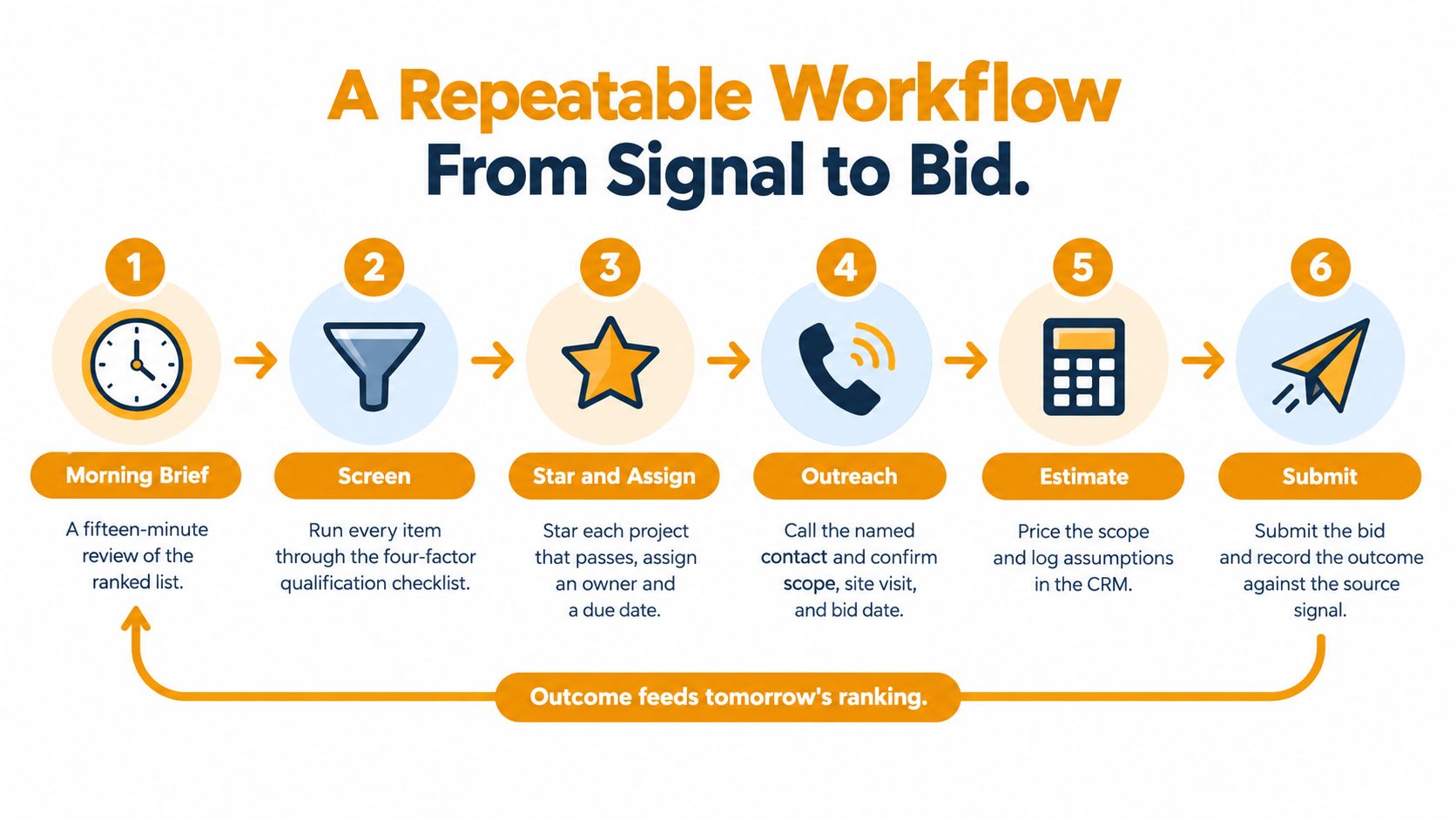
The morning starts with a fifteen-minute brief. Review the ranked list, mark the projects that pass the four-factor screen, and assign them to the right estimator or business development owner. If a lead doesn't get starved of attention by noon, it usually gets attention at all.
Then the day turns to outreach. Call the named contact, confirm the scope, ask for plans, and ask whether there's a pre-bid meeting. Log the contact attempt immediately, because unlogged follow-up is just hope wearing work boots.
Weekly work is where the pipeline stays clean. That's when you batch follow-ups, pull plan-room downloads, update scope notes, and record who makes decisions. Monthly review is where the channels get judged, because if a source isn't producing usable bids, it needs to get cut or deprioritized.
Keep the loop tight
The rule is simple: if a lead source doesn't improve your estimate load or your hit rate, it's clutter.
The workflow matters because it turns lead handling into a shared operating rhythm. Anyone on the team can run it if the rules are visible, and the feedback from each bid feeds back into tomorrow's ranking. That's how a preconstruction department gets better without adding headcount.
The reason this works is mechanical. A morning brief keeps the team focused on fresh signals. A weekly review stops stale records from clogging the CRM. A monthly source review forces honest decisions about where the next hour should go.
Connecting Qualification to a Daily Operating Rhythm
The four-factor screen only gets sharper if you feed it outcomes. Won, lost, no-bid, late, wrong trade, wrong territory, all of it matters because each result tells you what to value next time.
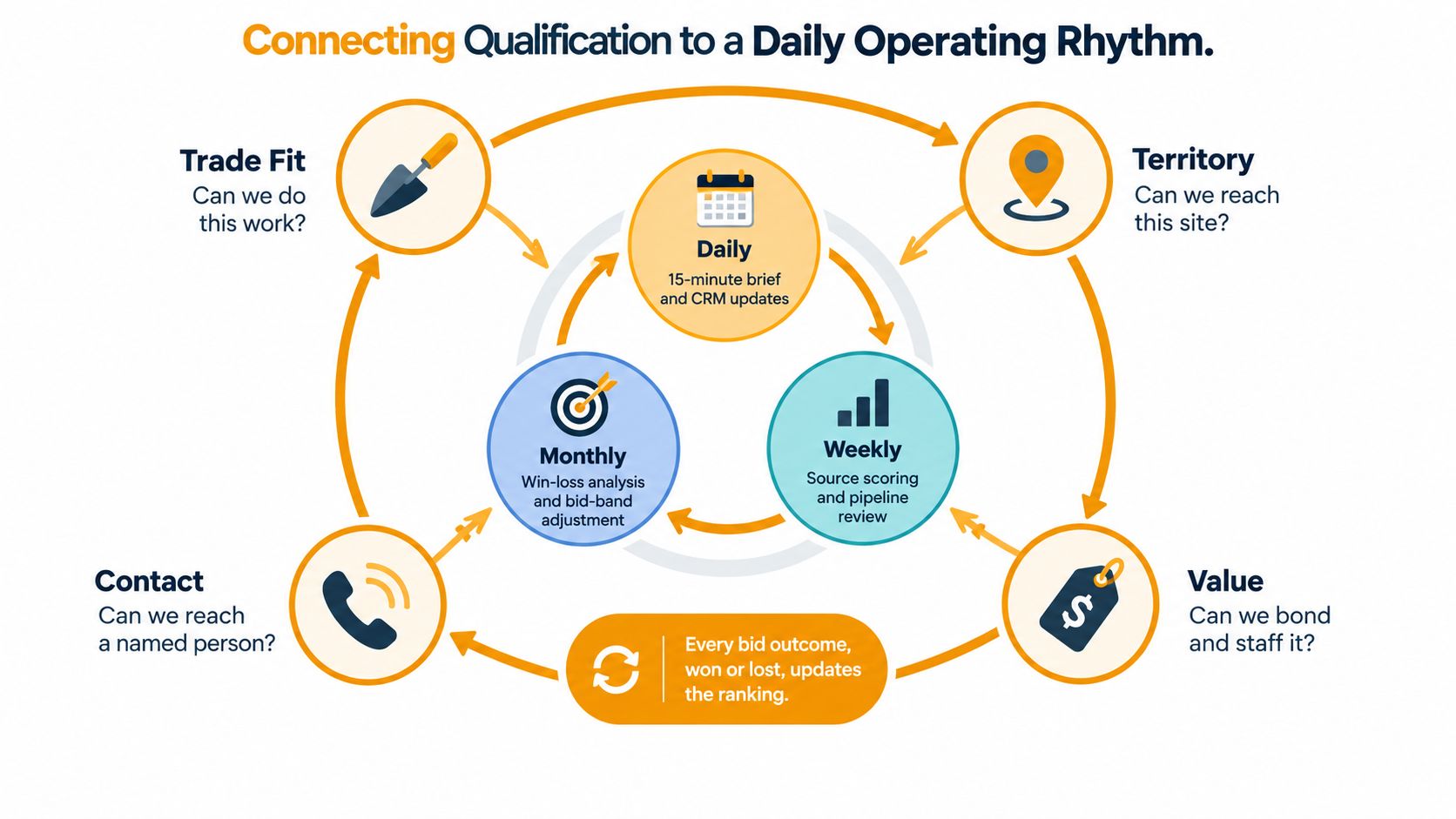
Score what actually happened
If a trade keeps producing low-margin work, deprioritize it. If a territory keeps producing slow response times or unreachable contacts, weight it down. If your ownership data keeps pointing to the wrong decision-maker, flag that source and stop trusting it blindly.
The goal isn't a perfect model. The goal is a system where every Monday morning is a little more accurate than the last one. That's what good preconstruction looks like, fewer guesses and more useful calls.
Use outcome memory
A roofing contractor I'd trust would notice where response rates are strong and where they aren't, then adjust the filter instead of blaming the market. The same logic applies to every trade. If the pipeline keeps giving you leads that look good but never convert, the scoring is off, not the universe.
Daily, weekly, and monthly rhythm only works if the team records the result. A bid without a source tag is wasted data. A lost job without a reason code is just noise.
Every bid outcome, won or lost, updates the ranking.
That's the feedback loop. Qualification tells you where to spend time today, and the operating rhythm tells the system what to trust tomorrow.
Putting It All Together and Trying the Workflow
A workable system ends with a decision and a short action queue. Start tomorrow's brief by removing stale records and projects outside your trade area. Send signals to estimating only when the stage supports a bid and a reachable contact is available.
Run each candidate through the defined filters, then archive anything failing trade fit or contactability before estimating sees it. Keep borderline records in a review queue. The active brief should be short enough for the team to act on that morning.
Platineer can ingest permit, plan-review, plat, and owner-record data, score it against your trade and radius, and deliver a ranked brief by stage, recency, and reachability, with decision-maker contacts by morning. Use that output as the starting queue. Call the strongest reachable contact, record the outcome, and feed it into the next ranking.
Test the rhythm this way: does the 06:00 brief produce one useful conversation before lunch? If not, adjust source mix, stage weighting, or contact data. The workflow earns its place when it shortens discovery to bid and gives the estimator a clear next action.
For a lead process that saves hours, visit Platineer and test it against a real project. Judge it by whether your team reaches a useful call before lunch.