You're on bid day, the drawings are open, subcontractor quotes are arriving, and someone wants a contractor price estimate before every scope question has an answer. The pressure pushes estimators toward a single clean number, but clean formatting doesn't make uncertain information reliable. Missing site conditions, vague finish requirements, incomplete engineering, and unpriced allowances can all make a bid look competitive while transferring risk to your margin.
A reliable estimate is built in stages. First define what's known, then measure the work, apply current pricing, compare coverage, add indirect costs and risk, and review the result before submission. The faster you can perform those steps without losing traceability, the more opportunities your team can price without turning estimating into unpaid overtime. Platineer's Estimate tool can help standardize early scope capture, cost breakdowns, assumptions, and estimate review while your team develops the bid.
Table of Contents
- Why Contractor Price Estimates Change as Information Improves
- What to Gather Before You Price Anything
- Building the Estimate From Takeoff to Unit Pricing
- Structuring Subcontractor Versus Self Perform Costs and Markup
- Quality Checks Tools and Time Savings That Protect Margin
- Final Takeaways for Faster More Reliable Contractor Pricing
Why Contractor Price Estimates Change as Information Improves
A contractor price estimate changes after design development because the work itself becomes more visible. An early conversation may identify a building type, approximate size, and preferred finish level, but it may not establish wall assemblies, mechanical capacity, structural requirements, utility conflicts, access restrictions, or permit obligations. An estimator has to fill those gaps with assumptions, and assumptions carry risk.
Construction estimating has long been treated as a phased process with different accuracy bands tied to available design information. An AACE-linked Canadian cost predictability guide says early conceptual estimates may be about plus or minus 20% to 30% accurate, while higher-definition estimate classes tighten to around plus or minus 5% to 10%. The same guide explains that the accepted accuracy range for Class A estimates was broadened from plus or minus 5% to approximately plus or minus 5% to 10% for non-standard projects.
That distinction matters in the field. A budget number based on limited scope is useful for testing feasibility, but it shouldn't be presented as bid-ready pricing. As drawings, specifications, site data, and vendor coverage improve, the estimator replaces broad assumptions with measured quantities, defined assemblies, and documented quotes.
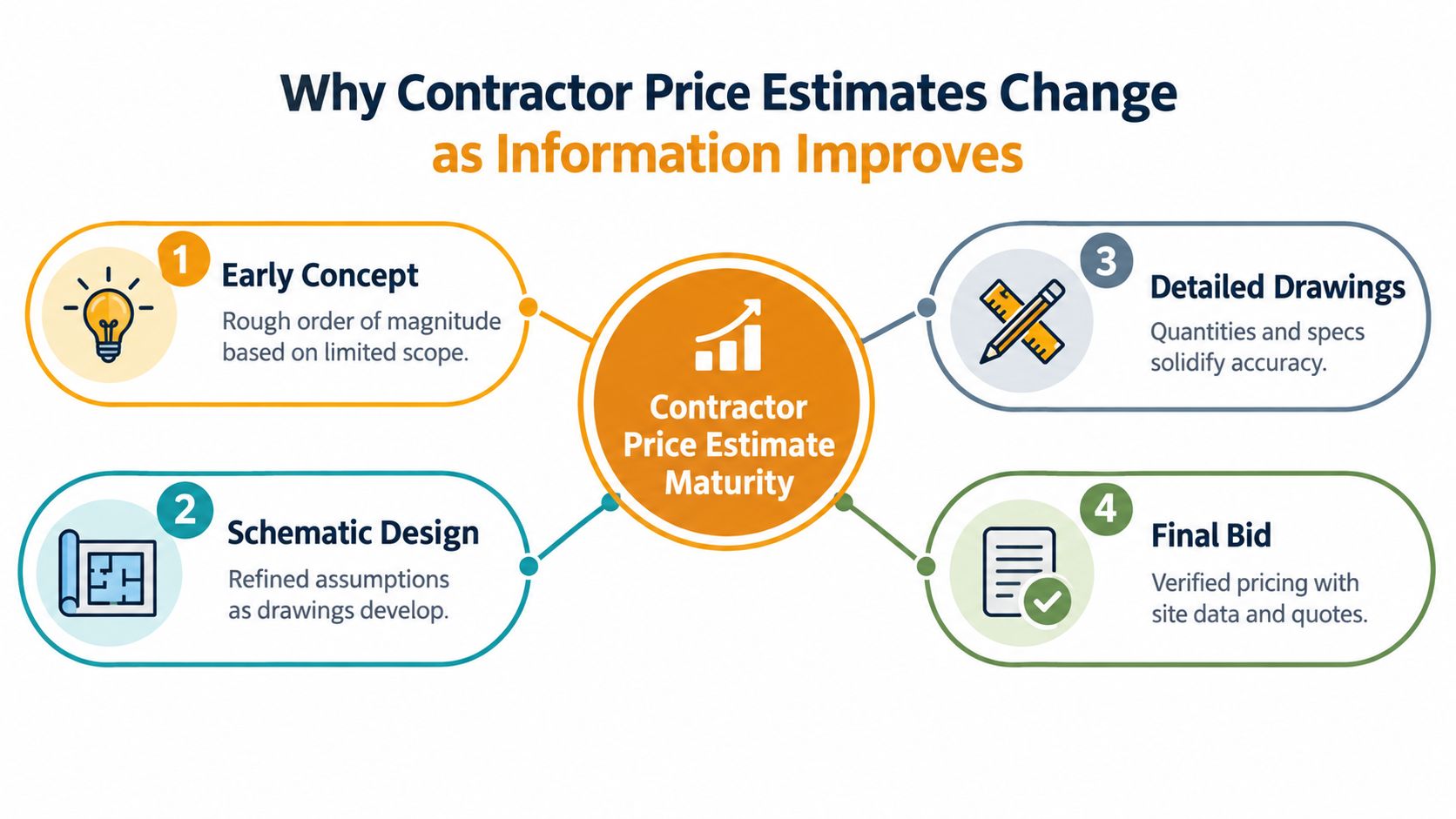
The four maturity points
Early concept supports rough-order budgeting. At this point, use known project characteristics and clearly label what remains unresolved.
Schematic design gives the estimator more useful geometry and system direction. The number should respond to developing drawings, not carry forward the first budget.
Detailed drawings allow quantities, specifications, and trade interfaces to solidify. Takeoff discipline becomes more valuable than broad historical assumptions.
Final bid should reflect verified documents, addenda, site observations, subcontractor coverage, and current supplier pricing. It still contains risk, but the risk is identified rather than hidden.
Practical rule: An estimate isn't wrong because it changes. It's weak when nobody can explain what information caused the change.
The workflow should preserve that explanation. Record the estimate basis, drawing issue, exclusions, allowances, and unresolved questions at every update. A standardized estimating tool can reduce the administrative drag of that progression, but it can't replace judgment about scope or risk. The tool earns its place when it lets estimators spend less time rebuilding spreadsheets and more time challenging the assumptions behind the number.
What to Gather Before You Price Anything
Before opening a takeoff, confirm whether the opportunity is ready to price. A rushed estimate built from an incomplete package consumes the same estimating labor as a disciplined one, but it gives management less confidence and gives the field more exposure.
Start with the document register. Identify the latest architectural, structural, civil, mechanical, electrical, plumbing, and specialty drawings available. Match each drawing to its issue date, revision, and addenda. If the plans conflict with the specifications, log the conflict instead of resolving it.
Build the input package
Collect the following before assigning serious pricing effort:
- Drawings and specifications: Confirm that the set includes the disciplines affecting your scope, and identify missing details that could change quantities or installation methods.
- Site conditions: Verify access, staging, existing utilities, demolition, soil information, adjacent structures, working-hour restrictions, and delivery constraints.
- Scope definition: Write inclusions, exclusions, owner-furnished items, alternates, allowances, temporary work, testing, cleanup, and closeout responsibilities.
- Finish and system requirements: Confirm quality level, equipment basis, controls, specialty systems, performance requirements, and approved manufacturers where specified.
- Client requirements: Clarify schedule expectations, phasing, procurement constraints, payment conditions, quality expectations, and budget flexibility.
- Permit status: Determine whether the project is pre-application, under review, approved, or awaiting revisions. Permit timing can affect mobilization, procurement, and the validity of vendor pricing.
- Vendor and subcontractor coverage: Send a consistent scope sheet so quotes can be compared against the same requirements.
Many contractor price estimate questions are really questions about what must be defined before a number is trustworthy, including scope clarity, drawings, site constraints, finish level, systems complexity, and budget flexibility, as explained in this guide to contractor pricing inputs.
Capture assumptions before takeoff
An assumption buried in a spreadsheet is difficult to defend. Put it in a visible assumptions log with an owner, status, and pricing consequence. Typical entries include the basis of design, assumed utility locations, soil treatment, access route, responsibility for permits, equipment lead times, and the treatment of incomplete details.
The bid deadline also needs its own control. Record the question deadline, site-visit date, quote-return date, addenda cut-off, internal review time, and final submission time. If the team doesn't reserve time for review, the estimate will be submitted with unresolved scope gaps.
A useful material takeoff workflow starts with clean source documents and consistent naming. That preparation prevents duplicated quantities, makes revisions easier to trace, and gives subcontractors a clearer basis for their proposals.
Building the Estimate From Takeoff to Unit Pricing
The estimate becomes defensible when every major cost can be traced from scope to quantity to unit price. Start with the work breakdown, not the markup. If the quantity is wrong, a polished summary only hides the problem.
At low design maturity, a top-down or parametric check can help test whether the opportunity fits the client's budget and your company's capacity. That check is a screening tool, not a substitute for measured takeoff. As the documents develop, shift toward bottom-up quantities, trade-level production assumptions, current quotes, and explicit risk pricing.
Measure and organize the work
Read the drawings systematically. Establish the measurement rules before you begin, then separate demolition, new work, temporary work, and owner-furnished scope. Keep the takeoff organized by cost code or CSI division so the estimate can be reviewed without hunting through unrelated line items.
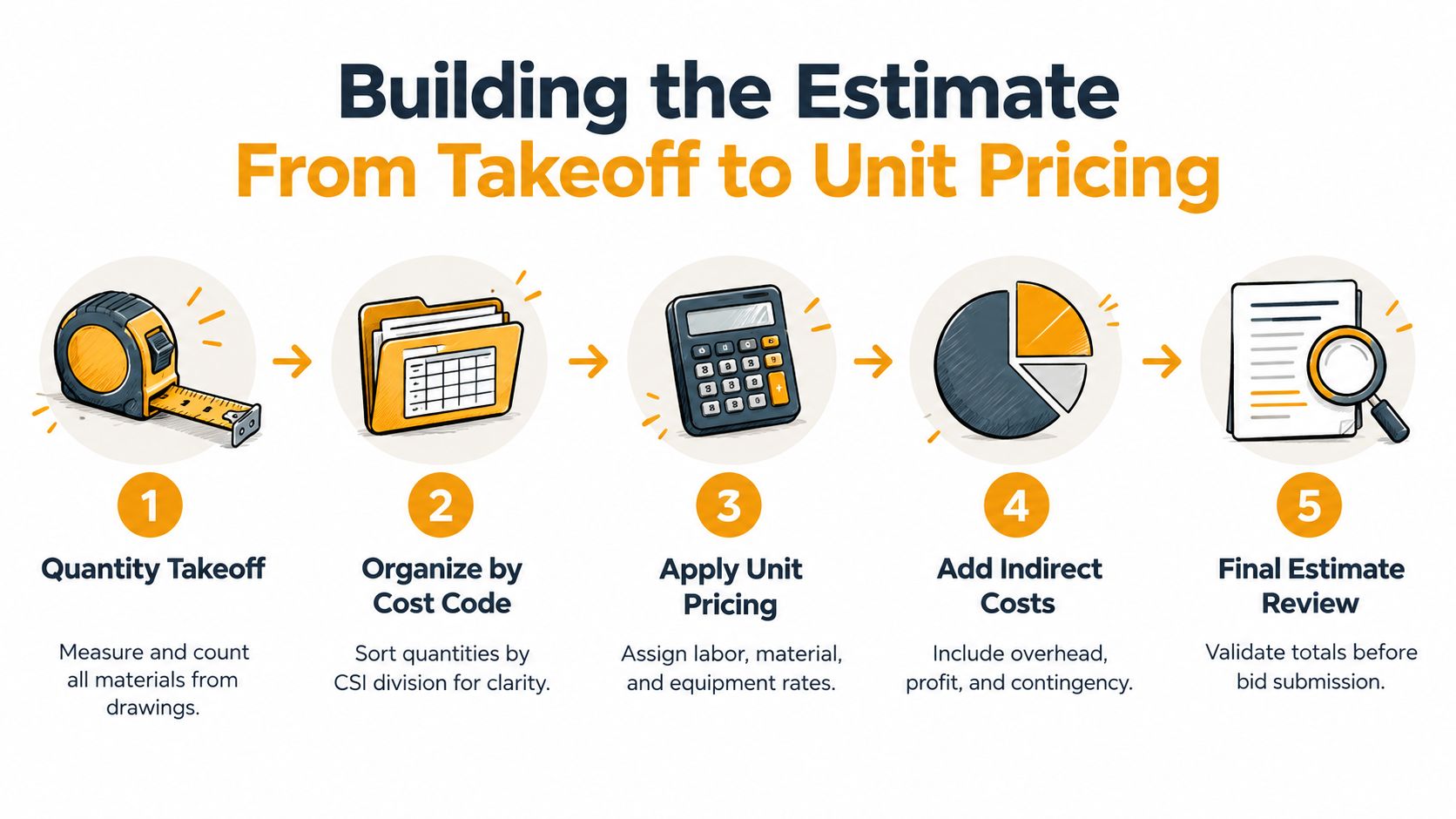
The core sequence is straightforward:
- Perform the quantity takeoff: Measure lengths, areas, volumes, counts, assemblies, equipment, and labor activities from the current documents.
- Assign cost codes: Put each quantity in a structure that separates trades, phases, locations, and direct-cost categories.
- Apply unit pricing: Assign labor, material, equipment, and subcontractor rates that match the scope and current market conditions.
- Add indirect costs: Include supervision, mobilization, temporary facilities, permits, insurance, logistics, project administration, and other support costs.
- Apply risk and markup: Keep contingency, overhead, and profit visible so management can make an informed bid decision.
- Review the estimate: Check quantities, formulas, scope coverage, quote validity, exclusions, and the relationship between cost, schedule, and risk.
Labor pricing needs more than an hourly wage. Use the crew composition, expected production, access conditions, installation sequence, supervision needs, and labor burden that apply to the project. Material pricing should identify unit, waste treatment, delivery, escalation exposure, and quote expiration. Equipment pricing should reflect ownership or rental assumptions, utilization, fuel, transport, and standby exposure where relevant.
Use allowances without hiding uncertainty
An allowance is appropriate when the scope isn't defined. It becomes dangerous when it replaces a missing scope decision that should have been resolved before bid submission. Label the basis, amount, responsibility, and change mechanism for every allowance.
Keep alternates separate from the base bid. Separate accepted scope from optional scope, and distinguish a fixed subcontractor quote from a budget number. That structure lets the client see what changed when the design evolves and lets your team defend a change order without reconstructing the original estimate.
A useful benchmark in the construction estimating methodology reference aligns estimate class with project definition. Conceptual estimates at very low design maturity can carry roughly minus 50% to plus 100% uncertainty, while detailed bid or check estimates with near-complete documents narrow to approximately minus 3% to plus 10%. The practical lesson is to increase detail as information improves, not to pretend an early estimate has final-bid precision.
The construction estimating cost guide is useful for reinforcing the relationship between takeoff, direct costs, indirect costs, contingency, and markup. Your finished estimate should let another estimator follow that chain from the drawing to the bid total.
Structuring Subcontractor Versus Self Perform Costs and Markup
Subcontractor pricing and self-perform pricing solve different problems. A subcontractor quote can transfer specialized execution risk, but only if the scope is complete and the quote is commercially usable. Self-perform work can improve control over sequence and quality, but it consumes labor capacity and exposes the company to productivity risk.
Normalize every subcontractor proposal before comparing it. Put quotes into the same scope grid and mark whether each proposal includes labor, materials, equipment, layout, permits, testing, protection, cleanup, supervision, warranty, and coordination. A low quote with major exclusions isn't lower cost. It's incomplete coverage.
Public guidance emphasizes comparing line-item detail, fixed quote versus estimate language, allowances, permit responsibility, deposit terms, and change-order triggers, because those items commonly create final-price drift. The contractor quote comparison guidance supports a review process that treats commercial terms as part of price, not as paperwork after the price is chosen.
Make the self-perform decision explicit
Use capacity and risk, not habit, to decide. Self-perform may make sense where your crew has proven productivity, the work controls adjacent activities, and schedule flexibility is valuable. Subcontracting may be more appropriate where the work requires specialized licensing, equipment, design responsibility, or labor you can't reliably staff.
| Scope Item | Self Perform Considerations | Subcontractor Considerations | Markup and Risk Note |
|---|---|---|---|
| Concrete work | Check crew availability, forming productivity, placement equipment, and finish control | Confirm reinforcing, forming, placement, testing, and pump coverage | Price productivity risk separately from ordinary overhead |
| Electrical scope | Confirm qualified labor, material procurement, coordination, and testing capability | Compare inclusions for devices, controls, temporary power, and commissioning | Don't bury uncovered design or coordination work in a vague allowance |
| HVAC scope | Evaluate equipment knowledge, controls coordination, startup, and warranty obligations | Normalize equipment basis, ductwork, insulation, controls, testing, and balance | Carry responsibility for unclear design as a visible risk item |
| Finish work | Consider quality control, punch capacity, sequencing, and labor availability | Compare substrate preparation, protection, cleanup, and warranty coverage | Low labor pricing can fail if productivity assumptions aren't realistic |
| Site work | Review equipment ownership, haul routes, soil risk, and operator capacity | Check excavation limits, disposal, imported material, utilities, and restoration | Site uncertainty belongs in risk review, not hidden inside unit rates |
Keep markup visible
Separate direct cost, project indirect cost, company overhead, contingency, and profit. The exact treatment depends on your accounting system and contract conditions, but the categories should remain visible enough for management to understand what the bid is carrying.
Avoid using markup to disguise scope gaps. If a permit responsibility is unclear, identify it. If a vendor quote excludes delivery, carry delivery. If a subcontractor's price is conditional, record the condition and its effect on the bid.
A construction markup versus margin guide can help teams keep those terms distinct. That distinction matters during bid review because a markup applied to cost isn't the same thing as the margin retained after revenue and cost are compared.
Quality Checks Tools and Time Savings That Protect Margin
A bid isn't finished when the total calculates. It's finished when another person can test the scope, quantities, rates, assumptions, exclusions, and commercial terms without rebuilding the estimate from scratch.
Start with a structured review rather than a general request to “look it over.” Review the estimate in passes. First check document completeness and scope. Then check quantities and formulas. Next check labor, material, equipment, subcontractor coverage, indirect costs, allowances, contingency, and markup. Finish by comparing the bid against schedule, site constraints, and the client's requirements.
Use independent checks
Historical project data provides a useful reasonableness check, but it shouldn't override project-specific takeoff. City-level benchmarks also help identify market movement. Engineering News-Record's Construction Cost Data Dashboard tracks its Construction Cost Index and Building Cost Index across 20 U.S. cities and the national average, with monthly economics reporting and visibility into labor and equipment cost drivers. Use those benchmarks to question stale rates, not to replace current supplier and subcontractor quotes.
Permit timing deserves similar attention. An Oregon permitting analysis reports that plan review is typically the longest building-permit phase, while intake is usually completed in under a week. The analysis gives a 56-day median plan-review duration across jurisdictions and identifies records extending beyond a full year, as documented in the Oregon permitting analysis. A separate 2026 permit-speed benchmark found that 51% of U.S. cities complete first plan review in 14 business days or less, while also showing wide variation by jurisdiction.
That variability affects bid validity, procurement, staffing, and workload planning. Track permit status and revisions instead of relying on occasional manual checks.
Treat saved hours as recovered production capacity
Time savings is money savings when the estimator can use recovered hours for more bids, better quote leveling, stronger scope review, or earlier procurement conversations. A University of Kansas-based study reported that an AI-automated takeoff took about one minute, manual corrections took roughly half an hour, and the AI workflow was 76% faster than the two-and-a-half-hour manual takeoff process, according to the reported takeoff comparison.
Automation still needs human QA. AI can accelerate measurement and first-pass scope organization, but an estimator must validate drawing interpretation, assemblies, exclusions, and site-specific conditions. The right use is not “accept the output.” It's “review more intelligently with less repetitive work.”
Close every estimate with a short checklist:
- Document control: Confirm the latest plans, specifications, addenda, and bid forms.
- Scope coverage: Check every trade interface, alternate, allowance, exclusion, and owner-furnished item.
- Quantity integrity: Spot-check high-value and repetitive quantities against the drawings.
- Quote leveling: Compare inclusions, exclusions, validity, delivery, permits, and change conditions.
- Cost freshness: Challenge rates that don't reflect current labor, material, equipment, and market conditions.
- Commercial review: Verify schedule, payment terms, bonds, insurance, deposits, escalation treatment, and markup.
- Independent sign-off: Have someone other than the original estimator review the final number and assumptions.
Final Takeaways for Faster More Reliable Contractor Pricing
A contractor price estimate becomes reliable through information maturity, not confidence in a single early number. Define the scope first, establish the document basis, inspect the site conditions, and record every unresolved item. Then build the estimate from measured quantities, current unit pricing, subcontractor coverage, indirect costs, contingency, and transparent markup.
The sequence matters. Price what's defined, qualify what isn't, and never let an allowance conceal a missing decision. A low opening number can look attractive while excluding permits, coordination, delivery, testing, cleanup, or difficult site work. A defensible bid makes those responsibilities visible before the contract turns them into disputes.
Quality control is where margin gets protected. Use phased reviews as documents develop, level subcontractor quotes against a common scope, compare the estimate with historical costs and relevant market indices, and check permit timing before committing to a schedule or quote validity. The Washington State estimate-quality review identifies estimator experience, estimating method, available project information, and considered factors as key drivers of accuracy. Across reviewed public-sector capital projects, 71% to 74% of estimates fell within expected accuracy ranges, supporting structured reviews, phased updates, and calibrated contingency rather than dependence on one early number.
Your next estimate should have a simple operating order:
- Lock the inputs: documents, scope, site conditions, schedule, permit status, and quote requirements.
- Build the cost base: takeoff, cost codes, labor, materials, equipment, subcontractors, and indirect costs.
- Price the risk: allowances, contingency, escalation exposure, exclusions, overhead, and profit.
- Verify before submission: quote coverage, formulas, quantities, commercial terms, and management approval.
The estimator who removes repetitive takeoff work doesn't just finish sooner. That estimator creates room for better judgment, more complete QA, and disciplined bidding. Standardization turns those habits into a repeatable process instead of relying on whoever has time to clean up the spreadsheet on bid day.
Platineer's Estimate tool helps contractors turn plan pages or site information into a structured estimate with costed line items, labor and material details, assumptions, risk factors, crew information, and timeline context. Visit Platineer to standardize your next estimate and spend the hours you recover on scope review, quote leveling, and bids that protect margin.