
Estimators and business development teams lose margin before a bid is ever submitted. Hours spent searching permits, sorting weak opportunities, or contacting the wrong stakeholder reduce time available for qualification, estimating, relationship building, and timely outreach. In construction, time savings are money savings.
This roundup shows how qualified lead generation can become a repeatable workflow rather than a list of disconnected tactics. Each strategy explains the signal or process involved, how to put it into practice, the trade and territory filters to define, its main limitation, and the next action to take.
You will see methods covering permit and plan scoring, plat filings, planning activity, multi-channel alerts, decision-maker mapping, valuation bands, project-status visibility, AI-assisted rendering and estimates, and ongoing market intelligence. Platineer is one project-intelligence option to review early through its platform or demo page; its current live market coverage includes Houston, Austin, and Dallas-Fort Worth.
Use the list to focus research on projects your firm can actually pursue, then move qualified opportunities into outreach and estimating before competitors do.
Table of Contents
- 1. Permit and Plan Review Intelligence Scoring
- 2. Early-Pipeline Detection via Plat Filings and Planning Activity
- 3. Multi-Channel Lead Notification and Workflow Integration
- 4. Decision-Maker Contact Intelligence and Relationship Mapping
- 5. Trade-Specific and Valuation-Band Lead Filtering
- 6. Real-Time Project Status Pipeline Visibility
- 7. AI-Powered Lead Rendering and Estimate Tools for Competitive Differentiation
- 8. Continuous Market Mapping and Competitive Intelligence
- 8-Point Qualified Lead Generation Comparison Guide
- Turn Lead Intelligence Into a Repeatable Trade Workflow
1. Permit and Plan Review Intelligence Scoring
Permit and plan review intelligence scoring monitors municipal filings continuously, then ranks projects by trade fit, ZIP code, valuation, project stage, and decision-maker availability. Instead of downloading permit lists once a week and sorting spreadsheets, estimators receive a shorter list of opportunities that match their services and territories.
A scoring setup might prioritize commercial projects above $1 million within selected counties, exclude permit types outside the firm’s capabilities, and flag jobs still in plan review. This timing matters: contractors can contact owners, developers, and general contractors before bid invitations become crowded. See how permit and plan review intelligence supports construction lead generation.
Time saved on sorting is money saved on estimating, and early contact gives the sales team more time to influence the opportunity.
How to put it into practice
During onboarding, spend 30 minutes defining exact trade classifications, valuation bands, project types, and ZIP code territories. Assign one person to review the daily 06:00 brief and route each lead to the right estimator within two hours.
Review Platineer’s platform or demo page early to see whether its project intelligence fits your trade and territory. Specialty trades can also monitor subdivision pre-development activity months before permits issue. Use the platform’s decision-maker details for early relationship calls, especially when qualified lead generation depends on reaching the right contact before competitors.
2. Early-Pipeline Detection via Plat Filings and Planning Activity
Early-pipeline detection tracks preliminary land records, subdivision plats, and planning submissions to identify construction opportunities 6-18 months before permit submission. These filings reveal site acquisition, developer intent, and schematic design activity, giving general contractors and specialty trades time to reach owners, applicants, and design teams before bid competition increases. See how to identify planned construction projects earlier.
Houston-area contractors can monitor residential subdivision plats and begin conversations early enough to pursue GC roles well before ground breaking. In DFW, tracking mixed-use approvals through phased delivery can help subcontractors prepare for multiple trade packages across 24 months.
Early contact changes the conversation from “submit your bid” to “help us plan the project.”
How to put it into practice
Create a warm outreach playbook that introduces your capabilities, offers a constructability discussion, and records each contact in your CRM. Filter new plat leads by prior developer relationships, then schedule quarterly calls to maintain momentum through design.
The timeline below visualizes how qualified lead generation combines municipal data, scoring, status changes, and daily delivery.
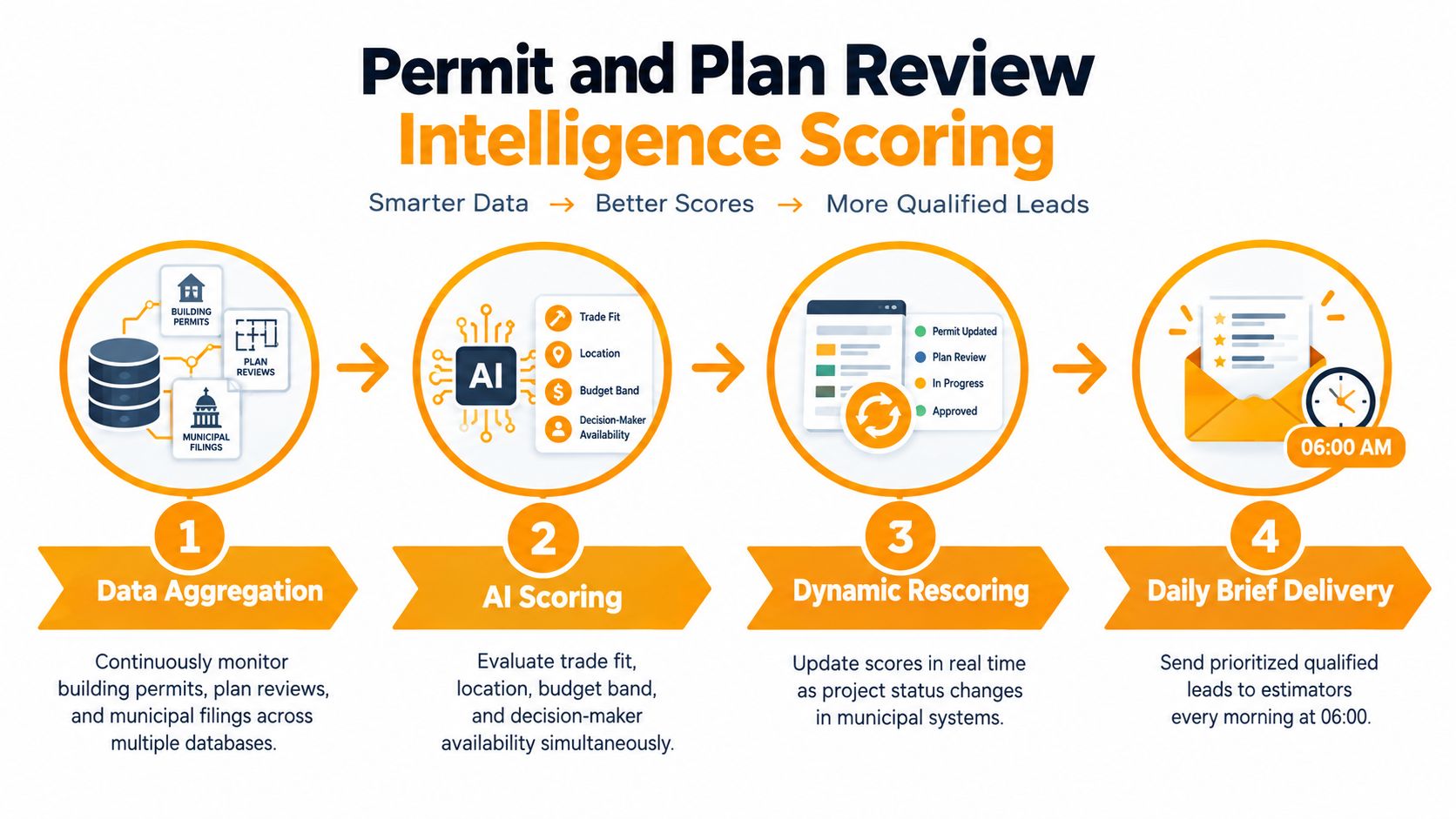
It shows why time savings become money savings: automated updates move the best opportunities to estimators before manual research delays outreach.
3. Multi-Channel Lead Notification and Workflow Integration
Multi-channel lead notification sends qualified construction opportunities through email, mobile apps, and a shared dashboard, with trade fit, territory, project stage, and decision-maker details attached. Instead of leaving estimators to search inboxes or discover leads informally, the system routes each opportunity to the right team and records ownership.
A 20-person estimating department can use a daily morning brief to review pre-sorted bids, while regional MEP or framing firms can send mobile alerts to field supervisors who need to arrange same-day site assessments. Platineer's lead intelligence and notification tools support this type of qualified lead generation workflow.
Every delayed lead is time lost, and time lost during preconstruction can become money lost on the bid.
How to put it into practice
During onboarding, define notification rules by trade, geography, project value, and bid stage. Assign a lead captain for each shift or department, with responsibility for routing new opportunities to an estimator within 30 minutes.
Connect alerts to the existing estimating or business development workflow, then review thresholds monthly. If staff ignore certain notifications, remove low-fit project types rather than increasing alert volume. Pre-sorted opportunities can reduce bid-preparation time by 20% for larger teams while giving specialty trades faster access to site and decision-maker information.
4. Decision-Maker Contact Intelligence and Relationship Mapping
Decision-maker contact intelligence connects each construction project with verified owner, applicant, developer, engineer, and GC details, including phone numbers, emails, roles, and past project context. This removes the “who do I call first?” problem and gives qualified lead generation teams a clear route to the stakeholder most likely to influence contractor or trade selection.

Review Platineer’s construction lead intelligence to assess whether verified project contacts can reduce research time and support earlier outreach.
Time saved finding the right contact becomes more time for useful conversations, and useful conversations create earlier project access.
How to put it into practice
Before calling, review the contact’s past projects and affiliations on LinkedIn. For early-stage work, reach the developer’s preconstruction or business development team, since they often influence GC and trade selections.
Create a simple nurture cadence:
- Initial discovery call
- Follow-up email with a capabilities deck
- 30-day value check-in
- Quarterly contact until project launch
Owner and applicant contacts can also turn one inquiry into multiple engagements as relationships develop.
5. Trade-Specific and Valuation-Band Lead Filtering
Trade-specific and valuation-band filtering uses AI-powered scoring to identify projects that match your trade capabilities, equipment, territory, and preferred budget range. HVAC, electrical, concrete, and framing contractors can avoid spending estimating hours on work that cannot meet their margin or delivery requirements.

A DFW electrical contractor can filter for $500,000-$3 million projects with significant systems integration. Platineer's configurable scoring helps teams focus on those opportunities, while a general contractor might reject projects below $2 million to protect estimating capacity and target stronger margins. See Platineer's construction lead generation platform.
Time spent qualifying a poor-fit bid is a hidden cost. Better filters turn saved estimating hours into more qualified lead generation capacity.
How to put it into practice
Review your last 50 bids and compare wins, losses, trade type, project size, and margin. Then configure filters around the strongest pattern, adding a 20% buffer, such as $800,000-$3.5 million for a $1 million-$3 million sweet spot.
Review those settings quarterly. As staffing, equipment, geography, or pricing changes, recalibrate the filters so your sales team keeps pursuing work it can deliver profitably.
6. Real-Time Project Status Pipeline Visibility
Real-time project status pipeline visibility tracks each job through plan review, approval, permit issuance, and construction, then displays changes in one dashboard. Instead of calling municipal departments or sorting stale permit databases, teams can see the next decision point and time outreach around actual project movement.
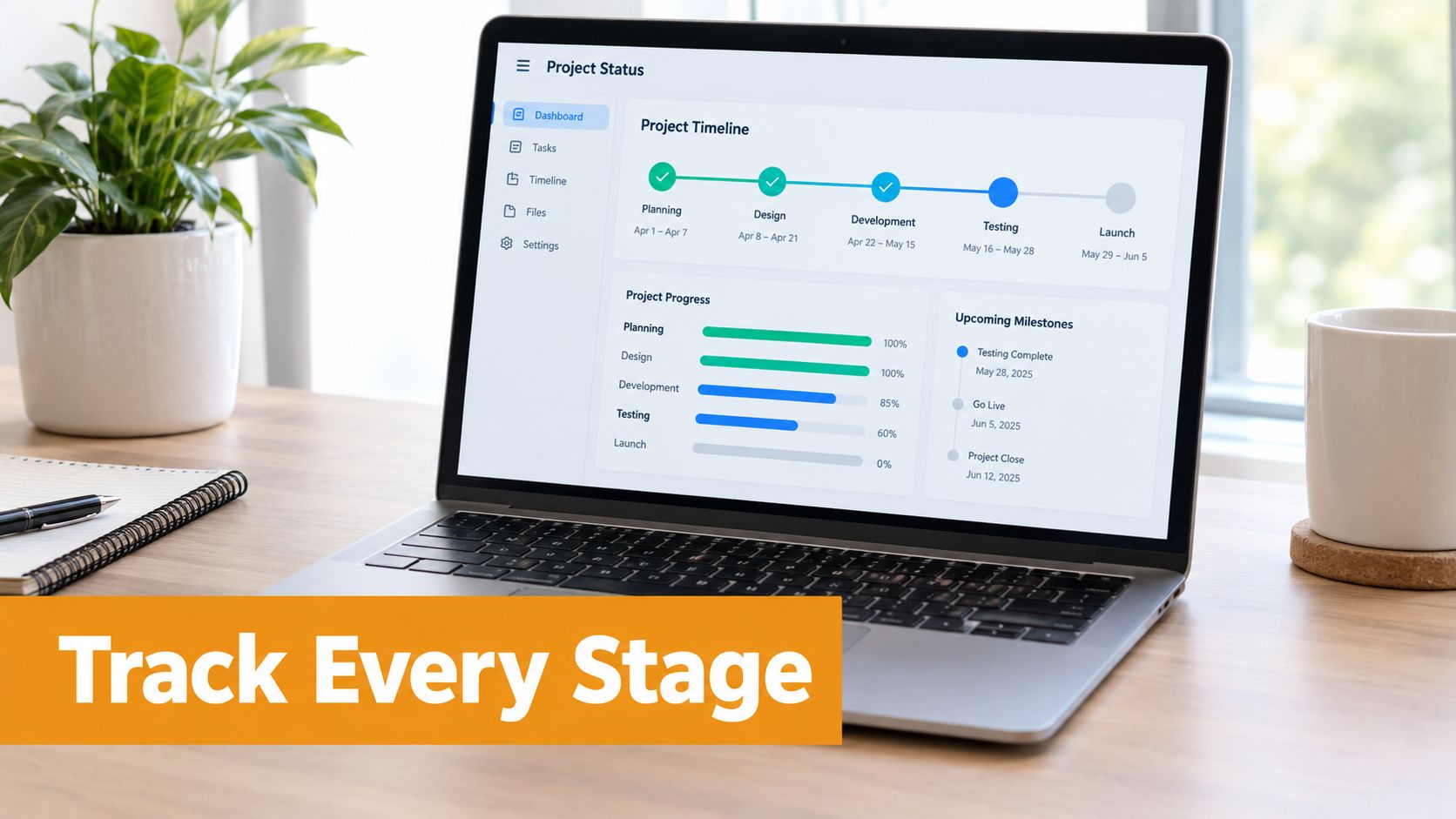
Review the Platineer demo to see how status data can support qualified lead generation and reduce time spent checking outdated records.
Knowing the next project milestone turns “when should we call?” into a scheduled business development action.
How to put it into practice
Hold a 15-minute weekly status review and flag changed projects by trade, territory, and expected bid timing. When permit issuance is imminent, send the GC or owner’s representative a short note: “We’re standing by to bid as soon as the permit is released.”
Projects stalled in plan review for 60 or more days deserve a different message. A call offering constructability input may uncover design or owner concerns while creating value before bidding begins. Time saved finding status is money saved preparing the right bid at the right moment.
7. AI-Powered Lead Rendering and Estimate Tools for Competitive Differentiation
AI rendering and estimate tools help contractors provide visual concepts and preliminary pricing during early conversations, before competitors submit formal bids. Remodelers can show homeowners kitchen or bathroom options in seconds, while general contractors can give owners a realistic budget range during preconstruction. Learn more about AI rendering for contractors.
This approach supports qualified lead generation because prospects receive useful answers immediately, not just a promise to prepare a proposal later.
Time saved preparing early concepts is money saved, and fast feedback helps your team shape the scope before the project becomes a price-only competition.
How to put it into practice
Use the tools during site visits or video calls, then spend 15 minutes checking each output before delivery.
- Present renders and estimates as discussion starters, not bid documents.
- Confirm dimensions, materials, labor assumptions, and exclusions.
- Ask the owner or GC what should change, then revise the concept live.
- Move serious opportunities into detailed design and costing after interest is confirmed.
This process positions your firm as a solutions provider and gives estimators earlier insight into budget, scope, and decision-maker priorities.
8. Continuous Market Mapping and Competitive Intelligence
Continuous market mapping combines permit, plan, plat, and owner records into a live view of active projects, competitor activity, project types, valuations, and territory gaps. Instead of waiting for quarterly reports, construction firms can see where demand is building and which segments remain less crowded. Platineer’s project intelligence supports this approach across major U.S. metros. Explore the Platineer demo to see how ongoing market data can support qualified lead generation.
A DFW review can identify accelerating mixed-use multifamily-retail work in Plano and Frisco, along with the number of primary GCs active. That signal can guide outreach toward potential annual bid opportunities. Competitive data can also reveal when a regional competitor pulls back from commercial interiors, helping a general contractor redirect business development toward available relationships and project types.
Time spent identifying white space is money saved on low-probability pursuits and missed opportunities.
How to put it into practice
Hold a 60-minute quarterly review and plot projects by trade, geography, valuation, and stage. Tag every win by project type, GC, location, and margin, then review those tags monthly with leadership and estimating.
Use the findings to prioritize territories, allocate outreach time, and decide whether adjacent markets or trades deserve investment. Industry reports from AGC, MCAA, and NECA can add context, but live project records should guide immediate action.
8-Point Qualified Lead Generation Comparison Guide
| Approach | Implementation Complexity 🔄 | Resource Requirements ⚡ | Expected Outcomes 📊 | Ideal Use Cases 💡 | Key Advantages ⭐ |
|---|---|---|---|---|---|
| Permit and Plan Review Intelligence Scoring | Medium; requires accurate trade, territory, and valuation configuration | Low ongoing effort; approximately 10 minutes for daily review | 3–5 additional qualified bids per month; saves 10–15 hours weekly | Firms replacing spreadsheet-based permit research and targeting pre-bid opportunities | Automated multi-factor scoring, reduced noise, consistent lead prioritization |
| Early-Pipeline Detection via Plat Filings and Planning Activity | Medium to high; requires monitoring, filtering, and relationship-based outreach | Moderate BD effort over extended project timelines | Identifies opportunities 6–18 months before permitting and can improve pricing leverage | Contractors seeking early influence with developers, owners, and design teams | Earlier access, reduced competition, stronger relationship development |
| Multi-Channel Lead Notification and Workflow Integration | Medium to high; integrations and notification rules require setup and training | Moderate implementation and user-adoption requirements | Reduces lead-response time to approximately 30 minutes and limits missed opportunities | Distributed estimating, BD, and field teams needing coordinated lead routing | Faster communication, mobile access, workflow visibility, and accountability |
| Decision-Maker Contact Intelligence and Relationship Mapping | Medium; depends on contact verification and CRM alignment | Moderate research and ongoing data-maintenance requirements | Can reduce research by 3–5 hours per lead and improve outreach response rates | Teams needing direct access to owners, developers, applicants, engineers, or GCs | Targeted outreach, stakeholder visibility, historical relationship context |
| Trade-Specific and Valuation-Band Lead Filtering | Low to medium; requires analysis of capabilities and historical bid performance | Low ongoing effort after initial calibration | Potentially improves bid-to-win ratios by 20–35% and reduces wasted estimating effort | Specialty contractors and GCs focused on defined project sizes or scopes | Better-fit opportunities, improved profitability, lower estimating workload |
| Real-Time Project Status Pipeline Visibility | Medium; depends on municipal data availability and dashboard configuration | Low to moderate monitoring effort; periodic status reviews recommended | Saves approximately 2–4 hours weekly per project and improves outreach timing | Teams managing many projects across multiple jurisdictions | Timely status updates, better forecasting, early detection of delays |
| AI-Powered Lead Rendering and Estimate Tools | Medium; requires tool integration and human validation processes | Moderate review effort; approximately 15 minutes per client-ready output | Generates preliminary visuals in under 60 seconds and may shorten sales cycles by 2–4 weeks | Remodelers and contractors engaging owners during early design discussions | Rapid visualization, faster preliminary pricing, stronger differentiation |
| Continuous Market Mapping and Competitive Intelligence | High; requires ongoing data aggregation, analysis, and strategic interpretation | Moderate to high leadership and analytics involvement | Identifies emerging markets, competitive gaps, and resource-allocation opportunities | Firms evaluating territory expansion, market shifts, or trade diversification | Real-time market insight, white-space discovery, and strategic planning support |
Turn Lead Intelligence Into a Repeatable Trade Workflow
Qualified lead generation becomes useful only when intelligence changes what your team does next. Permit scores, planning activity, plat filings, contact maps, valuation bands, project status, and competitor signals should feed one practical workflow rather than sit in separate research files.
Build the workflow in a controlled sequence
Start narrow: choose one trade, one territory, and one valuation band. A focused launch makes it easier to see whether the data is producing real opportunities for your business instead of creating another large, unqualified lead list.
Then:
- Configure fit filters. Set project type, location, estimated value, permit or planning stage, and trade relevance. Exclude work your crews cannot serve or projects outside your commercial range.
- Assign daily ownership. One person should receive and review the daily brief, remove duplicates, confirm priority, and route each opportunity to the right estimator or business development owner.
- Set a response standard. Define how quickly high-fit projects receive research, contact, or outreach. A useful lead that waits several days can lose its practical value.
- Map decision-makers. Connect owners, developers, architects, general contractors, construction managers, and procurement contacts to each project before outreach begins.
- Review status on a fixed cadence. Update contacted, qualified, estimating, bid submitted, won, lost, and paused stages weekly. Compare outcomes by trade, territory, source, and project value.
The goal is not the largest lead list. It is fewer research hours and more time spent in high-fit conversations.
Measure the commercial result
Track a small set of operational metrics:
- Research hours saved
- Qualified leads routed
- Average response time
- Outreach completed
- Bids submitted
- Wins and win rate
- Gross margin by source and project type
These measures connect early signals to money saved and revenue produced. They also show which filters need adjustment instead of relying on impressions from a busy pipeline.
If manual permit hunting is slowing your team, explore Platineer for scored project intelligence. Teams that need quick visual concepts or preliminary estimates can also try the Render tool and Estimate tool.
Platineer helps construction teams turn project data into qualified lead generation opportunities, with tools that support faster research, visual concepts, and early estimates. Explore Platineer and give your team more time for the conversations that can become profitable work.